



 Chat with AI
Exam 19: Open-Economy Macroeconomics

Exam 1: First Principles233 Questions
Exam 2: Economic Models319 Questions
Exam 3: Supply and Demand292 Questions
Exam 5: International Trade 5274 Questions
Exam 6: Macroeconomics: the Big Picture168 Questions
Exam 7: Gdp and Cpi: Tracking the Macroeconomy434 Questions
Exam 8: Unemployment and Inflation354 Questions
Exam 9: Long-Run Economic Growth316 Questions
Exam 10: Savings, Investment Spending, and the Financial System402 Questions
Exam 13: Fiscal Policy Appendix Taxes and the Multiplier382 Questions
Exam 14: Money, Banking, and the Federal Reserve System468 Questions
Exam 15: Monetary Policy359 Questions
Exam 16: Inflation, Disinflation, and Deflation240 Questions
Exam 17: Crises and Consequences214 Questions
Exam 18: Events and Ideas322 Questions
Exam 19: Open-Economy Macroeconomics467 Questions
Exam 20: Graphs in Economics75 Questions
Exam 21: toward a Fuller Understanding of Present Value36 Questions
Select questions type


Economists usually use GDP rather than GNP because they are tracking:

Free
(Multiple Choice)
4.8/5  (93)
(93) Correct Answer: Verified
C
The value of accounting services purchased by clients in China is included in the merchandise trade balance.
Free
(True/False)
4.9/5 (78)
(78) Correct Answer:Verified
VerifiedFalse
The global savings glut of the early 2000s was caused primarily by:
Free
(Multiple Choice)
4.8/5 (82)
(82) Correct Answer:Verified
VerifiedA
Foreign exchange controls are systems of a common currency used by a group of countries, such as the Asian Tigers.
(True/False)
4.9/5 (69)
(69) Foreign exchange reserves are stocks of foreign currencies that a government maintains to buy its currency in foreign exchange markets.
(True/False)
4.8/5 (69)
(69) If a country with a floating exchange rate follows a contractionary monetary policy, with everything else remaining unchanged, it leads to a(n) _____ in interest rates and a(n) _____ in the currency.
(Multiple Choice)
4.8/5 (77)
(77) If a government fixes the exchange rate so as to generate a surplus of the domestic currency, the exchange rate (U.S. dollars per unit of the other currency) will tend to _____. To maintain the fixed exchange rate, the government must _____ the domestic currency.
(Multiple Choice)
4.8/5 (74)
(74) A change in the U.S. balance of payments on financial account generates an equal and opposite reaction in the balance of payments on current account.
(True/False)
4.8/5 (80)
(80) After the Bretton Woods agreement broke down in 1971, the U.S. and most industrialized countries adopted:
(Multiple Choice)
5.0/5 (74)
(74) Use the following to answer questions :
Scenario: Exchange Rates
The value of a euro goes from US$1.25 to US$1.50.
-(Scenario: Exchange Rates) Look at the scenario Exchange Rates. French exports to the United States will:
(Multiple Choice)
4.9/5 (83)
(83) Use the following to answer questions :
Figure: Change in the Demand for U.S. Dollars  -(Figure: Change in the Demand for U.S. Dollars) Look at the figure Change in the Demand for U.S. Dollars. A movement from E1 to E2 in this foreign exchange market would cause Americans to purchase _____ goods and services from Europe.
 (Multiple Choice)
4.9/5 (71)
(71) Use the following to answer questions:
Figure: International Capital Flows 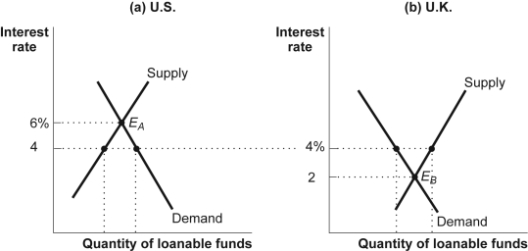 -(Figure: International Capital Flows) Look at the figure International Capital Flows. At an interest rate of 4%, the total quantity of loanable funds demanded across the two markets is _____ the total quantity of loanable funds supplied by lenders.
 (Multiple Choice)
4.8/5 (85)
(85) The Exchange Rate Mechanism established a target zone for European exchange rates during the late 1980s and 1990s.
(True/False)
4.8/5 (80)
(80) Which of the following countries did NOT adopt the euro?
I. Britain
II. Switzerland
III. Sweden
(Multiple Choice)
5.0/5 (90)
(90) An increase in the value of a floating currency is called a revaluation.
(True/False)
4.9/5 (88)
(88) A country's balance of payments on financial account is the difference between the country's sales of assets to foreigners and its purchases of assets from foreigners during a given period.
(True/False)
4.9/5 (82)
(82) The pound sterling floats. If the exchange rate for the pound changes from $1.68 to $1.60, the pound has:
(Multiple Choice)
4.8/5 (70)
(70) 
Filters
- Essay(0)
- Multiple Choice(0)
- Short Answer(0)
- True False(0)
- Matching(0)