



 Chat with AI
Exam 19: Open-Economy Macroeconomics

Exam 1: First Principles233 Questions
Exam 2: Economic Models319 Questions
Exam 3: Supply and Demand292 Questions
Exam 5: International Trade 5274 Questions
Exam 6: Macroeconomics: the Big Picture168 Questions
Exam 7: Gdp and Cpi: Tracking the Macroeconomy434 Questions
Exam 8: Unemployment and Inflation354 Questions
Exam 9: Long-Run Economic Growth316 Questions
Exam 10: Savings, Investment Spending, and the Financial System402 Questions
Exam 13: Fiscal Policy Appendix Taxes and the Multiplier382 Questions
Exam 14: Money, Banking, and the Federal Reserve System468 Questions
Exam 15: Monetary Policy359 Questions
Exam 16: Inflation, Disinflation, and Deflation240 Questions
Exam 17: Crises and Consequences214 Questions
Exam 18: Events and Ideas322 Questions
Exam 19: Open-Economy Macroeconomics467 Questions
Exam 20: Graphs in Economics75 Questions
Exam 21: toward a Fuller Understanding of Present Value36 Questions
Select questions type


If exports from the United States decrease because of a recession in Japan, all other things equal, the dollar will appreciate.
(True/False)
4.9/5  (89)
(89) A reduction in the interest rate has _____ impact on aggregate demand with _____ exchange rates than with _____ exchange rates.
(Multiple Choice)
4.8/5 (74)
(74) A reduction in the value of a floating currency is called a devaluation.
(True/False)
4.8/5 (82)
(82) Other things equal, a recession in Mexico would cause U.S. exports to Mexico to increase and U.S. aggregate demand to increase.
(True/False)
4.8/5 (90)
(90) A reduction in the value of a currency that is determined under a floating exchange rate regime is a(n):
(Multiple Choice)
4.7/5 (69)
(69) Use the following to answer questions :
Scenario: Purchasing Power Parity
A car costs $30,000 in the United States and the exchange rate is $1 = £0.50. The same car costs £12,000 in Britain.
-(Scenario: Purchasing Power Parity) Look at the scenario Purchasing Power Parity. What is the purchasing power parity of the pound?
(Multiple Choice)
4.8/5 (80)
(80) Use the following to answer questions :
Figure: Exchange Market Intervention 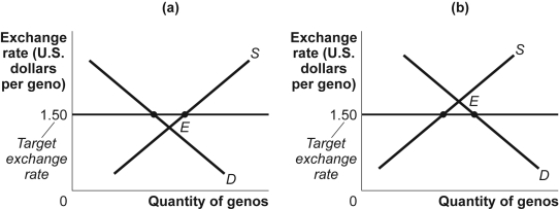 -(Figure: Exchange Market Intervention) Look at panel (a) in the figure Exchange Market Intervention. Which of the following approaches could the Genovian government use to raise the value of the geno above its present equilibrium exchange rate and into the target range?
 (Multiple Choice)
4.9/5 (72)
(72) If the supply of U.S. dollars in Britain increases, then all of the following occurs EXCEPT that:
(Multiple Choice)
4.8/5 (71)
(71) Consider the demand for and the supply of the U.S. dollar. The exchange rate is measured in terms of yen per dollar. If the demand for the U.S. dollar decreases, all of the following will be true EXCEPT that:
(Multiple Choice)
4.8/5 (71)
(71) The purchasing power parity between two currencies is the exchange rate at which a given basket of goods and services would cost the same amount in each country.
(True/False)
4.9/5 (71)
(71) An increase in U.S. interest rates causes a decrease in aggregate demand by _____ investment spending, _____ the dollar, and _____.
(Multiple Choice)
4.8/5 (77)
(77) Use the following to answer questions :
Scenario: Exchange Rates
The value of a euro goes from US$1.25 to US$1.50.
-(Scenario: Exchange Rates) Look at the scenario Exchange Rates. The euro has:
(Multiple Choice)
4.9/5 (69)
(69) A floating exchange rate:
I. leaves monetary policy available for domestic stabilization.
II. reduces the uncertainty of international trade.
(Multiple Choice)
4.9/5 (68)
(68) When a currency becomes more valuable in terms of other currencies, it depreciates.
(True/False)
4.8/5 (84)
(84) A floating rate system eliminates uncertainty about the future value of a currency.
(True/False)
4.8/5 (81)
(81) 
Filters
- Essay(0)
- Multiple Choice(0)
- Short Answer(0)
- True False(0)
- Matching(0)