



 Chat with AI
Exam 5: International Trade 5

Exam 1: First Principles233 Questions
Exam 2: Economic Models319 Questions
Exam 3: Supply and Demand292 Questions
Exam 5: International Trade 5274 Questions
Exam 6: Macroeconomics: the Big Picture168 Questions
Exam 7: Gdp and Cpi: Tracking the Macroeconomy434 Questions
Exam 8: Unemployment and Inflation354 Questions
Exam 9: Long-Run Economic Growth316 Questions
Exam 10: Savings, Investment Spending, and the Financial System402 Questions
Exam 13: Fiscal Policy Appendix Taxes and the Multiplier382 Questions
Exam 14: Money, Banking, and the Federal Reserve System468 Questions
Exam 15: Monetary Policy359 Questions
Exam 16: Inflation, Disinflation, and Deflation240 Questions
Exam 17: Crises and Consequences214 Questions
Exam 18: Events and Ideas322 Questions
Exam 19: Open-Economy Macroeconomics467 Questions
Exam 20: Graphs in Economics75 Questions
Exam 21: toward a Fuller Understanding of Present Value36 Questions
Select questions type


Assume that the United States imposes an import quota on Scottish wool suits. Relative to the equilibrium price that would prevail in the absence of quotas, the equilibrium price of suits in the United States will most likely _____ and the equilibrium price of suits in Scotland will most likely _____.

Free
(Multiple Choice)
4.9/5  (79)
(79) Correct Answer: Verified
D
Since labor is relatively scarce in Canada, free trade should cause the wages paid to Canadian labor to rise.
Free
(True/False)
4.9/5 (76)
(76) Correct Answer:Verified
VerifiedFalse
Use the following to answer questions :
Figure: The Production Possibility Frontiers for Jackson and Tahoe  -(Figure: The Production Possibility Frontiers for Jackson and Tahoe) Look at the figure The Production Possibility Frontiers for Jackson and Tahoe. In autarky, Jackson produces and consumes 30 head of cattle and 80 bushels of wheat, while Tahoe produces and consumes 80 head of cattle and 60 bushels of wheat. _____ has a(n) _____ advantage in the production of _____.
Free
(Multiple Choice)
4.7/5 (69)
(69) Correct Answer:Verified
VerifiedC
Use the following to answer questions :
Figure: The Market for Laptop Sleeves 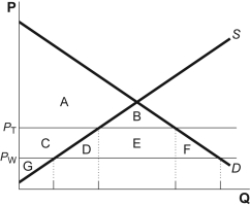 -(Figure: The Market for Laptop Sleeves) Look at the figure The Market for Laptop Sleeves. Assume that S and D are the domestic supply and demand curves and the world price is PW. Identify the area of government tax revenue when a tariff raises the domestic price from the world price to PT.
 (Multiple Choice)
4.9/5 (57)
(57) Lower wages in China reflect _____ labor productivity in China than in the United States. This means that if the United States moved high-tech industries to China, the overall cost of production would be _____ in China than in the United States.
(Multiple Choice)
4.9/5 (66)
(66) Suppose a nation is considering two alternative policies to protect a domestic industry from world trade. The two policies are an import quota of X units and a per-unit tariff that would reduce imports to X units. Though either policy would result in only X imported units of this good, there is a fundamental difference in the outcome. Explain this difference.
(Essay)
4.8/5 (89)
(89) Explain the difference between comparative advantage and absolute advantage.
(Essay)
4.9/5 (85)
(85) Use the following to answer questions :
Figure: The Market for Melons in Russia  -(Figure: The Markets for Melons in Russia) Look at the figure The Market for Melons in Russia. Suppose the world price of melons is D. Russia will _____ of melons.
 (Multiple Choice)
4.7/5 (76)
(76) Use the following to answer questions:  -(Table: Production Possibilities for Machinery and Petroleum) Look at the table Production Possibilities for Machinery and Petroleum. The opportunity cost in Mexico of producing 10 units of machinery is _____ units of petroleum.
 (Multiple Choice)
4.8/5 (87)
(87) In a single year, Argentina can raise 100 tons of beef or produce 1,000 boxes of tulips. In the same growing season, Venezuela can raise 50 tons of beef or produce 750 boxes of tulips. When the two countries begin trading beef for tulips, we expect the total surplus from beef consumption and production to:
(Multiple Choice)
4.8/5 (70)
(70) If labor is scarce in Sri Lanka but capital is abundant, when Sri Lanka opens to trade, the price of labor will _____ and the price of capital will _____.
(Multiple Choice)
4.8/5 (80)
(80) Chile has a comparative advantage over the United States in copper. Which of the following is a source of this comparative advantage?
(Multiple Choice)
4.9/5 (70)
(70) Use the following to answer questions :  -(Table: The Production Possibilities for Tractors and Crude Oil) Look at the table The Production Possibilities for Tractors and Crude Oil. In the United States the opportunity cost of producing 40 tractors is _____ barrels of crude oil.
 (Multiple Choice)
4.8/5 (80)
(80) If the United States can produce 30 computers for every car it produces and Japan can produce 15 computers for every car it produces, _____ has the _____ advantage in car production.
(Multiple Choice)
4.9/5 (79)
(79) Use the following to answer questions:
Figure: The Market for Calculators  -(Figure: The Market for Calculators) Look at the figure The Market for Calculators. Assume that S and D represent the domestic demand and supply of calculators. The world price, PW, equals $100. When the economy moves from autarky, under which the price is $150, to free trade, consumer surplus rises by area _____ and producer surplus falls by _____.
 (Multiple Choice)
4.8/5 (89)
(89) Goods and services purchased from abroad are _____, while goods and services sold abroad are _____.
(Multiple Choice)
4.8/5 (81)
(81) Use the following to answer questions:
Figure: The Domestic Market for Digital Cameras 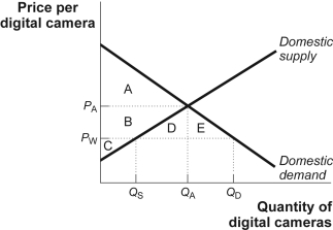 -(Figure: Domestic Market for Digital Cameras) Look at the figure The Domestic Market for Digital Cameras. Assume that PA is the autarky price and PW is the world price. Total surplus after international trade _____ by the area _____.
 (Multiple Choice)
4.8/5 (69)
(69) 
Filters
- Essay(0)
- Multiple Choice(0)
- Short Answer(0)
- True False(0)
- Matching(0)