



 Chat with AI
Exam 5: International Trade 5

Exam 1: First Principles233 Questions
Exam 2: Economic Models319 Questions
Exam 3: Supply and Demand292 Questions
Exam 5: International Trade 5274 Questions
Exam 6: Macroeconomics: the Big Picture168 Questions
Exam 7: Gdp and Cpi: Tracking the Macroeconomy434 Questions
Exam 8: Unemployment and Inflation354 Questions
Exam 9: Long-Run Economic Growth316 Questions
Exam 10: Savings, Investment Spending, and the Financial System402 Questions
Exam 13: Fiscal Policy Appendix Taxes and the Multiplier382 Questions
Exam 14: Money, Banking, and the Federal Reserve System468 Questions
Exam 15: Monetary Policy359 Questions
Exam 16: Inflation, Disinflation, and Deflation240 Questions
Exam 17: Crises and Consequences214 Questions
Exam 18: Events and Ideas322 Questions
Exam 19: Open-Economy Macroeconomics467 Questions
Exam 20: Graphs in Economics75 Questions
Exam 21: toward a Fuller Understanding of Present Value36 Questions
Select questions type


Use the following to answer question :
Figure: The Gains from International Trade 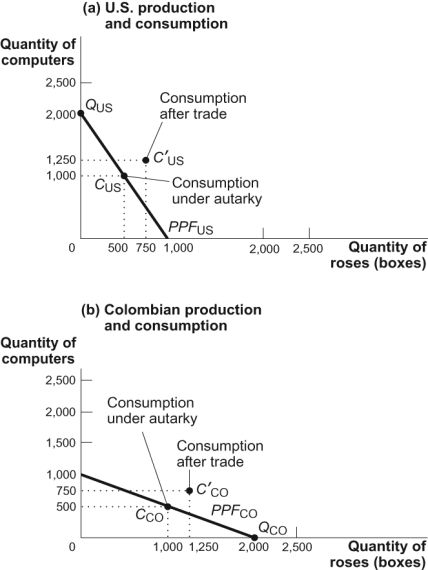 -(Figure: The Gains from International Trade) Look at the figure The Gains from International Trade. If each country specializes completely in the good for which it has a comparative advantage, each country must trade _____ computer(s) for _____ box of roses to consume at combination C'.
 (Multiple Choice)
4.9/5  (81)
(81) Use the following to answer questions :
Figure: Comparative Advantage and the Production Possibility Frontier 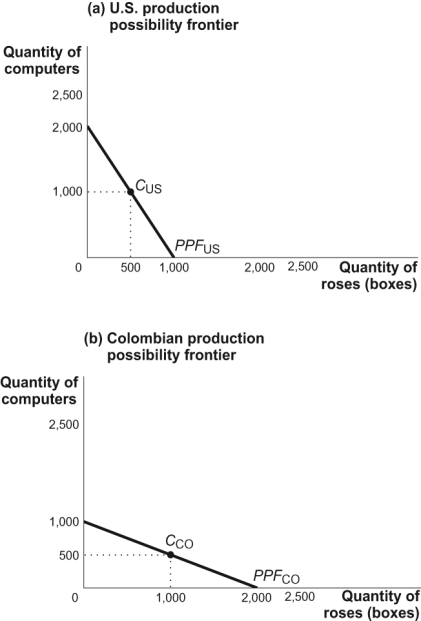 -(Figure: Comparative Advantage and the Production Possibility Frontier) Look at the figure Comparative Advantage and the Production Possibility Frontier. _____ has an absolute advantage in the production of _____ and a comparative advantage in the production of _____.
 (Multiple Choice)
5.0/5 (87)
(87) Since the production of clothing is labor-intensive relative to the production of wheat and China is labor-abundant relative to most countries, we expect China to export clothing.
(True/False)
4.8/5 (92)
(92) Use the following to answer questions :
Figure: The Market for Thumb Drives 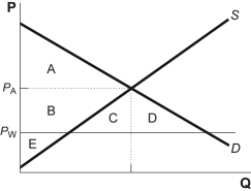 -(Figure: The Market for Thumb Drives) Look at the figure The Market for Thumb Drives. Assume that PA is the autarky price, PW is the world price, and D and S represent domestic demand and supply, respectively. Producer surplus in free trade equals the area:
 (Multiple Choice)
4.9/5 (82)
(82) If the United States placed larger tariffs on all textiles, domestic _____ surplus would _____.
(Multiple Choice)
4.8/5 (77)
(77) In the importing country, the most likely effect of a tariff is to:
(Multiple Choice)
4.8/5 (71)
(71) Advocates of trade barriers suggest that the barriers are needed for national security, job creation, and to:
(Multiple Choice)
4.8/5 (94)
(94) Japan must give up the production of 75 computers to produce 25 additional cellular telephones. The opportunity cost of producing 3 computers is _____ cell phone(s).
(Multiple Choice)
4.8/5 (89)
(89) Use the following to answer questions :
Figure: The Production Possibility Frontiers for Jackson and Tahoe  -(Figure: The Production Possibility Frontiers for Jackson and Tahoe) Look at the figure The Production Possibility Frontiers for Jackson and Tahoe. In autarky, Jackson produces and consumes 30 head of cattle and 80 bushels of wheat, while Tahoe produces and consumes 80 head of cattle and 60 bushels of wheat. If both nations specialize completely in the good of their comparative advantage and Jackson exports 120 bushels of wheat to Tahoe in exchange for 60 head of cattle, then the new consumption point for Jackson after trade is _____ bushels of wheat and _____ head of cattle.
 (Multiple Choice)
4.9/5 (81)
(81) A direct restriction on the quantity of an import is called a(n):
(Multiple Choice)
4.8/5 (73)
(73) Both the United States and Canada produce automobiles and their components; however, each particular model or component is produced in only one of the two countries. Which of the following explains this pattern of production and trade?
(Multiple Choice)
4.8/5 (76)
(76) A tariff _____ the price received by domestic producers and _____ the price paid by domestic consumers.
(Multiple Choice)
4.9/5 (90)
(90) Use the following to answer questions :
Figure: The Market for Thumb Drives
-(Figure: The Market for Thumb Drives) Look at the figure The Market for Thumb Drives. Assume that PA is the autarky price, PW is the world price, and D and S represent domestic demand and supply, respectively. The loss of producer surplus when the market moves from autarky to free trade equals the area:
-(Figure: The Market for Thumb Drives) Look at the figure The Market for Thumb Drives. Assume that PA is the autarky price, PW is the world price, and D and S represent domestic demand and supply, respectively. The loss of producer surplus when the market moves from autarky to free trade equals the area: (Multiple Choice)
4.8/5 (75)
(75) Which of the following trade patterns is best explained by increasing returns?
(Multiple Choice)
4.7/5 (83)
(83) Use the following to answer questions :
Figure: The Market for MP3 Players  -(Figure: The Market for MP3 Players) Look at the figure The Market for MP3 Players. Assume that Sd represents the domestic supply curve and Dd represents the domestic demand curve. If the world price equals $100 and there is free trade, consumer surplus _____ and producer surplus _____ compared to autarky.
 (Multiple Choice)
4.9/5 (80)
(80) Use the following to answer questions :
Figure: The Market for Computers  -(Figure: The Market for Computers) Look at the figure The Market for Computers. Assume that PA is the autarky price and PW is the world price. Consumer surplus with international trade is area:
 (Multiple Choice)
4.8/5 (83)
(83) The United States can produce wine domestically, but it can also import wine if the world price is lower than the domestic price. If the United States imports wine, consumer surplus will _____ by _____ the _____ in producer surplus; total surplus will _____.
(Multiple Choice)
4.9/5 (91)
(91) France and England both produce wine and clothing with constant opportunity costs. France will have a comparative advantage in wine production if:
(Multiple Choice)
4.9/5 (87)
(87) The most likely effects of tariffs and/or import quotas are to _____ prices and to _____ consumption of the protected goods in the importing country.
(Multiple Choice)
4.8/5 (82)
(82) 
Filters
- Essay(0)
- Multiple Choice(0)
- Short Answer(0)
- True False(0)
- Matching(0)