



 Chat with AI
Exam 5: International Trade 5

Exam 1: First Principles233 Questions
Exam 2: Economic Models319 Questions
Exam 3: Supply and Demand292 Questions
Exam 5: International Trade 5274 Questions
Exam 6: Macroeconomics: the Big Picture168 Questions
Exam 7: Gdp and Cpi: Tracking the Macroeconomy434 Questions
Exam 8: Unemployment and Inflation354 Questions
Exam 9: Long-Run Economic Growth316 Questions
Exam 10: Savings, Investment Spending, and the Financial System402 Questions
Exam 13: Fiscal Policy Appendix Taxes and the Multiplier382 Questions
Exam 14: Money, Banking, and the Federal Reserve System468 Questions
Exam 15: Monetary Policy359 Questions
Exam 16: Inflation, Disinflation, and Deflation240 Questions
Exam 17: Crises and Consequences214 Questions
Exam 18: Events and Ideas322 Questions
Exam 19: Open-Economy Macroeconomics467 Questions
Exam 20: Graphs in Economics75 Questions
Exam 21: toward a Fuller Understanding of Present Value36 Questions
Select questions type


Use the following to answer questions :  -(Table: Production Possibilities for the United States and Canada) Look at the table Production Possibilities for the United States and Canada. Both nations can produce cars and lumber. If these nations trade, Canada has the comparative advantage in _____ and should trade _____ to the United States in exchange for _____.
 (Multiple Choice)
4.8/5  (80)
(80) Assume an economy moves from autarky to free international trade. In the export sector, consumer surplus _____, producer surplus _____, and the economy as a whole _____.
(Multiple Choice)
4.9/5 (85)
(85) Use the following to answer questions :
Figure: The Market for Laptop Sleeves 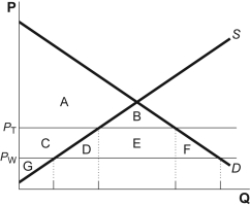 -(Figure: The Market for Laptop Sleeves) Look at the figure The Market for Laptop Sleeves. Assume that S and D are the domestic supply and demand curves and the world price is PW. Identify the area of consumer surplus when a tariff raises the domestic price from the world price to PT.
 (Multiple Choice)
4.7/5 (82)
(82) Use the following to answer questions:  -(Table: Production Possibilities for Machinery and Petroleum) Look at the table Production Possibilities for Machinery and Petroleum. The opportunity cost in the United States of producing 30 units of petroleum is _____ units of machinery.
 (Multiple Choice)
4.8/5 (80)
(80) In a single year, Argentina can raise 100 tons of beef or produce 1,000 boxes of tulips. In the same growing season, Venezuela can raise 50 tons of beef or produce 750 boxes of tulips. When the two countries begin trading beef for tulips, we expect the price of beef in Venezuela:
(Multiple Choice)
4.9/5 (77)
(77) Countries that trade based on the Heckscher-Ohlin model will find that:
(Multiple Choice)
4.8/5 (77)
(77) China, which is labor-abundant, has a comparative advantage in clothing production, which is labor-intensive. Which of the following models explains this pattern of comparative advantage?
(Multiple Choice)
4.9/5 (86)
(86) Britain must give up the production of 75 hats to produce 25 additional sweaters. The opportunity cost of producing 3 hats is _____ sweater(s).
(Multiple Choice)
4.8/5 (69)
(69) Use the following to answer questions :
Figure: The Market for Tea in Sri Lanka  -(Figure: The Market for Tea in Sri Lanka) Look at the figure The Market for Tea in Sri Lanka. In autarky, the price is P1. When the economy is opened to trade, the price rises to PW and consumer surplus _____ to _____.
 (Multiple Choice)
4.8/5 (78)
(78) Use the following to answer questions : 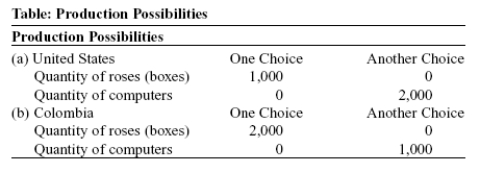 -(Table: Production Possibilities) Look at the table Production Possibilities. The opportunity cost of 1 computer for _____ is _____.
 (Multiple Choice)
4.9/5 (81)
(81) If Japan levies tariffs on U.S. goods entering Japan, this will tend to:
(Multiple Choice)
4.8/5 (78)
(78) Use the following to answer questions :
Scenario: The Production of Wheat and Toys  The table describes the production of two goods, wheat and toys, in country A and country B. Each country has a linear production possibility frontier with respect to its production of the two goods. The numbers in each column represent the total number of units each country could produce if it used all of its resources to produce the good.
-(Scenario: The Production of Wheat and Toys) Look at the scenario Production of Wheat and Toys. If each country specializes in the good for which it has the comparative advantage, then the price of wheat in terms of toys will be:
The table describes the production of two goods, wheat and toys, in country A and country B. Each country has a linear production possibility frontier with respect to its production of the two goods. The numbers in each column represent the total number of units each country could produce if it used all of its resources to produce the good.
-(Scenario: The Production of Wheat and Toys) Look at the scenario Production of Wheat and Toys. If each country specializes in the good for which it has the comparative advantage, then the price of wheat in terms of toys will be: (Multiple Choice)
4.9/5 (76)
(76) Although U.S. exports and imports have grown substantially in absolute terms since the 1960s, the share of exports and imports in total output has fallen significantly over the past few decades.
(True/False)
4.9/5 (73)
(73) If labor is abundant in South Africa but capital is scarce, when South Africa opens to trade, the price of labor will _____ and the price of capital will _____.
(Multiple Choice)
5.0/5 (84)
(84) Use the following to answer questions :
Figure: The Market for Melons in Russia II  -(Figure: The Markets for Melons in Russia II) Look at the figure The Market for Melons in Russia II. Suppose producers lobby effectively for the imposition of a tariff that raises the world price from $10 to $15. Tariff revenue to the government will equal:
 (Multiple Choice)
4.7/5 (73)
(73) Saudi Arabia has a tremendous comparative advantage in petroleum. Which of the following is a source of this comparative advantage?
(Multiple Choice)
4.8/5 (65)
(65) Use the following to answer questions :
Figure: The Market for Oranges in South Africa  -(Figure: The Market for Oranges in South Africa) Look at the figure The Market for Oranges in South Africa. In autarky, the price of oranges in South Africa is P1. When the economy is opened to trade, the price falls to PW. South Africa will _____ oranges and the volume of trade will equal _____.
 (Multiple Choice)
4.9/5 (77)
(77) Use the following to answer questions :
Figure: The Market for Roses  -(Figure: The Market for Roses) Look at the figure The Market for Roses. Assume that PA is the autarky price and PW is the world price. Consumer surplus with international trade would be area:
 (Multiple Choice)
4.7/5 (82)
(82) In a single year, the Netherlands can raise 100 tons of beef or produce 1,000 boxes of tulips. In the same growing season, Belgium can raise 50 tons of beef or produce 750 boxes of tulips. In autarky, the opportunity cost of 1 ton of beef in the Netherlands is:
(Multiple Choice)
4.9/5 (88)
(88) 
Filters
- Essay(0)
- Multiple Choice(0)
- Short Answer(0)
- True False(0)
- Matching(0)