



 Chat with AI
Exam 19: Open-Economy Macroeconomics

Exam 1: First Principles233 Questions
Exam 2: Economic Models319 Questions
Exam 3: Supply and Demand292 Questions
Exam 5: International Trade 5274 Questions
Exam 6: Macroeconomics: the Big Picture168 Questions
Exam 7: Gdp and Cpi: Tracking the Macroeconomy434 Questions
Exam 8: Unemployment and Inflation354 Questions
Exam 9: Long-Run Economic Growth316 Questions
Exam 10: Savings, Investment Spending, and the Financial System402 Questions
Exam 13: Fiscal Policy Appendix Taxes and the Multiplier382 Questions
Exam 14: Money, Banking, and the Federal Reserve System468 Questions
Exam 15: Monetary Policy359 Questions
Exam 16: Inflation, Disinflation, and Deflation240 Questions
Exam 17: Crises and Consequences214 Questions
Exam 18: Events and Ideas322 Questions
Exam 19: Open-Economy Macroeconomics467 Questions
Exam 20: Graphs in Economics75 Questions
Exam 21: toward a Fuller Understanding of Present Value36 Questions
Select questions type


Suppose that the United States and European Union are the only trading partners in the world. If the United States lowers import restrictions from the European Union, we would expect:
(Multiple Choice)
4.9/5  (76)
(76) A Brazilian bank buys shares of stock in Intel, a U.S. high-tech company. In the U.S. balance of payments, this transaction causes the balance on the _____ account to _____.
(Multiple Choice)
4.7/5 (74)
(74) When the Mexican government changes the fixed rate of pesos per U.S. dollar from 1.5 to 3.0, the peso is _____. When the equilibrium exchange rate of U.S. dollars per euro changes from 1.15 to 1.30, the euro is _____.
(Multiple Choice)
4.8/5 (75)
(75) If the equilibrium exchange rate is below the target rate, the government should:
I. buy its domestic currency in foreign exchange markets.
II. engage in expansionary monetary policy.
III. restrict the purchase of the domestic currency by foreigners.
(Multiple Choice)
4.9/5 (75)
(75) Holding everything else constant, if the U.S. dollar falls against the Mexican peso:
(Multiple Choice)
4.8/5 (80)
(80) When the value of a pound sterling changes from US$1.50 to US$2, it follows that the:
(Multiple Choice)
4.9/5 (81)
(81) If the target exchange rate of a fixed currency is above the equilibrium exchange rate, to reach the target rate, the government should sell that currency and buy foreign currencies.
(True/False)
4.8/5 (82)
(82) Use the following to answer questions : 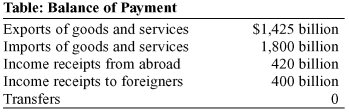 -(Table: Balance of Payment) Refer to the table Balance of Payments. The country's balance of payments on current account is:
 (Multiple Choice)
4.9/5 (80)
(80) When a currency becomes more valuable in terms of other currencies, it appreciates.
(True/False)
4.9/5 (75)
(75) If the U.S. dollar changes from $1 = ¥200 to $1 = ¥100, then:
(Multiple Choice)
4.9/5 (85)
(85) Assume that the foreign exchange market is trading the domestic currency at a rate (U.S. dollars per unit of the domestic currency) above the rate fixed by the government. To maintain the fixed exchange rate, the government must:
(Multiple Choice)
4.8/5 (83)
(83) Use the following to answer questions :
-(Table: Balance of Payment) Refer to the table Balance of Payments. In this case, the country's balance of payments on goods and services is:
-(Table: Balance of Payment) Refer to the table Balance of Payments. In this case, the country's balance of payments on goods and services is: (Multiple Choice)
4.9/5 (83)
(83) Use the following to answer questions :
Scenario: Gizmovia II
The Republic of Gizmovia wants to maintain the exchange rate of its currency, the gizmo, at $0.50, but the current exchange rate for the gizmo is $0.75.
-(Scenario: Gizmovia II) Look at the scenario Gizmovia II. At the target rate of $0.50:
(Multiple Choice)
4.9/5 (78)
(78) The 2001 devaluation of the Argentine peso had all of the following effects EXCEPT:
(Multiple Choice)
4.9/5 (73)
(73) A reduction in the value of a floating currency is called a depreciation.
(True/False)
4.9/5 (87)
(87) A fixed exchange rate means that supply and demand of the currency determine its exchange rate.
(True/False)
4.9/5 (81)
(81) 
Filters
- Essay(0)
- Multiple Choice(0)
- Short Answer(0)
- True False(0)
- Matching(0)