



 Chat with AI
Exam 19: Open-Economy Macroeconomics

Exam 1: First Principles233 Questions
Exam 2: Economic Models319 Questions
Exam 3: Supply and Demand292 Questions
Exam 5: International Trade 5274 Questions
Exam 6: Macroeconomics: the Big Picture168 Questions
Exam 7: Gdp and Cpi: Tracking the Macroeconomy434 Questions
Exam 8: Unemployment and Inflation354 Questions
Exam 9: Long-Run Economic Growth316 Questions
Exam 10: Savings, Investment Spending, and the Financial System402 Questions
Exam 13: Fiscal Policy Appendix Taxes and the Multiplier382 Questions
Exam 14: Money, Banking, and the Federal Reserve System468 Questions
Exam 15: Monetary Policy359 Questions
Exam 16: Inflation, Disinflation, and Deflation240 Questions
Exam 17: Crises and Consequences214 Questions
Exam 18: Events and Ideas322 Questions
Exam 19: Open-Economy Macroeconomics467 Questions
Exam 20: Graphs in Economics75 Questions
Exam 21: toward a Fuller Understanding of Present Value36 Questions
Select questions type


Some countries have exchange rate policies that lie somewhere between fixed and floating exchange rates, such as rates that are managed by the government to avoid wide swings.
(True/False)
4.9/5  (90)
(90) A revaluation of a currency, holding everything else constant:
(Multiple Choice)
4.7/5 (85)
(85) Explain two purposes of devaluation and revaluation in a fixed exchange rate regime.
(Essay)
4.9/5 (69)
(69) If a fixed currency is below its target exchange rate, the government will sell its own currency in foreign exchange markets.
(True/False)
4.9/5 (84)
(84) Use the following to answer questions:
Figure: International Capital Flows 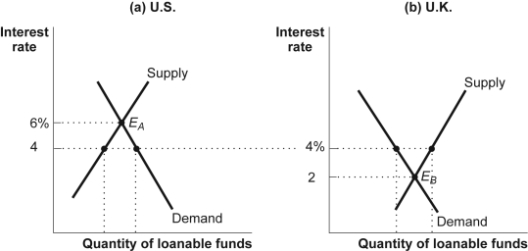 -(Figure: International Capital Flows) Look at the figure International Capital Flows. At an interest rate of 4%, the quantity of loanable funds supplied by U.S. lenders is _____ the quantity of loanable funds demanded by U.S. borrowers.
 (Multiple Choice)
5.0/5 (75)
(75) In the foreign exchange market, when the demand for the euro increases, the equilibrium U.S. dollar price of the euro _____ and the U.S. dollar _____.
(Multiple Choice)
4.9/5 (88)
(88) When a Japanese investor buys stock in General Motors, the _____ account is affected.
(Multiple Choice)
4.9/5 (78)
(78) The Cuban peso is on a fixed rate. If the government of Cuba uses foreign exchange controls to change the exchange rate of the peso from $1 to $1.20, the Cuban peso has been revalued.
(True/False)
4.9/5 (71)
(71) The Canadian dollar is a floating currency. If the exchange rate for the Canadian dollar changes from US$0.95 to US$0.98, the Canadian dollar has appreciated.
(True/False)
4.8/5 (80)
(80) Which of the following was an argument IN FAVOR of Britain's adopting the euro?
I. Using the same currency as many other European countries would expand trade and increase productivity.
II. Using the euro would increase the effectiveness of monetary policy.
(Multiple Choice)
4.8/5 (90)
(90) Government purchases or sales of currency in the foreign exchange market constitute:
I. a floating exchange rate regime.
II. foreign exchange controls.
III. exchange market intervention.
(Multiple Choice)
4.7/5 (83)
(83) If the Chinese government wants to keep the real and nominal exchange rates between the yuan and the U.S. dollar fixed at 8 yuan per dollar without government intervention in the foreign exchange market, the _____ rate in China must be _____ that in the United States.
(Multiple Choice)
4.9/5 (83)
(83) Use the following to answer questions :
Scenario: Exchange Rates
The value of a euro goes from US$1.25 to US$1.50.
-(Scenario: Exchange Rates) Look at the scenario Exchange Rates. The dollar has:
(Multiple Choice)
4.7/5 (73)
(73) Why did China buy $450 billion in foreign exchange reserves in 2010?
(Multiple Choice)
4.8/5 (80)
(80) A devaluation will make exports _____expensive and imports _____ expensive.
(Multiple Choice)
4.8/5 (89)
(89) According to the principle of purchasing power parity, the 2001 devaluation of the Argentine peso:
(Multiple Choice)
4.9/5 (86)
(86) After a revaluation, all other things equal, probably exports will increase and imports will decrease.
(True/False)
4.8/5 (88)
(88) The behavior of the financial accounts is determined in the international _____ market.
(Multiple Choice)
4.8/5 (77)
(77) 
Filters
- Essay(0)
- Multiple Choice(0)
- Short Answer(0)
- True False(0)
- Matching(0)