



 Chat with AI
Exam 13: Biochemical Signaling

Exam 1: Introduction to the Chemistry of Life56 Questions
Exam 2: Water59 Questions
Exam 3: Nucleotides, nucleic Acids, and Genetic Information67 Questions
Exam 4: Amino Acids68 Questions
Exam 5: Proteins: Primary Structure68 Questions
Exam 6: Proteins: Three-Dimensional Structure60 Questions
Exam 7: Protein Function Part I: Myoglobin and Hemoglobin74 Questions
Exam 8: Carbohydrates66 Questions
Exam 9: Lipids and Biological Membranes58 Questions
Exam 10: Membrane Transport49 Questions
Exam 11: Enzyme Catalysis53 Questions
Exam 12: Enzyme Kinetics, inhibition and Control54 Questions
Exam 13: Biochemical Signaling50 Questions
Exam 14: Introduction to Metabolism52 Questions
Exam 15: Glucose Catabolism50 Questions
Exam 16: Glycogen Metabolism and Gluconeogenesis50 Questions
Exam 17: Citric Acid Cycle50 Questions
Exam 18: Electron Transport and Oxidative Phosphorylation50 Questions
Exam 19: Photosynthesis50 Questions
Exam 20: Lipid Metabolism51 Questions
Exam 21: Amino Acid Metabolism50 Questions
Exam 22: Mammalian Fuel Metabolism: Integration and Regulation50 Questions
Exam 23: Nucleotide Metabolism50 Questions
Exam 24: Nucleic Acid Structure50 Questions
Exam 25: DNA Replication, repair and Recombination50 Questions
Exam 26: Transcription and Rna Processing50 Questions
Exam 27: Protein Synthesis49 Questions
Exam 28: Regulation of Gene Expression50 Questions
Select questions type


The activity of protein kinase A is affected by which of the following?
(I)caffeine
(II)levels of cAMP
(III)phosphodiesterases
(IV)cholera toxin
(Multiple Choice)
4.8/5  (64)
(64) Recently a researcher has discovered several unidentified proteins (UPS-1 through UPS-3)that are up regulated (produced in higher levels)by the cell in response to the inclusion of high levels of an artificial sweetener called "sugarish".The research ran a PAGE gel of the protein samples after the cells were treated with different concentrations of "sugarish" (0-5 nm).One sample was also treated with the detergent SDS.The results are shown below.Which of the following are possible conclusions given these results and the knowledge you have gained from this chapter? 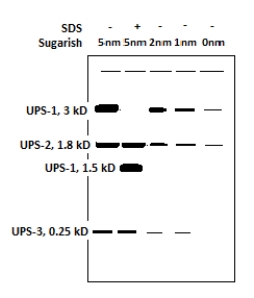 (I)UPS-1 functions as a dimer.
(II)UPS-1 interacts with UPS-2.
(III)UPS-1 interacts with UPS-3.
(IV)UPS-2 interacts with UPS-3.
(I)UPS-1 functions as a dimer.
(II)UPS-1 interacts with UPS-2.
(III)UPS-1 interacts with UPS-3.
(IV)UPS-2 interacts with UPS-3. (Multiple Choice)
4.7/5 (63)
(63) Which of the following are activated either directly or indirectly by a heterotrimeric G protein subunit?
(I)phospholipase C
(II)Herceptin ®
(III)calmodulin (CaM)sensitive kinase
(IV)MAPK
(Multiple Choice)
5.0/5 (67)
(67) Based on the following figure,which of the following are possible? 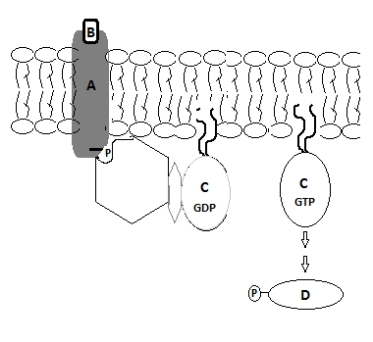 (I)"A" could be adenylate cyclase.
(II)"B" is a receptor protein.
(III)"C" could be an inactive Ras protein.
(IV)"D" could be an SH2 domain.
(I)"A" could be adenylate cyclase.
(II)"B" is a receptor protein.
(III)"C" could be an inactive Ras protein.
(IV)"D" could be an SH2 domain. (Multiple Choice)
4.9/5 (81)
(81) Ras is an example of
(I)a protein anchoted by prenylation.
(II)a heterotrimeric G protein.
(III)a kinase activated protein.
(IV)a GTP dependent protein.
(Multiple Choice)
4.9/5 (85)
(85) Which of the following generalizations explains how anabolic steroids can affect muscle growth?
(Multiple Choice)
4.8/5 (66)
(66) Which of the following are produced in the adrenal cortex?
(I)Glucorticoids
(II)mineralcorticoides
(III)androgens
(IV)estrogens
(Multiple Choice)
4.8/5 (69)
(69) The insulin signaling pathway includes which of the following steps?
(Multiple Choice)
4.8/5 (83)
(83) Oncogenes
(I)function as cell cycle inhibitors.
(II)encode a protein which block cell cycle inhibition.
(III)are expressed by cells that have higher levels of human growth hormone.
(IV)can function as transcription factors.
(Multiple Choice)
4.7/5 (88)
(88) 
Filters
- Essay(0)
- Multiple Choice(0)
- Short Answer(0)
- True False(0)
- Matching(0)