



 Chat with AI
Exam 12: Enzyme Kinetics, inhibition and Control

Exam 1: Introduction to the Chemistry of Life56 Questions
Exam 2: Water59 Questions
Exam 3: Nucleotides, nucleic Acids, and Genetic Information67 Questions
Exam 4: Amino Acids68 Questions
Exam 5: Proteins: Primary Structure68 Questions
Exam 6: Proteins: Three-Dimensional Structure60 Questions
Exam 7: Protein Function Part I: Myoglobin and Hemoglobin74 Questions
Exam 8: Carbohydrates66 Questions
Exam 9: Lipids and Biological Membranes58 Questions
Exam 10: Membrane Transport49 Questions
Exam 11: Enzyme Catalysis53 Questions
Exam 12: Enzyme Kinetics, inhibition and Control54 Questions
Exam 13: Biochemical Signaling50 Questions
Exam 14: Introduction to Metabolism52 Questions
Exam 15: Glucose Catabolism50 Questions
Exam 16: Glycogen Metabolism and Gluconeogenesis50 Questions
Exam 17: Citric Acid Cycle50 Questions
Exam 18: Electron Transport and Oxidative Phosphorylation50 Questions
Exam 19: Photosynthesis50 Questions
Exam 20: Lipid Metabolism51 Questions
Exam 21: Amino Acid Metabolism50 Questions
Exam 22: Mammalian Fuel Metabolism: Integration and Regulation50 Questions
Exam 23: Nucleotide Metabolism50 Questions
Exam 24: Nucleic Acid Structure50 Questions
Exam 25: DNA Replication, repair and Recombination50 Questions
Exam 26: Transcription and Rna Processing50 Questions
Exam 27: Protein Synthesis49 Questions
Exam 28: Regulation of Gene Expression50 Questions
Select questions type


A lab recently developed a new drug which is hypothesized to inhibit the enzyme cyclooxygenase-2 (COX-2)and reduce inflammation.In their first test they monitored the reaction of substrate as it is converted to product in the presence of the new drug (data shown below).If the hypothesis is correct the observed initial rate will be at least 2 times slower than the normal reaction without the drug.If the normal initial rate is 30 mM/s,does the data below indicate that the team has designed a successful inhibitor? 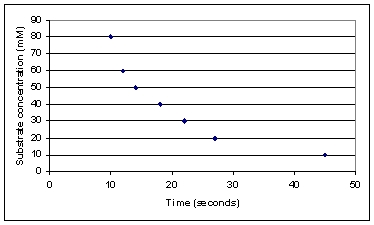
(Multiple Choice)
4.9/5  (85)
(85) The following data were collected under conditions indicated in the graph below during the time period of 0-5 seconds.Upon plotting the Lineweaver-Burk plot,the information given in the table below was determined.Based on this available information which of the following is FALSE?
X-intercept - 0.002 (Units on the x-axis are 1/M)
Y-intercept 0.005 (Units on the y-axis are 1/s)
Slope 2.50 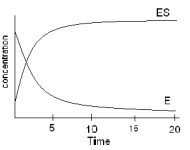
(Multiple Choice)
5.0/5 (74)
(74) An extremely efficient enzyme called "efficase" catalyzes the conversion of "A" to "B." A researcher decides to mutate the enzyme in order to try to improve its performance.Following active site mutations,a significant reduction in the value of KM and Vmax was observed.Which of the following may have occurred?
(Multiple Choice)
4.7/5 (80)
(80) Parallel lines on a Lineweaver-Burk plot indicate
(I)an increase in KM.
(II)decrease in KM.
(III)decrease in Vmax.
(IV)uncompetitive inhibition.
(Multiple Choice)
4.9/5 (87)
(87) Matching
-Assume a first order reaction,the rate of the reaction 2A B is dependent on ______.
(Multiple Choice)
4.7/5 (83)
(83) Matching
-A lead compound for a new drug should bind to its target protein with a very ______.
(Multiple Choice)
4.8/5 (69)
(69) Find the initial velocity for an enzymatic reaction when Vmax = 6.5 × 10⁻⁵ mol•sec-1,[S] = 3.0 × 10⁻³ M,KM = 4.5 × 10⁻³ M and the enzyme concentration at time zero is 1.5 × 10⁻² M.
(Multiple Choice)
4.8/5 (76)
(76) Following several experiments,the data presented on the graph below was obtained.What can you determine from this graph? 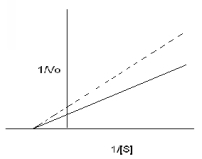
(Multiple Choice)
4.8/5 (79)
(79) The following questions refer to the diagram (with boxes where it has been left incomplete): 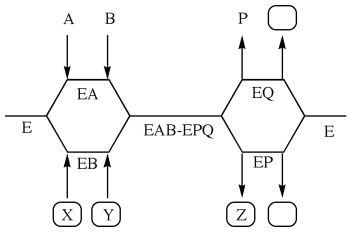 -Which of the following is correct in regards to the diagram above?
 (Multiple Choice)
4.9/5 (78)
(78) 
Filters
- Essay(0)
- Multiple Choice(0)
- Short Answer(0)
- True False(0)
- Matching(0)