



 Chat with AI
Exam 4: Amino Acids

Exam 1: Introduction to the Chemistry of Life56 Questions
Exam 2: Water59 Questions
Exam 3: Nucleotides, nucleic Acids, and Genetic Information67 Questions
Exam 4: Amino Acids68 Questions
Exam 5: Proteins: Primary Structure68 Questions
Exam 6: Proteins: Three-Dimensional Structure60 Questions
Exam 7: Protein Function Part I: Myoglobin and Hemoglobin74 Questions
Exam 8: Carbohydrates66 Questions
Exam 9: Lipids and Biological Membranes58 Questions
Exam 10: Membrane Transport49 Questions
Exam 11: Enzyme Catalysis53 Questions
Exam 12: Enzyme Kinetics, inhibition and Control54 Questions
Exam 13: Biochemical Signaling50 Questions
Exam 14: Introduction to Metabolism52 Questions
Exam 15: Glucose Catabolism50 Questions
Exam 16: Glycogen Metabolism and Gluconeogenesis50 Questions
Exam 17: Citric Acid Cycle50 Questions
Exam 18: Electron Transport and Oxidative Phosphorylation50 Questions
Exam 19: Photosynthesis50 Questions
Exam 20: Lipid Metabolism51 Questions
Exam 21: Amino Acid Metabolism50 Questions
Exam 22: Mammalian Fuel Metabolism: Integration and Regulation50 Questions
Exam 23: Nucleotide Metabolism50 Questions
Exam 24: Nucleic Acid Structure50 Questions
Exam 25: DNA Replication, repair and Recombination50 Questions
Exam 26: Transcription and Rna Processing50 Questions
Exam 27: Protein Synthesis49 Questions
Exam 28: Regulation of Gene Expression50 Questions
Select questions type


The pK1,pK2,and pKR for the amino acid aspartic acid are 2.0,9.9,and 3.9,respectively.At pH 7.0,aspartic acid would be charged predominantly as follows:
(Multiple Choice)
4.9/5  (72)
(72) Glutamine is an amino acid (pKas are 2.2,and 9.1).Draw the predominant structure of glutamine at pH 1.0.
(Essay)
4.7/5 (91)
(91) Which of the following amino acids has a charged polar side chain at pH 7.0?
(Multiple Choice)
4.8/5 (74)
(74) An amide bond between a side-chain carboxylate and an -amino group is also called a(n)
(Multiple Choice)
4.7/5 (81)
(81) All the standard amino acids except ____ are optically active.
(Multiple Choice)
4.8/5 (94)
(94) For the following questions refer to the diagram below 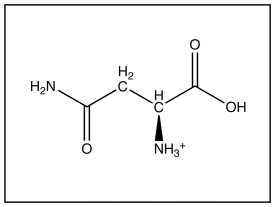 -What is the three-letter symbol for the amino acid shown above?
 (Multiple Choice)
4.8/5 (76)
(76) Which of the amino acids represented below has two chiral centers?
(Multiple Choice)
4.8/5 (87)
(87) Questions are based on the diagram below.  -What is the three-letter symbol of the N-terminal amino acid in the structure shown above?
 (Multiple Choice)
4.9/5 (71)
(71) Which of the five amino acids shown below has 2 chiral centers?
(Multiple Choice)
4.8/5 (85)
(85) Questions are based on the diagram below.
-What is the name of this molecule?
-What is the name of this molecule? (Multiple Choice)
4.9/5 (85)
(85) The pK1,pK2,and pKR for the amino acid arginine are 1.8,9.0,and 12.5,respectively.At pH 7.0 arginine would be charged predominantly as follows:
(Multiple Choice)
4.7/5 (76)
(76) Matching
-Biological systems usually produce a single enantiomer,whereas chemical synthesis produces a ______.
(Multiple Choice)
4.9/5 (72)
(72) Which of the following amino acids does not have an ionizable side chain?
(Multiple Choice)
4.9/5 (88)
(88) The isoelectronic point of an amino acid is the point where
(Multiple Choice)
4.8/5 (98)
(98) Which of the following amino acids has a sulfur atom in its side chain?
(Multiple Choice)
5.0/5 (76)
(76) Matching
-In the tripeptide Lys─Pro─Ile,the C-terminal residue is _________.
(Multiple Choice)
4.8/5 (67)
(67) The picture below shows the structure of -amino-butyric acid (GABA). 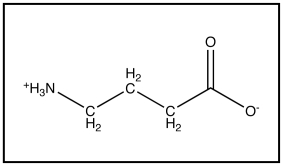 a.From which amino acid is GABA derived (give the name of the amino acid closest in structure to GABA).
b.What is the structural difference between GABA and this amino acid.
c.What is the function of GABA.
a.From which amino acid is GABA derived (give the name of the amino acid closest in structure to GABA).
b.What is the structural difference between GABA and this amino acid.
c.What is the function of GABA. (Essay)
4.9/5 (82)
(82) Questions are based on the diagram shown below.  -What is the name of the N-terminal amino acid in the peptide shown above?
 (Multiple Choice)
4.8/5 (80)
(80) 
Filters
- Essay(0)
- Multiple Choice(0)
- Short Answer(0)
- True False(0)
- Matching(0)