



 Chat with AI
Exam 12: Firms in Perfectly Competitive Markets

Exam 1: Economics: Foundations and Models444 Questions
Exam 2: Trade-Offs, Comparative Advantage, and the Market System498 Questions
Exam 3: Where Prices Come From: the Interaction of Demand and Supply475 Questions
Exam 4: Economic Efficiency, Government Price Setting, and Taxes419 Questions
Exam 5: Externalities, Environmental Policy, and Public Goods266 Questions
Exam 6: Elasticity: the Responsiveness of Demand and Supply295 Questions
Exam 7: The Economics of Health Care334 Questions
Exam 8: Firms, the Stock Market, and Corporate Governance278 Questions
Exam 9: Comparative Advantage and the Gains From International Trade379 Questions
Exam 10: Consumer Choice and Behavioral Economics302 Questions
Exam 11: Technology, Production, and Costs330 Questions
Exam 12: Firms in Perfectly Competitive Markets298 Questions
Exam 13: Monopolistic Competition: the Competitive Model in a More Realistic Setting276 Questions
Exam 14: Oligopoly: Firms in Less Competitive Markets262 Questions
Exam 15: Monopoly and Antitrust Policy271 Questions
Exam 16: Pricing Strategy263 Questions
Exam 17: The Markets for Labor and Other Factors of Production286 Questions
Exam 18: Public Choice, Taxes, and the Distribution of Income258 Questions
Exam 19: GDP: Measuring Total Production and Income266 Questions
Exam 20: Unemployment and Inflation292 Questions
Exam 21: Economic Growth, the Financial System, and Business Cycles257 Questions
Exam 22: Long-Run Economic Growth: Sources and Policies268 Questions
Exam 23: Aggregate Expenditure and Output in the Short Run306 Questions
Exam 24: Aggregate Demand and Aggregate Supply Analysis284 Questions
Exam 25: Money, Banks, and the Federal Reserve System280 Questions
Exam 26: Monetary Policy277 Questions
Exam 27: Fiscal Policy303 Questions
Exam 28: Inflation, Unemployment, and Federal Reserve Policy257 Questions
Exam 29: Macroeconomics in an Open Economy278 Questions
Exam 30: The International Financial System262 Questions
Select questions type


Jason, a high-school student, mows lawns for families in his neighborhood. The going rate is $12 for each lawn-mowing service. Jason would like to charge $20 because he believes he has more experience mowing lawns than the many other teenagers who also offer the same service. If the market for lawn mowing services is perfectly competitive, what would happen if Jason raised his price?
(Multiple Choice)
4.9/5  (83)
(83) A firm's total profit can be calculated as all of the following except
(Multiple Choice)
5.0/5 (70)
(70) A perfectly competitive firm breaks even at a price equal to its minimum average total cost.
(True/False)
4.8/5 (78)
(78) In a perfectly competitive industry, in the long-run equilibrium,
(Multiple Choice)
4.8/5 (66)
(66) For a perfectly competitive firm, which of the following is not true at profit maximization?
(Multiple Choice)
4.9/5 (87)
(87) Table 12-1
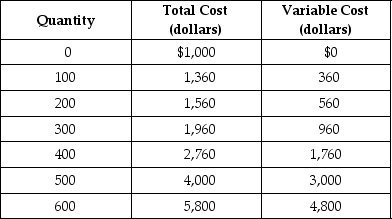 Table 12-1 shows the short-run cost data of a perfectly competitive firm that produces plastic camera cases. Assume that output can only be increased in batches of 100 units.
-Refer to Table 12-1. What is the fixed cost of production?
Table 12-1 shows the short-run cost data of a perfectly competitive firm that produces plastic camera cases. Assume that output can only be increased in batches of 100 units.
-Refer to Table 12-1. What is the fixed cost of production? (Multiple Choice)
4.9/5 (72)
(72) If a perfectly competitive apple farm's marginal revenue exceeds the marginal cost of the last bushel of apples sold, what should the farm do to maximize its profit?
(Multiple Choice)
4.9/5 (65)
(65) Figure 12-8 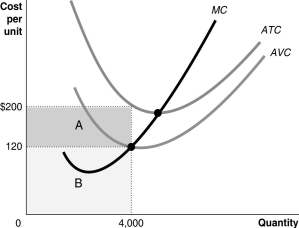 -Refer to Figure 12-8. Suppose the market price is $120. Which of the following is true?
 (Multiple Choice)
4.9/5 (90)
(90) Which of the following characteristics of a farmers' market make it a good example of a perfectly competitive market?
(Multiple Choice)
4.7/5 (87)
(87) Fill in the columns in the following table and use the values in the table to determine the profit-maximizing level of output.
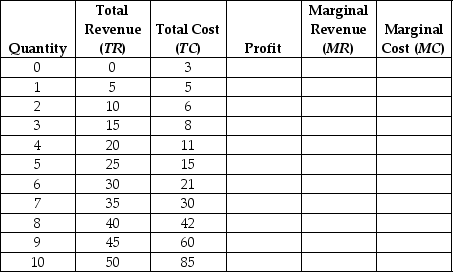
(Essay)
4.8/5 (73)
(73) The demand curve for an individual seller's product in perfect competition is
(Multiple Choice)
4.9/5 (74)
(74) Figure 12-6  Figure 12-6 shows the demand, marginal cost (MC) and average total cost (ATC) curves for Jason's House of Apples.
-Refer to Figure 12-6. Jason is currently producing 20 thousand pounds of apples. To maximize his profit Jason should
Figure 12-6 shows the demand, marginal cost (MC) and average total cost (ATC) curves for Jason's House of Apples.
-Refer to Figure 12-6. Jason is currently producing 20 thousand pounds of apples. To maximize his profit Jason should (Multiple Choice)
4.9/5 (92)
(92) Figure 12-10 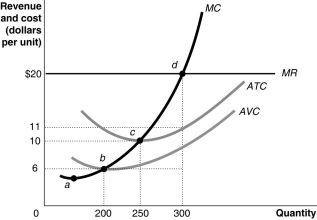 -In the short run, if a firm shuts down, its maximum loss equals the amount of its fixed cost.
 (True/False)
4.8/5 (87)
(87) A perfectly competitive firm's horizontal demand curve implies that the firm does not have to lower its price to sell more output.
(True/False)
4.9/5 (83)
(83) Ben's Peanut Shoppe suffers a short-run loss. Ben will not choose to shut down if
(Multiple Choice)
4.7/5 (81)
(81) Figure 12-1 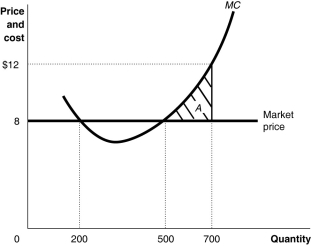 -Refer to Figure 12-1. If the firm is producing 700 units, what is the amount of its profit or loss?
 (Multiple Choice)
4.9/5 (83)
(83) Figure 12-8
-Refer to Figure 12-8. Suppose the firm produces 4,000 units. What does the shaded area labeled A represent?
-Refer to Figure 12-8. Suppose the firm produces 4,000 units. What does the shaded area labeled A represent? (Multiple Choice)
4.7/5 (78)
(78) New York Times writer Michael Lewis wrote that "The sad truth, for investors, seems to be that most of the benefits... are passed through to consumers free of charge." To which of the following did Lewis refer?
(Multiple Choice)
4.9/5 (92)
(92) 
Filters
- Essay(0)
- Multiple Choice(0)
- Short Answer(0)
- True False(0)
- Matching(0)