



 Chat with AI
Exam 12: Firms in Perfectly Competitive Markets

Exam 1: Economics: Foundations and Models444 Questions
Exam 2: Trade-Offs, Comparative Advantage, and the Market System498 Questions
Exam 3: Where Prices Come From: the Interaction of Demand and Supply475 Questions
Exam 4: Economic Efficiency, Government Price Setting, and Taxes419 Questions
Exam 5: Externalities, Environmental Policy, and Public Goods266 Questions
Exam 6: Elasticity: the Responsiveness of Demand and Supply295 Questions
Exam 7: The Economics of Health Care334 Questions
Exam 8: Firms, the Stock Market, and Corporate Governance278 Questions
Exam 9: Comparative Advantage and the Gains From International Trade379 Questions
Exam 10: Consumer Choice and Behavioral Economics302 Questions
Exam 11: Technology, Production, and Costs330 Questions
Exam 12: Firms in Perfectly Competitive Markets298 Questions
Exam 13: Monopolistic Competition: the Competitive Model in a More Realistic Setting276 Questions
Exam 14: Oligopoly: Firms in Less Competitive Markets262 Questions
Exam 15: Monopoly and Antitrust Policy271 Questions
Exam 16: Pricing Strategy263 Questions
Exam 17: The Markets for Labor and Other Factors of Production286 Questions
Exam 18: Public Choice, Taxes, and the Distribution of Income258 Questions
Exam 19: GDP: Measuring Total Production and Income266 Questions
Exam 20: Unemployment and Inflation292 Questions
Exam 21: Economic Growth, the Financial System, and Business Cycles257 Questions
Exam 22: Long-Run Economic Growth: Sources and Policies268 Questions
Exam 23: Aggregate Expenditure and Output in the Short Run306 Questions
Exam 24: Aggregate Demand and Aggregate Supply Analysis284 Questions
Exam 25: Money, Banks, and the Federal Reserve System280 Questions
Exam 26: Monetary Policy277 Questions
Exam 27: Fiscal Policy303 Questions
Exam 28: Inflation, Unemployment, and Federal Reserve Policy257 Questions
Exam 29: Macroeconomics in an Open Economy278 Questions
Exam 30: The International Financial System262 Questions
Select questions type


A perfectly competitive firm has to charge the same price as every other firm in the market. Therefore, the firm
(Multiple Choice)
4.9/5  (86)
(86) Figure 12-9 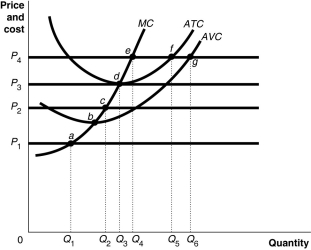 Figure 12-9 shows cost and demand curves facing a profit-maximizing, perfectly competitive firm.
-Refer to Figure 12-9. Identify the short-run shut down point for the firm.
Figure 12-9 shows cost and demand curves facing a profit-maximizing, perfectly competitive firm.
-Refer to Figure 12-9. Identify the short-run shut down point for the firm. (Multiple Choice)
4.8/5 (76)
(76) Competition has driven the economic profits in the video rental business to zero. Surya Bacha, who owns a video rental business, would be better off leaving the industry for another alternative.
(True/False)
4.9/5 (93)
(93) Figure 12-17  The graphs in Figure 12-17 represent the perfectly competitive market demand and supply curves for the apple industry and demand and cost curves for a typical firm in the industry.
-Refer to Figure 12-17. The graphs depict a short-run equilibrium. How will this differ from the long-run equilibrium? (Assume this is a constant-cost industry.)
The graphs in Figure 12-17 represent the perfectly competitive market demand and supply curves for the apple industry and demand and cost curves for a typical firm in the industry.
-Refer to Figure 12-17. The graphs depict a short-run equilibrium. How will this differ from the long-run equilibrium? (Assume this is a constant-cost industry.) (Multiple Choice)
4.7/5 (89)
(89) The perfectly competitive market structure benefits consumers because
(Multiple Choice)
4.8/5 (93)
(93) In analyzing the decision to shut down in the short run we assume that the firm's fixed costs are
(Multiple Choice)
4.8/5 (80)
(80) Figure 12-17 The graphs in Figure 12-17 represent the perfectly competitive market demand and supply curves for the apple industry and demand and cost curves for a typical firm in the industry.
-Refer to Figure 12-17. Which of the following statements is true?
The graphs in Figure 12-17 represent the perfectly competitive market demand and supply curves for the apple industry and demand and cost curves for a typical firm in the industry.
-Refer to Figure 12-17. Which of the following statements is true? (Multiple Choice)
4.8/5 (80)
(80) Figure 12-11  -Refer to Figure 12-11. Suppose the prevailing price is $20 and the firm is currently producing 1,350 units. In the long-run equilibrium, the firm represented in the diagram
 (Multiple Choice)
4.8/5 (74)
(74) The short-run supply curve for a perfectly competitive firm is that part of the firm's marginal cost curve that lies above the minimum point of its average variable cost curve.
(True/False)
4.9/5 (82)
(82) Explain two different ways to determine the profit-maximizing level of output for a firm in a perfectly competitive market.
(Essay)
4.8/5 (68)
(68) If a perfectly competitive firm's price is above its average total cost, the firm
(Multiple Choice)
4.9/5 (82)
(82) Figure 12-15  -Refer to Figure 12-15. Assume that the medical screening industry is perfectly competitive and that some firms are making short-run losses. Suppose the medical screening industry runs an effective advertising campaign which convinces a large number of people that yearly CT scans are critical for good health. Which of the diagrams in the figure best describes what happens in the industry?
 (Multiple Choice)
4.7/5 (72)
(72) Which of the following is the best example of a perfectly competitive industry?
(Multiple Choice)
4.9/5 (89)
(89) If, as a perfectly competitive industry expands, it can supply larger quantities at the same long-run market price, it is
(Multiple Choice)
4.7/5 (94)
(94) Perfectly competitive industries tend to produce low-priced, low-technology products.
(True/False)
4.9/5 (64)
(64) Figure 12-13 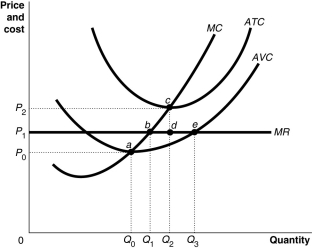 -A perfectly competitive market is in long-run equilibrium. At present there are 100 identical firms each producing 5,000 units of output. The prevailing market price is $20. Assume that each firm faces increasing marginal cost. Now suppose there is a sudden increase in demand for the industry's product which causes the price of the good to rise to $24. Which of the following describes the effect of this increase in demand on a typical firm in the industry?
 (Multiple Choice)
4.8/5 (84)
(84) Figure 12-5  Figure 12-5 shows cost and demand curves facing a typical firm in a constant-cost, perfectly competitive industry.
-Refer to Figure 12-5. What is the amount of the firm's fixed cost of production?
Figure 12-5 shows cost and demand curves facing a typical firm in a constant-cost, perfectly competitive industry.
-Refer to Figure 12-5. What is the amount of the firm's fixed cost of production? (Multiple Choice)
4.8/5 (66)
(66) If the long-run average cost curve is U-shaped, the optimal scale of production from society's viewpoint is
(Multiple Choice)
4.9/5 (72)
(72) A teenaged babysitter is similar to a firm in a perfectly competitive industry in that, for both,
(Multiple Choice)
4.8/5 (90)
(90) 
Filters
- Essay(0)
- Multiple Choice(0)
- Short Answer(0)
- True False(0)
- Matching(0)