



 Chat with AI
Exam 15: Monopoly and Antitrust Policy

Exam 1: Economics: Foundations and Models444 Questions
Exam 2: Trade-Offs, Comparative Advantage, and the Market System498 Questions
Exam 3: Where Prices Come From: the Interaction of Demand and Supply475 Questions
Exam 4: Economic Efficiency, Government Price Setting, and Taxes419 Questions
Exam 5: Externalities, Environmental Policy, and Public Goods266 Questions
Exam 6: Elasticity: the Responsiveness of Demand and Supply295 Questions
Exam 7: The Economics of Health Care334 Questions
Exam 8: Firms, the Stock Market, and Corporate Governance278 Questions
Exam 9: Comparative Advantage and the Gains From International Trade379 Questions
Exam 10: Consumer Choice and Behavioral Economics302 Questions
Exam 11: Technology, Production, and Costs330 Questions
Exam 12: Firms in Perfectly Competitive Markets298 Questions
Exam 13: Monopolistic Competition: the Competitive Model in a More Realistic Setting276 Questions
Exam 14: Oligopoly: Firms in Less Competitive Markets262 Questions
Exam 15: Monopoly and Antitrust Policy271 Questions
Exam 16: Pricing Strategy263 Questions
Exam 17: The Markets for Labor and Other Factors of Production286 Questions
Exam 18: Public Choice, Taxes, and the Distribution of Income258 Questions
Exam 19: GDP: Measuring Total Production and Income266 Questions
Exam 20: Unemployment and Inflation292 Questions
Exam 21: Economic Growth, the Financial System, and Business Cycles257 Questions
Exam 22: Long-Run Economic Growth: Sources and Policies268 Questions
Exam 23: Aggregate Expenditure and Output in the Short Run306 Questions
Exam 24: Aggregate Demand and Aggregate Supply Analysis284 Questions
Exam 25: Money, Banks, and the Federal Reserve System280 Questions
Exam 26: Monetary Policy277 Questions
Exam 27: Fiscal Policy303 Questions
Exam 28: Inflation, Unemployment, and Federal Reserve Policy257 Questions
Exam 29: Macroeconomics in an Open Economy278 Questions
Exam 30: The International Financial System262 Questions
Select questions type


BHP Billiton is a Canadian company that owns mines in Canada that
(Multiple Choice)
4.9/5  (70)
(70) When the government wants to give an exclusive right to one firm to produce a product, it
(Multiple Choice)
4.9/5 (77)
(77) Identify the type of merger in each of the following situations and indicate how the post-merger concentration ratio for the industry is affected.
a. A steel company merges with a coal and iron ore mining company.
b. Staples, a retailer of office supplies, acquires Office Depot, another retailer of office supplies.
c. An oil company merges with pipeline, shipping, and railroad companies as well as refineries and gas stations.
(Essay)
4.8/5 (72)
(72) Figure 15-9  Figure 15-9 shows the demand and cost curves for a monopolist.
-Compared to perfect competition, the consumer surplus in a monopoly
Figure 15-9 shows the demand and cost curves for a monopolist.
-Compared to perfect competition, the consumer surplus in a monopoly (Multiple Choice)
4.9/5 (76)
(76) Figure 15-16  Figure 15-16 shows the market demand and cost curves facing a natural monopoly.
-Refer to Figure 15-16. If the regulators of the natural monopoly allow the owners of the firm to break even on their investment, the firm will produce an output of ________ and charge a price of ________.
Figure 15-16 shows the market demand and cost curves facing a natural monopoly.
-Refer to Figure 15-16. If the regulators of the natural monopoly allow the owners of the firm to break even on their investment, the firm will produce an output of ________ and charge a price of ________. (Multiple Choice)
4.9/5 (66)
(66) Consider an industry that is made up of nine firms each with a market share (percent of sales) as follows: a. Firm A: 30%
B. Firm B: 20%
C. Firms C, D and E: 10% each
D. Firms F, G, H and J: 5% each
What is the value of the Herfindahl-Hirschman Index and how is the industry categorized?
(Multiple Choice)
4.8/5 (76)
(76) The term "trust" in antitrust refers to a board of trustees that has collusive control over different companies.
(True/False)
4.9/5 (77)
(77) If a monopolist's marginal revenue is $25 a unit and its marginal cost is $25, then
(Multiple Choice)
4.9/5 (73)
(73) Many biologic drug manufacturers are pushing for patent protection to be extended to 12 years before generics are allowed to be introduced to the market. This reflects which of the following barriers to entry?
(Multiple Choice)
4.8/5 (85)
(85) Peet's Coffee and Teas produces some flavorful varieties of Peet's brand coffee. Is Peet's a monopoly?
(Multiple Choice)
4.7/5 (75)
(75) Market power in the United States causes a huge loss of economic efficiency.
(True/False)
4.8/5 (85)
(85) Which of following is the best example of a monopoly if we use a broader definition of monopoly?
(Multiple Choice)
4.8/5 (80)
(80) If a monopolist's price is $50 at 63 units of output, and marginal revenue equals marginal cost and average total cost equals $43, then the firm's total profit is
(Multiple Choice)
4.9/5 (79)
(79) What is the difference between a monopoly's marginal revenue curve and a perfect competitor's marginal revenue curve?
(Essay)
4.9/5 (82)
(82) A possible advantage of a horizontal merger for the economy is that
(Multiple Choice)
4.8/5 (86)
(86) If a monopolist's price is $50 at the output where marginal revenue equals marginal cost and average total cost is $43, then the average profit is $7.
(True/False)
4.8/5 (95)
(95) Figure 15-17 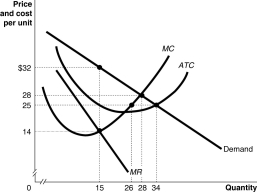 -Consider two industries, industry Q and industry Z. In industry Q there are 10 companies, each with a market share of 10% of total sales. In industry Z, there are eight companies. One company has a 65% market share and each of the other seven firms has a market share of 5%.
a. Calculate the four-firm concentration ratio for each industry.
b. Calculate the Herfindahl-Hirschman Index (HHI) for each industry.
c. What do the values of the two concentration measures imply about the degree of market power in the two industries?
-Consider two industries, industry Q and industry Z. In industry Q there are 10 companies, each with a market share of 10% of total sales. In industry Z, there are eight companies. One company has a 65% market share and each of the other seven firms has a market share of 5%.
a. Calculate the four-firm concentration ratio for each industry.
b. Calculate the Herfindahl-Hirschman Index (HHI) for each industry.
c. What do the values of the two concentration measures imply about the degree of market power in the two industries? (Essay)
4.8/5 (65)
(65) Figure 15-4  Figure 15-4 shows the demand and cost curves for a monopolist.
-Refer to Figure 15-4. What is the price charged for the profit-maximizing output level?
Figure 15-4 shows the demand and cost curves for a monopolist.
-Refer to Figure 15-4. What is the price charged for the profit-maximizing output level? (Multiple Choice)
4.9/5 (79)
(79) 
Filters
- Essay(0)
- Multiple Choice(0)
- Short Answer(0)
- True False(0)
- Matching(0)