



 Chat with AI
Exam 15: Monopoly and Antitrust Policy

Exam 1: Economics: Foundations and Models444 Questions
Exam 2: Trade-Offs, Comparative Advantage, and the Market System498 Questions
Exam 3: Where Prices Come From: the Interaction of Demand and Supply475 Questions
Exam 4: Economic Efficiency, Government Price Setting, and Taxes419 Questions
Exam 5: Externalities, Environmental Policy, and Public Goods266 Questions
Exam 6: Elasticity: the Responsiveness of Demand and Supply295 Questions
Exam 7: The Economics of Health Care334 Questions
Exam 8: Firms, the Stock Market, and Corporate Governance278 Questions
Exam 9: Comparative Advantage and the Gains From International Trade379 Questions
Exam 10: Consumer Choice and Behavioral Economics302 Questions
Exam 11: Technology, Production, and Costs330 Questions
Exam 12: Firms in Perfectly Competitive Markets298 Questions
Exam 13: Monopolistic Competition: the Competitive Model in a More Realistic Setting276 Questions
Exam 14: Oligopoly: Firms in Less Competitive Markets262 Questions
Exam 15: Monopoly and Antitrust Policy271 Questions
Exam 16: Pricing Strategy263 Questions
Exam 17: The Markets for Labor and Other Factors of Production286 Questions
Exam 18: Public Choice, Taxes, and the Distribution of Income258 Questions
Exam 19: GDP: Measuring Total Production and Income266 Questions
Exam 20: Unemployment and Inflation292 Questions
Exam 21: Economic Growth, the Financial System, and Business Cycles257 Questions
Exam 22: Long-Run Economic Growth: Sources and Policies268 Questions
Exam 23: Aggregate Expenditure and Output in the Short Run306 Questions
Exam 24: Aggregate Demand and Aggregate Supply Analysis284 Questions
Exam 25: Money, Banks, and the Federal Reserve System280 Questions
Exam 26: Monetary Policy277 Questions
Exam 27: Fiscal Policy303 Questions
Exam 28: Inflation, Unemployment, and Federal Reserve Policy257 Questions
Exam 29: Macroeconomics in an Open Economy278 Questions
Exam 30: The International Financial System262 Questions
Select questions type


Beginning in 1965, the head of the Antitrust Division of the U.S. Department of Justice began to change antitrust policy. How did antitrust policy change?
(Multiple Choice)
4.8/5  (103)
(103) Table 15-1
 A monopoly producer of foreign language translation software faces a demand and cost structure as given in Table 15-1.
-Refer to Table 15-1. What is the firm's profit-maximizing output and what is the price charged to sell this output?
A monopoly producer of foreign language translation software faces a demand and cost structure as given in Table 15-1.
-Refer to Table 15-1. What is the firm's profit-maximizing output and what is the price charged to sell this output? (Multiple Choice)
4.8/5 (64)
(64) A natural monopoly is most likely to occur in which of the following industries?
(Multiple Choice)
4.7/5 (84)
(84) Figure 15-11  In 2011, Verizon was granted permission to enter the market for cable TV in Upstate New York, ending the virtual monopoly that Time Warner Cable had in most local communities in the region. Figure 15-11 shows the cable television market in Upstate New York.
-Which of the following statements is consistent with the views of Joseph Schumpeter?
In 2011, Verizon was granted permission to enter the market for cable TV in Upstate New York, ending the virtual monopoly that Time Warner Cable had in most local communities in the region. Figure 15-11 shows the cable television market in Upstate New York.
-Which of the following statements is consistent with the views of Joseph Schumpeter? (Multiple Choice)
4.8/5 (71)
(71) Firms do not have market power in which of the following market structures?
(Multiple Choice)
4.8/5 (83)
(83) Figure 15-6  Figure 15-6 shows the cost and demand curves for a monopolist.
-Refer to Figure 15-6. The monopolist earns a profit of
Figure 15-6 shows the cost and demand curves for a monopolist.
-Refer to Figure 15-6. The monopolist earns a profit of (Multiple Choice)
4.8/5 (80)
(80) Figure 15-11 In 2011, Verizon was granted permission to enter the market for cable TV in Upstate New York, ending the virtual monopoly that Time Warner Cable had in most local communities in the region. Figure 15-11 shows the cable television market in Upstate New York.
-A market economy benefits from market power
In 2011, Verizon was granted permission to enter the market for cable TV in Upstate New York, ending the virtual monopoly that Time Warner Cable had in most local communities in the region. Figure 15-11 shows the cable television market in Upstate New York.
-A market economy benefits from market power (Multiple Choice)
4.7/5 (78)
(78) Figure 15-12  Figure 15-12 shows the cost and demand curves for a monopolist.
-Refer to Figure 15-12. If this industry was organized as a perfectly competitive industry, the market output and market price would be
Figure 15-12 shows the cost and demand curves for a monopolist.
-Refer to Figure 15-12. If this industry was organized as a perfectly competitive industry, the market output and market price would be (Multiple Choice)
4.8/5 (79)
(79) If you own the only bookstore in a small town, do you have a monopoly?
(Essay)
4.8/5 (87)
(87) A monopoly is a firm that is the only seller of a good or service that does not have
(Multiple Choice)
4.9/5 (91)
(91) Figure 15-16  Figure 15-16 shows the market demand and cost curves facing a natural monopoly.
-Refer to Figure 15-16. Suppose the government regulates this industry in order to remove the inefficiency implied by the behavior of the profit maximizing owners. If regulators require that the firm produces the economically efficient output level, what is this level and what price will be charged?
Figure 15-16 shows the market demand and cost curves facing a natural monopoly.
-Refer to Figure 15-16. Suppose the government regulates this industry in order to remove the inefficiency implied by the behavior of the profit maximizing owners. If regulators require that the firm produces the economically efficient output level, what is this level and what price will be charged? (Multiple Choice)
4.7/5 (75)
(75) Figure 15-17 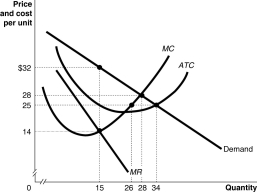 -Refer to Figure 15-17 to answer the following questions.
a. What quantity will this monopoly produce and what price will it charge?
b. Suppose the government decides to regulate this monopoly and imposes a price ceiling of $25. Now what quantity will the monopoly produce and what price will it charge?
c. Will every consumer who is willing to pay the ceiling price of $25 be able to buy the product? Briefly explain.
-Refer to Figure 15-17 to answer the following questions.
a. What quantity will this monopoly produce and what price will it charge?
b. Suppose the government decides to regulate this monopoly and imposes a price ceiling of $25. Now what quantity will the monopoly produce and what price will it charge?
c. Will every consumer who is willing to pay the ceiling price of $25 be able to buy the product? Briefly explain. (Essay)
4.8/5 (76)
(76) Suppose a monopoly is producing its profit-maximizing output level. Now suppose the government imposes a lump-sum tax on the monopoly, independent of its output. As a result, the monopolist will increase the price of its product to cover its higher cost.
(True/False)
4.9/5 (93)
(93) Arnold Harberger was the first economist to estimate the loss of economic efficiency due to market power. Since Harberger's findings were published, other researchers have studied this same issue. How do the results of these researchers compare to Harberger's results?
(Multiple Choice)
4.8/5 (84)
(84) a. What is the defining characteristic of a natural monopoly?
b. Should the government break up a natural monopoly into two or more firms to make the industry more competitive?
c. Suppose the government wants to ensure that some of the benefits of declining average total cost are passed on to consumers. To achieve this goal, it requires that the natural monopoly set its price equal to marginal cost. Is this a feasible goal? Explain.
d. What is an alternative to marginal cost pricing that ensures that consumers reap some of the benefits of declining average total cost?
(Essay)
4.8/5 (81)
(81) Figure 15-16 Figure 15-16 shows the market demand and cost curves facing a natural monopoly.
-Refer to Figure 15-16. Which of the following would be true if government regulators require the natural monopoly to produce at the economically efficient output level?
Figure 15-16 shows the market demand and cost curves facing a natural monopoly.
-Refer to Figure 15-16. Which of the following would be true if government regulators require the natural monopoly to produce at the economically efficient output level? (Multiple Choice)
4.9/5 (83)
(83) Consider the following characteristics: a. a market structure with barriers to entry
B. demand curves that are easily identified
C. firm cannot make zero profits in the long run
D. firm can reap long-run profits.
Which of the characteristics in the list above is shared by an oligopolist and a monopolist?
(Multiple Choice)
4.9/5 (78)
(78) Table 15-1
A monopoly producer of foreign language translation software faces a demand and cost structure as given in Table 15-1.
-Refer to Table 15-1. What is the marginal revenue from the sale of the 12th unit?
A monopoly producer of foreign language translation software faces a demand and cost structure as given in Table 15-1.
-Refer to Table 15-1. What is the marginal revenue from the sale of the 12th unit? (Multiple Choice)
4.8/5 (63)
(63) The 10-year protection period from generic competition for drug manufacturers is a form of
(Multiple Choice)
4.7/5 (83)
(83) 
Filters
- Essay(0)
- Multiple Choice(0)
- Short Answer(0)
- True False(0)
- Matching(0)