



 Chat with AI
Exam 15: Monopoly and Antitrust Policy

Exam 1: Economics: Foundations and Models444 Questions
Exam 2: Trade-Offs, Comparative Advantage, and the Market System498 Questions
Exam 3: Where Prices Come From: the Interaction of Demand and Supply475 Questions
Exam 4: Economic Efficiency, Government Price Setting, and Taxes419 Questions
Exam 5: Externalities, Environmental Policy, and Public Goods266 Questions
Exam 6: Elasticity: the Responsiveness of Demand and Supply295 Questions
Exam 7: The Economics of Health Care334 Questions
Exam 8: Firms, the Stock Market, and Corporate Governance278 Questions
Exam 9: Comparative Advantage and the Gains From International Trade379 Questions
Exam 10: Consumer Choice and Behavioral Economics302 Questions
Exam 11: Technology, Production, and Costs330 Questions
Exam 12: Firms in Perfectly Competitive Markets298 Questions
Exam 13: Monopolistic Competition: the Competitive Model in a More Realistic Setting276 Questions
Exam 14: Oligopoly: Firms in Less Competitive Markets262 Questions
Exam 15: Monopoly and Antitrust Policy271 Questions
Exam 16: Pricing Strategy263 Questions
Exam 17: The Markets for Labor and Other Factors of Production286 Questions
Exam 18: Public Choice, Taxes, and the Distribution of Income258 Questions
Exam 19: GDP: Measuring Total Production and Income266 Questions
Exam 20: Unemployment and Inflation292 Questions
Exam 21: Economic Growth, the Financial System, and Business Cycles257 Questions
Exam 22: Long-Run Economic Growth: Sources and Policies268 Questions
Exam 23: Aggregate Expenditure and Output in the Short Run306 Questions
Exam 24: Aggregate Demand and Aggregate Supply Analysis284 Questions
Exam 25: Money, Banks, and the Federal Reserve System280 Questions
Exam 26: Monetary Policy277 Questions
Exam 27: Fiscal Policy303 Questions
Exam 28: Inflation, Unemployment, and Federal Reserve Policy257 Questions
Exam 29: Macroeconomics in an Open Economy278 Questions
Exam 30: The International Financial System262 Questions
Select questions type


Table 15-4
 Shakti Inc. has been granted a patent for its Arnica toothache balm. Table 15-4 shows the demand and the total cost schedule for the firm.
-Refer to Table 15-4. What is the economically efficient output level?
Shakti Inc. has been granted a patent for its Arnica toothache balm. Table 15-4 shows the demand and the total cost schedule for the firm.
-Refer to Table 15-4. What is the economically efficient output level? (Multiple Choice)
4.7/5  (85)
(85) A vertical merger is one that takes place between two companies producing different goods or services for one specific finished product.
(True/False)
4.8/5 (81)
(81) Suppose a monopoly is producing its profit-maximizing output level. Now suppose the government imposes a lump-sum tax on the monopoly, independent of its output. As a result the monopoly's profit will fall.
(True/False)
4.8/5 (68)
(68) If a monopolist's price is $50 per unit and its marginal cost is $25, then
(Multiple Choice)
4.9/5 (80)
(80) Figure 15-18  -Refer to Figure 15-18 to answer the following questions.
a. What quantity will this monopoly produce and what price will it charge?
b. Suppose the monopoly is regulated. If the regulatory agency wants to achieve economic efficiency, what price should it require the monopoly to charge?
c. To achieve economic efficiency, what quantity will the regulated monopoly produce?
d. Will the regulated monopoly make a profit if it charges the price that will achieve economic efficiency?
e. Suppose the government decides to regulate the monopoly by imposing a price ceiling of $35. What quantity will the monopoly produce and what price will the monopoly charge?
f. With the price ceiling of $35, what profit will the monopoly earn?
-Refer to Figure 15-18 to answer the following questions.
a. What quantity will this monopoly produce and what price will it charge?
b. Suppose the monopoly is regulated. If the regulatory agency wants to achieve economic efficiency, what price should it require the monopoly to charge?
c. To achieve economic efficiency, what quantity will the regulated monopoly produce?
d. Will the regulated monopoly make a profit if it charges the price that will achieve economic efficiency?
e. Suppose the government decides to regulate the monopoly by imposing a price ceiling of $35. What quantity will the monopoly produce and what price will the monopoly charge?
f. With the price ceiling of $35, what profit will the monopoly earn? (Essay)
4.7/5 (89)
(89) The market demand curve facing a monopolist is more elastic than the market demand curve facing a monopolistic competitor.
(True/False)
4.8/5 (76)
(76) Natural monopolies in the United States are generally regulated by
(Multiple Choice)
4.9/5 (85)
(85) If a natural monopoly regulatory commission sets a price where marginal cost is equal to demand,
(Multiple Choice)
4.8/5 (64)
(64) In the short run, even if a monopoly's total revenue does not cover its variable costs, it should continue to produce because ultimately in the long run, the monopoly will start earning profits.
(True/False)
4.8/5 (67)
(67) Figure 15-9 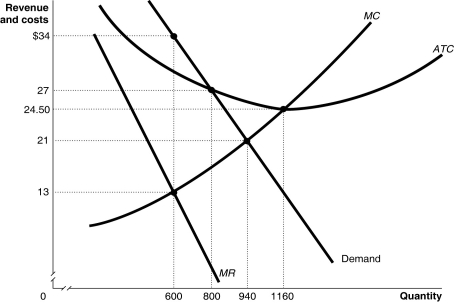 Figure 15-9 shows the demand and cost curves for a monopolist.
-Relative to a perfectly competitive market, a monopoly results in
Figure 15-9 shows the demand and cost curves for a monopolist.
-Relative to a perfectly competitive market, a monopoly results in (Multiple Choice)
4.9/5 (94)
(94) A monopolist's demand curve is the same as the marginal revenue curve for the product.
(True/False)
4.8/5 (82)
(82) Suppose that a perfectly competitive industry becomes a monopoly. What effect will this have on consumer surplus, producer surplus, and deadweight loss?
(Essay)
4.8/5 (79)
(79) The International Nickel Company of Canada is often cited as an example of monopoly. What was the source of the barrier to entry that gave this firm monopoly power?
(Multiple Choice)
4.8/5 (83)
(83) If a monopolist's marginal revenue is $15 per unit and its marginal cost is $25, then to maximize profit the firm should decrease output.
(True/False)
4.9/5 (76)
(76)  -The Clayton Act prohibited
The De Beers diamond mining and marketing company of South Africa became one of the most profitable and longest-lived monopolies in history. Which of the following has always threatened De Beers' control of the diamond market?
(Multiple Choice)
4.7/5 (79)
(79) Figure 15-11  In 2011, Verizon was granted permission to enter the market for cable TV in Upstate New York, ending the virtual monopoly that Time Warner Cable had in most local communities in the region. Figure 15-11 shows the cable television market in Upstate New York.
-Refer to Figure 15-11. Following the entry of Verizon, the subscription price falls from PM to PC. What is the increase in consumer surplus as a result of this change?
In 2011, Verizon was granted permission to enter the market for cable TV in Upstate New York, ending the virtual monopoly that Time Warner Cable had in most local communities in the region. Figure 15-11 shows the cable television market in Upstate New York.
-Refer to Figure 15-11. Following the entry of Verizon, the subscription price falls from PM to PC. What is the increase in consumer surplus as a result of this change? (Multiple Choice)
4.7/5 (68)
(68) Figure 15-4  Figure 15-4 shows the demand and cost curves for a monopolist.
-Refer to Figure 15-4. What is the amount of the monopoly's total cost of production?
Figure 15-4 shows the demand and cost curves for a monopolist.
-Refer to Figure 15-4. What is the amount of the monopoly's total cost of production? (Multiple Choice)
4.7/5 (88)
(88) 
Filters
- Essay(0)
- Multiple Choice(0)
- Short Answer(0)
- True False(0)
- Matching(0)