



 Chat with AI
Exam 22: S: Corporations

Exam 1: An Introduction to Taxation and Understanding the Federal Tax Law159 Questions
Exam 2: Working With the Tax Law85 Questions
Exam 3: Computing the Tax150 Questions
Exam 4: Gross Income: Concepts and Inclusions125 Questions
Exam 5: Gross Income: Exclusions116 Questions
Exam 6: Deductions and Losses: in General153 Questions
Exam 7: Deductions and Losses: Certain Business Expenses and Losses97 Questions
Exam 8: Depreciation, Cost Recovery, Amortization, and Depletion116 Questions
Exam 9: Deductions: Employee and Self-Employed-Related Expenses166 Questions
Exam 10: Deductions and Losses: Certain Itemized Deductions106 Questions
Exam 11: Investor Losses103 Questions
Exam 12: Tax Credits and Payments109 Questions
Exam 13: Property Transactions: Determination of Gain or Loss, Basis Considerations, and Nontaxable Exchanges-Part 1200 Questions
Exam 13: Property Transactions: Determination of Gain or Loss, Basis Considerations, and Nontaxable Exchanges-Part 292 Questions
Exam 14: Property Transactions: Capital Gains and Losses, 1231, Recapture Provisions144 Questions
Exam 15: Alternative Minimum Tax125 Questions
Exam 16: Accounting Periods and Methods87 Questions
Exam 17: Corporations: Introduction and Operating Rules109 Questions
Exam 18: Corporations: Organization and Capital Structure93 Questions
Exam 19: Corporations: Distributions Not in Complete Liquidation145 Questions
Exam 20: Corporations: Distributions in Complete Liquidation and an Overview of Reorganizations70 Questions
Exam 21: Partnerships159 Questions
Exam 22: S: Corporations159 Questions
Exam 23: Exempt Entities151 Questions
Exam 24: Multistate Corporate Taxation145 Questions
Exam 25: Taxation of International Transactions148 Questions
Exam 26: Tax Practice and Ethics147 Questions
Exam 28: Income Taxation of Trusts and Estates145 Questions
Select questions type


Claude Bergeron sold 1,000 shares of Ditta, Inc., an S corporation, for $12,000.He had owned the stock for three years and had a stock basis of $111,000 in the shares.Claude is single, and he is the original owner of the § 1244 stock shares.Calculate the appropriate tax treatment.
(Multiple Choice)
4.7/5  (83)
(83) Tax-exempt income is not separately stated on Schedule K of Form 1120S.
(True/False)
4.9/5 (77)
(77) To make a valid S election, the entity must file a properly completed Form ____________________.
(Short Answer)
5.0/5 (85)
(85) Individuals Adam and Bonnie form an S corporation, with Adam contributing cash of $100,000 for a 50% interest and Bonnie contributing appreciated ordinary income property with an adjusted basis of $20,000 and a fair market value of $100,000.

(Essay)
4.9/5 (92)
(92) An S corporation shareholder's basis includes his or her direct investments plus a ratable share of any corporate liabilities.
(True/False)
4.9/5 (71)
(71) The § 1374 tax is a corporate-level tax on any built-in gain recognized in 2012 when an S corporation disposes of an asset in a taxable disposition within 10 tax years after the date on which the S election took effect.
(True/False)
4.8/5 (83)
(83) You are given the following facts about a 40% owner of an S corporation, and you are asked to prepare her ending stock basis. 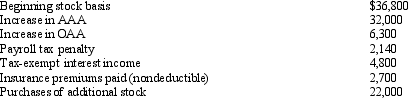
(Multiple Choice)
4.8/5 (65)
(65) Which statement is incorrect with respect to filing an S election?
(Multiple Choice)
4.9/5 (81)
(81) An S corporation's separately stated items are identical to those separately stated by partnerships.
(True/False)
4.9/5 (75)
(75) Mock Corporation converts to S corporation status in 2012.Mock used the LIFO inventory method in 2011 and had a LIFO inventory of $435,000 (FIFO value of $550,000) on the date of the S election.How much tax must be added to the 2011 corporate tax liability, assuming that Mock is subject to a 35% tax rate.
(Multiple Choice)
4.9/5 (76)
(76) Any excess of S corporation losses or deductions over the shareholder's combined stock and debt basis is suspended until there is a subsequent stock or debt basis.
(True/False)
4.9/5 (78)
(78) Shareholders may deduct losses in excess of their basis in S corporation stock when a shareholder holds a loan basis of zero.
(True/False)
4.9/5 (91)
(91) Net operating losses incurred before an S election do not flow through to the shareholders once the election is in effect.
(True/False)
4.9/5 (89)
(89) Milke, Inc., an S corporation, has gross receipts of $190,000 and gross income of $170,000.Milke has AEP of $22,000 and ordinary income of $29,000.The company reports passive investment income of $100,000, with $40,000 of expenses directly related to the production of passive investment income.Calculate Milke's excess net passive income and any passive investment income penalty tax.
(Essay)
4.7/5 (82)
(82) As a general rule, S corporation treatment is not advantageous when the individual tax rate far exceeds the applicable corporate tax rate.
(True/False)
4.8/5 (72)
(72) Outline the requirements that an entity must meet to elect S corporation status.
(Essay)
4.9/5 (68)
(68) 
Filters
- Essay(0)
- Multiple Choice(0)
- Short Answer(0)
- True False(0)
- Matching(0)