



 Chat with AI
Exam 12: Solutions and Their Properties

Exam 1: Chemical Tools: Experimentation and Measurement154 Questions
Exam 2: Atoms, molecules, and Ions275 Questions
Exam 3: Mass Relationships in Chemical Reactions159 Questions
Exam 4: Reactions in Aqueous Solutions211 Questions
Exam 5: Periodicity and the Electronic Structure of Atoms168 Questions
Exam 6: Ionic Compounds: Periodic Trends and Bonding138 Questions
Exam 7: Covalent Bonding and Electron-Dot Structures92 Questions
Exam 8: Covalent Compounds: Bonding Theories and Molecular Structure205 Questions
Exam 9: Thermochemistry: Chemical Energy170 Questions
Exam 10: Gases: Their Properties and Behavior188 Questions
Exam 11: Liquids, solids, and Phase Changes141 Questions
Exam 12: Solutions and Their Properties198 Questions
Exam 13: Chemical Kinetics190 Questions
Exam 14: Chemical Equilibrium171 Questions
Exam 15: Aqueous Equilibria: Acids and Bases231 Questions
Exam 16: Applications of Aqueous Equilibria201 Questions
Exam 17: Thermodynamics: Entropy, free Energy, and Equilibrium150 Questions
Exam 18: Electrochemistry212 Questions
Exam 19: Nuclear Chemistry176 Questions
Exam 20: Transition Elements and Coordination Chemistry190 Questions
Exam 21: Metals and Solid-State Materials154 Questions
Exam 22: The Main-Group Elements294 Questions
Exam 23: Connections to Organic and Biological Chemistry290 Questions
Select questions type


Amphetamines in urine can be confirmed by mass spectroscopy at a concentration of 500 ng/mL.Assuming a urine density of 1.025 g/mL,what is this concentration in parts per million?
(Short Answer)
4.9/5  (85)
(85) At a given temperature the vapor pressures of benzene and toluene are 183 mm Hg and 59.2 mm Hg,respectively.Calculate the mole fraction of benzene in the vapor phase over a solution of benzene and toluene with Xbenzene = 0.600.
(Multiple Choice)
4.8/5 (88)
(88) Arrows in the energy diagram below represent enthalpy changes occurring in the endothermic formation of a solution:
ΔHsoln = enthalpy of solution
ΔHsolute-solute = enthalpy change involving solute-solute interactions
ΔHsolute-solvent = enthalpy change involving solute-solvent interactions
ΔHsolvent-solvent = enthalpy change involving solvent-solvent interactions 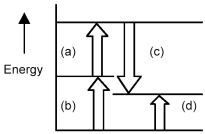 -Which arrows represent ΔHsolute-solute and ΔHsolvent-solvent?
 (Multiple Choice)
4.8/5 (82)
(82) 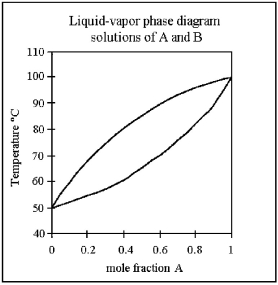 -What is the approximate boiling temperature of the liquid formed from the condensation of the vapor above a boiling solution that is 0.70 XA and 0.30 XB?
 (Multiple Choice)
4.8/5 (89)
(89) If dissociation of MgCl2 in water were 100%,the van't Hoff factor would be ________;however,for real solutions the van't Hoff factor for MgCl2 is ________ (greater than,less than)this value.
(Short Answer)
4.9/5 (73)
(73) The vapor pressure of water at 25°C is 23.8 mm Hg.The vapor pressure lowering,ΔP,of an aqueous solution containing 0.500 mole fraction NaCl is ________ (equal to,greater than,less than)11.9 mm Hg?
(Short Answer)
4.9/5 (87)
(87) In the process of dissolving ionic compounds,the cations and anions are separated from the crystal lattice and surrounded by an ordered shell of solvent molecules.If the solvent is water,the dissolved ions are said to be
(Multiple Choice)
4.8/5 (86)
(86) A phase diagram of temperature versus composition for a mixture of the two volatile liquids octane (bp =  and decane (bp = 126°C)is shown.
 -Assume that you start with a mixture containing 0.80 mol of decane and 0.20 mol of octane,at what approximate temperature will the mixture begin to boil?
and decane (bp = 126°C)is shown.
-Assume that you start with a mixture containing 0.80 mol of decane and 0.20 mol of octane,at what approximate temperature will the mixture begin to boil? (Multiple Choice)
4.8/5 (68)
(68) Molarity is defined as ________,whereas molality is defined as ________.
(Essay)
4.9/5 (90)
(90) What volume of 3.00 M CH3OH solution is needed to provide 0.500 mol of CH3OH?
(Multiple Choice)
4.8/5 (74)
(74) Calculate the freezing point of a solution of 30.0 g methyl salicylate,C7H6O2,dissolved in 800.g of benzene,C6H6.Kf for benzene is 5.10°C/m and the freezing point is 5.50°C for benzene.
(Multiple Choice)
4.9/5 (78)
(78) When an ionic solute dissolves in water to form an unsaturated solution,the free energy change (ΔGsoln)is
(Multiple Choice)
4.7/5 (73)
(73) When two similar liquids mix to form a solution,the entropy of solution (ΔSsoln)is expected to be
(Multiple Choice)
4.7/5 (69)
(69) A 0.020 m aqueous solution containing which solute will have the lowest freezing point?
(Multiple Choice)
4.8/5 (85)
(85) A 3.17 m solution of CaCl2 in water has a density of 1.24 g/mL.What is the molarity?
(Multiple Choice)
4.9/5 (81)
(81) Arrows in the energy diagram below represent enthalpy changes occurring in the exothermic formation of a solution:
ΔHsoln = enthalpy of solution
ΔHsolute-solute = enthalpy change involving solute-solute interactions
ΔHsolute-solvent = enthalpy change involving solute-solvent interactions
ΔHsolvent-solvent = enthalpy change involving solvent-solvent interactions 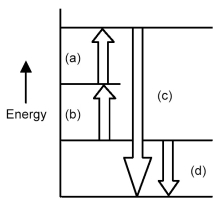 -Which arrows represent ΔHsolute-solute and ΔHsolvent-solvent?
 (Multiple Choice)
4.8/5 (84)
(84) Which of the following solutions will have the lowest freezing point?
(Multiple Choice)
4.7/5 (82)
(82) A solution is made by dissolving 19.5 g of sucrose,C12H22O11,in 117 g of water,producing a solution with a volume of 125 mL at 20°C.What is the expected osmotic pressure at 20°C?
(Multiple Choice)
4.7/5 (93)
(93) How many grams of KBr are required to make 250.mL of a 0.115 M KBr solution?
(Multiple Choice)
4.9/5 (85)
(85) 
Filters
- Essay(0)
- Multiple Choice(0)
- Short Answer(0)
- True False(0)
- Matching(0)