



 Chat with AI
Exam 23: Catalysis

Exam 1: Remembering General Chemistry: Electronic Structure and Bonding81 Questions
Exam 2: Acids and Bases: Central to Understanding Organic Chemistry37 Questions
Exam 3: An Introduction to Organic Compounds123 Questions
Exam 4: Isomers: the Arrangement of Atoms in Space111 Questions
Exam 5: Alkenes Thermodynamics and Kinetics76 Questions
Exam 6: Reactions of Alkenes93 Questions
Exam 7: Reactions of Alkynes Introduction to Multistep Synthesis119 Questions
Exam 8: Electron Delocalization, Resonance, and Aromaticity More About Molecular Orbital Theory166 Questions
Exam 9: Substitution Reactions of Alkyl Halides118 Questions
Exam 10: Elimination Reactions of Alkyl Halides Competition Between Substitution and Elimination94 Questions
Exam 11: Reactions of Alcohols, Ethers, Epoxides, and Sulfur-Containing Compounds100 Questions
Exam 12: Organometallic Compounds57 Questions
Exam 13: Reactions of Alkanes, Radicals130 Questions
Exam 14: Mass Spectrometry, Infrared Spectroscopy, and Uvvis Spectroscopy127 Questions
Exam 15: Nmr Spectroscopy110 Questions
Exam 16: Reactions of Carboxylic Acids and Carboxylic Acid Derivatives128 Questions
Exam 17: Reactions of Aldehydes and Ketones116 Questions
Exam 18: Reactions at the Alpha Carbon of Carbonyl Compounds113 Questions
Exam 19: Reactions of Benzene and Substituted Benzenes155 Questions
Exam 20: More About Amines Heterocylic Compounds115 Questions
Exam 21: Carbohydrates100 Questions
Exam 22: Amino Acids, Peptides, and Proteins105 Questions
Exam 23: Catalysis85 Questions
Exam 24: The Organic Mechanisms of the Coenzymes92 Questions
Exam 25: The Chemistry of Metabolism94 Questions
Exam 26: Nucleosides, Nucleotides, and Nucleic Acids85 Questions
Exam 27: Synthetic Polymers106 Questions
Exam 28: Pericyclic Reactions92 Questions
Select questions type


Describe the reaction coordinate diagram for a specific-acid-catalyzed reaction.
(Multiple Choice)
4.8/5  (73)
(73) Which of the following residues acts as a general-acid catalyst in aldolase but as a general-base catalyst in chymotrypsin?
(Multiple Choice)
4.8/5 (63)
(63) The reaction below occurs by a general-acid catalyzed mechanism. Use curved arrows to illustrate the ring-forming step of the mechanism. 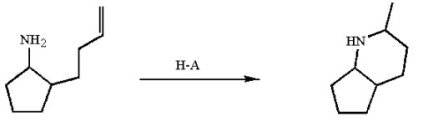
(Essay)
4.9/5 (70)
(70) ________ molarity is the concentration of the reactant that would be required to give the corresponding intermolecular reaction the same rate as its intramolecular counterpart.
(Multiple Choice)
4.8/5 (84)
(84) List four common types of catalysts used in organic reactions and give one example of each.
(Essay)
4.8/5 (80)
(80) Explain the large difference in the relative rates of the following hydrolysis reactions: 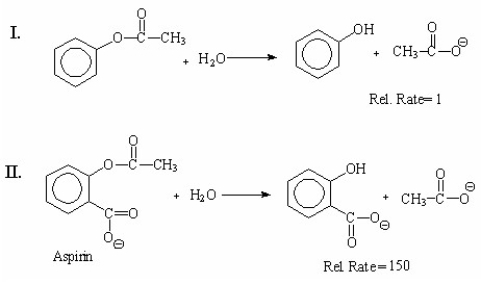
(Essay)
4.8/5 (75)
(75) Which of the following are affected when an intramolecular catalyst is used?
(Multiple Choice)
4.8/5 (80)
(80) Explain the phenomenon known as molecular recognition. Give an example.
(Essay)
4.8/5 (59)
(59) Identify the factors that contribute to the catalytic ability of enzymes.
(Multiple Choice)
4.9/5 (89)
(89) Which of the following statements is not true about catalysts?
(Multiple Choice)
4.9/5 (85)
(85) 
Describe the acid-catalyzed second slow step in the hydrolysis of an ester.
(Multiple Choice)
4.8/5 (58)
(58) Propose a step-by-step mechanism for the general-acid catalyzed reaction shown below: 
(Essay)
4.9/5 (83)
(83) Which of the following statements account for the remarkable catalytic ability of enzymes?
(Multiple Choice)
4.9/5 (62)
(62) In what kind of acid catalysis is the proton transferred completely to the reactant before a subsequent slow step?
(Short Answer)
4.9/5 (82)
(82) 
Filters
- Essay(0)
- Multiple Choice(0)
- Short Answer(0)
- True False(0)
- Matching(0)