



 Chat with AI
Exam 14: Mass Spectrometry, Infrared Spectroscopy, and Uvvis Spectroscopy

Exam 1: Remembering General Chemistry: Electronic Structure and Bonding81 Questions
Exam 2: Acids and Bases: Central to Understanding Organic Chemistry37 Questions
Exam 3: An Introduction to Organic Compounds123 Questions
Exam 4: Isomers: the Arrangement of Atoms in Space111 Questions
Exam 5: Alkenes Thermodynamics and Kinetics76 Questions
Exam 6: Reactions of Alkenes93 Questions
Exam 7: Reactions of Alkynes Introduction to Multistep Synthesis119 Questions
Exam 8: Electron Delocalization, Resonance, and Aromaticity More About Molecular Orbital Theory166 Questions
Exam 9: Substitution Reactions of Alkyl Halides118 Questions
Exam 10: Elimination Reactions of Alkyl Halides Competition Between Substitution and Elimination94 Questions
Exam 11: Reactions of Alcohols, Ethers, Epoxides, and Sulfur-Containing Compounds100 Questions
Exam 12: Organometallic Compounds57 Questions
Exam 13: Reactions of Alkanes, Radicals130 Questions
Exam 14: Mass Spectrometry, Infrared Spectroscopy, and Uvvis Spectroscopy127 Questions
Exam 15: Nmr Spectroscopy110 Questions
Exam 16: Reactions of Carboxylic Acids and Carboxylic Acid Derivatives128 Questions
Exam 17: Reactions of Aldehydes and Ketones116 Questions
Exam 18: Reactions at the Alpha Carbon of Carbonyl Compounds113 Questions
Exam 19: Reactions of Benzene and Substituted Benzenes155 Questions
Exam 20: More About Amines Heterocylic Compounds115 Questions
Exam 21: Carbohydrates100 Questions
Exam 22: Amino Acids, Peptides, and Proteins105 Questions
Exam 23: Catalysis85 Questions
Exam 24: The Organic Mechanisms of the Coenzymes92 Questions
Exam 25: The Chemistry of Metabolism94 Questions
Exam 26: Nucleosides, Nucleotides, and Nucleic Acids85 Questions
Exam 27: Synthetic Polymers106 Questions
Exam 28: Pericyclic Reactions92 Questions
Select questions type


Which molecule below has two significant bands (medium and broad)in the 3300 - 3500 cm-1 range of its IR spectrum?
(Multiple Choice)
4.8/5  (78)
(78) How can UV spectroscopy be used to estimate the nucleotide composition of DNA?
(Essay)
4.8/5 (68)
(68) Which of the following carbon-hydrogen bonds exhibits the lowest wavenumber for a C-H stretch in infrared spectroscopy? 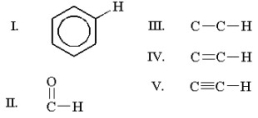
(Multiple Choice)
5.0/5 (71)
(71) How could IR spectroscopy be used to distinguish between the following pair of compounds?
CH3OCH2CH3 and CH3CH2CH2OH
(Short Answer)
4.9/5 (75)
(75) Which molecule below has a significant band in the IR at 3400 cm-1 (strong and broad)?
(Multiple Choice)
4.8/5 (78)
(78) Which of the following statements best explains how a hydrocarbon can show an M+2 peak in mass spectrometry?
(Multiple Choice)
4.9/5 (78)
(78) Give the m/z ratio of the molecular ion in the mass spectrum of 1-butanol.
(Short Answer)
4.9/5 (88)
(88) Describe the molecular ion region in the mass spectrum of CH3CH2Br.
(Essay)
5.0/5 (101)
(101) Does the position of the stretch of the oxygen-hydrogen bond in alcohols depend on the concentration of the alcohol?
(Essay)
4.9/5 (74)
(74) In the UV-visible spectrum of (E)-1,3,5-hexatriene, the lowest energy absorption corresponds to ________.
(Multiple Choice)
4.8/5 (86)
(86) Which compound's carbonyl stretch occurs at the lowest wavenumber?
(Multiple Choice)
4.9/5 (78)
(78) Which of the following characterizes the unusually intense peak of alkyl chlorides in MS spectrometry?
(Multiple Choice)
4.9/5 (68)
(68) Give the m/z ratio that corresponds to the molecular ion in the mass spectrum of ethylpropylamine.
(Short Answer)
4.8/5 (91)
(91) Which of the following statements is true about a molecular ion?
(Multiple Choice)
4.8/5 (73)
(73) A compound shows a molecular ion peak at m/z 167. The relative intensities of the M and M+1 peaks are 50.0 and 4.4 respectively. How many carbons are in each molecule of the compound?
(Short Answer)
4.9/5 (76)
(76) A mixture of two compounds give absorption bands at 1470, 1595, 1700, 2720, and 2740 cm-1. What compounds are present?
(Multiple Choice)
4.8/5 (88)
(88) Which of the following compounds absorbs the longest wavelength of UV-visible light?
(Multiple Choice)
4.9/5 (78)
(78) An increase in conjugation is correlated with ________ in the energy of the LUMO, ________ in the energy of the HOMO, and ________ in lmax.
(Multiple Choice)
5.0/5 (95)
(95) Which of the following species has a characteristic broad absorption at 3200-3500 cm-1 in its IR spectrum?
(Multiple Choice)
4.8/5 (94)
(94) 
Filters
- Essay(0)
- Multiple Choice(0)
- Short Answer(0)
- True False(0)
- Matching(0)