



 Chat with AI
Exam 9: Substitution Reactions of Alkyl Halides

Exam 1: Remembering General Chemistry: Electronic Structure and Bonding81 Questions
Exam 2: Acids and Bases: Central to Understanding Organic Chemistry37 Questions
Exam 3: An Introduction to Organic Compounds123 Questions
Exam 4: Isomers: the Arrangement of Atoms in Space111 Questions
Exam 5: Alkenes Thermodynamics and Kinetics76 Questions
Exam 6: Reactions of Alkenes93 Questions
Exam 7: Reactions of Alkynes Introduction to Multistep Synthesis119 Questions
Exam 8: Electron Delocalization, Resonance, and Aromaticity More About Molecular Orbital Theory166 Questions
Exam 9: Substitution Reactions of Alkyl Halides118 Questions
Exam 10: Elimination Reactions of Alkyl Halides Competition Between Substitution and Elimination94 Questions
Exam 11: Reactions of Alcohols, Ethers, Epoxides, and Sulfur-Containing Compounds100 Questions
Exam 12: Organometallic Compounds57 Questions
Exam 13: Reactions of Alkanes, Radicals130 Questions
Exam 14: Mass Spectrometry, Infrared Spectroscopy, and Uvvis Spectroscopy127 Questions
Exam 15: Nmr Spectroscopy110 Questions
Exam 16: Reactions of Carboxylic Acids and Carboxylic Acid Derivatives128 Questions
Exam 17: Reactions of Aldehydes and Ketones116 Questions
Exam 18: Reactions at the Alpha Carbon of Carbonyl Compounds113 Questions
Exam 19: Reactions of Benzene and Substituted Benzenes155 Questions
Exam 20: More About Amines Heterocylic Compounds115 Questions
Exam 21: Carbohydrates100 Questions
Exam 22: Amino Acids, Peptides, and Proteins105 Questions
Exam 23: Catalysis85 Questions
Exam 24: The Organic Mechanisms of the Coenzymes92 Questions
Exam 25: The Chemistry of Metabolism94 Questions
Exam 26: Nucleosides, Nucleotides, and Nucleic Acids85 Questions
Exam 27: Synthetic Polymers106 Questions
Exam 28: Pericyclic Reactions92 Questions
Select questions type


Idenitfy the halide(s)that react in a SN1 reaction.
A)benzyl bromide
B)bromobenzene
C)1-bromo-1-butene
D)1-bromo-2-butene
E)2-bromo-2-phenylpropane
(Short Answer)
5.0/5  (80)
(80) Provide the structure of the major organic product of the following reaction. 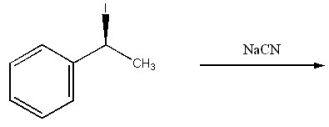
(Essay)
4.8/5 (77)
(77) Which of the following best explains why SN1 reactions involving a neutral reactant are faster in polar solvents?
(Multiple Choice)
4.7/5 (89)
(89) Which of the following alkyl bromides undergoes solvolysis in methanol without rearrangement?
(Multiple Choice)
4.9/5 (65)
(65) Assuming no other changes, what is the effect of doubling only the concentration of the alkyl halide in the above SN2 reaction?
(Multiple Choice)
4.9/5 (80)
(80) The specific rotation of optically pure (R)-C6H5CHOHCH3 is -42.3°. An optically pure sample of (R)-C6H5CHClCH3 was converted into the corresponding alcohol via an SN2 reaction. What is the specific rotation of the product?
(Multiple Choice)
4.9/5 (71)
(71) Which of the following correctly describes the relative nucleophilicities of methoxide and tert-butoxide?
(Multiple Choice)
4.9/5 (76)
(76) Which of the following is not normally considered to be a nucleophile?
(Multiple Choice)
4.8/5 (74)
(74) Rank the species below in order of increasing nucleophilicity in protic solvents:
CH3CO2- , CH3S- , HO- , H2O.
(Essay)
4.8/5 (65)
(65) Which of the following best describes the carbon-chlorine bond of an alkyl chloride?
(Multiple Choice)
4.9/5 (87)
(87) Provide the structure of the major organic product of the following reaction. 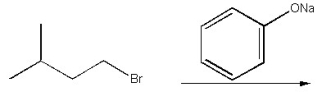
(Essay)
4.7/5 (75)
(75) Which of the following alkyl halides gives the slowest SN2 reaction?
(Multiple Choice)
4.9/5 (73)
(73) Provide the structure of the major organic product(s)of the following reaction. 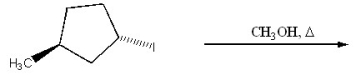
(Essay)
4.7/5 (82)
(82) 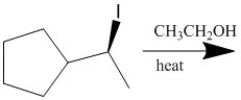
A 1,2-methyl shift occurs when which of the following iodides is heated in ethanol?
(Multiple Choice)
4.9/5 (68)
(68) When nucleophile and leaving group are contained in the same molecule, is intermolecular or intramolecular reaction favored? Explain.
(Essay)
4.8/5 (76)
(76) 
Filters
- Essay(0)
- Multiple Choice(0)
- Short Answer(0)
- True False(0)
- Matching(0)