



 Chat with AI
Exam 9: Substitution Reactions of Alkyl Halides

Exam 1: Remembering General Chemistry: Electronic Structure and Bonding81 Questions
Exam 2: Acids and Bases: Central to Understanding Organic Chemistry37 Questions
Exam 3: An Introduction to Organic Compounds123 Questions
Exam 4: Isomers: the Arrangement of Atoms in Space111 Questions
Exam 5: Alkenes Thermodynamics and Kinetics76 Questions
Exam 6: Reactions of Alkenes93 Questions
Exam 7: Reactions of Alkynes Introduction to Multistep Synthesis119 Questions
Exam 8: Electron Delocalization, Resonance, and Aromaticity More About Molecular Orbital Theory166 Questions
Exam 9: Substitution Reactions of Alkyl Halides118 Questions
Exam 10: Elimination Reactions of Alkyl Halides Competition Between Substitution and Elimination94 Questions
Exam 11: Reactions of Alcohols, Ethers, Epoxides, and Sulfur-Containing Compounds100 Questions
Exam 12: Organometallic Compounds57 Questions
Exam 13: Reactions of Alkanes, Radicals130 Questions
Exam 14: Mass Spectrometry, Infrared Spectroscopy, and Uvvis Spectroscopy127 Questions
Exam 15: Nmr Spectroscopy110 Questions
Exam 16: Reactions of Carboxylic Acids and Carboxylic Acid Derivatives128 Questions
Exam 17: Reactions of Aldehydes and Ketones116 Questions
Exam 18: Reactions at the Alpha Carbon of Carbonyl Compounds113 Questions
Exam 19: Reactions of Benzene and Substituted Benzenes155 Questions
Exam 20: More About Amines Heterocylic Compounds115 Questions
Exam 21: Carbohydrates100 Questions
Exam 22: Amino Acids, Peptides, and Proteins105 Questions
Exam 23: Catalysis85 Questions
Exam 24: The Organic Mechanisms of the Coenzymes92 Questions
Exam 25: The Chemistry of Metabolism94 Questions
Exam 26: Nucleosides, Nucleotides, and Nucleic Acids85 Questions
Exam 27: Synthetic Polymers106 Questions
Exam 28: Pericyclic Reactions92 Questions
Select questions type


List the following compounds in order of increasing reactivity in an SN1 reaction.
CH3Br, CH3CH2CH2I, (CH3)3CI, CH3CHBrCH3, CH3CHICH3
(Essay)
4.9/5  (89)
(89) Rank the species below in order of leaving group capabilities in SN2 reactions (worst leaving group to best):
CH3O-, H2O, C6H5SO3-, H2N-.
(Essay)
4.9/5 (79)
(79) 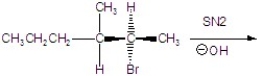
Which of the following does not provide evidence that there are two different mechanisms for nucleophilic substitution?
(Multiple Choice)
4.7/5 (69)
(69) Which of the following alkyl bromides is likely to undergo rearrangement by a 1, 2-methyl shift?
(Multiple Choice)
4.8/5 (70)
(70) 
Which of the following statements is generally true for SN1 reactions?
(Multiple Choice)
4.8/5 (77)
(77) Provide a detailed, stepwise mechanism for the reaction below.
(CH3)2CHCH2CH2CH2I + CN- → (CH3)2CHCH2CH2CH2CN + I-
(Essay)
4.9/5 (77)
(77) A student attempted to prepare 1-chlorobutane by treating 1-butanol with NaCl in acetone. Was the student successful? Explain.
(Essay)
4.9/5 (83)
(83) 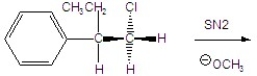
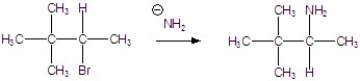
Which of the following factors has no effect on the rate of SN1 reactions?
(Multiple Choice)
4.8/5 (75)
(75) Which of the following correctly describes SAM, a biological methylating agent?
(Multiple Choice)
5.0/5 (80)
(80) The hydrolysis of tert-butyl chloride proceeds more rapidly in a solvent mixture which is 70% water/30% acetone than in one which is 30% water/70% acetone. Why?
(Multiple Choice)
4.9/5 (77)
(77) Give the name(s)of the product(s)of the SN1 reaction of 3-bromo-2,2-dimethylbutane with water.
(Multiple Choice)
4.8/5 (66)
(66) 
Filters
- Essay(0)
- Multiple Choice(0)
- Short Answer(0)
- True False(0)
- Matching(0)