



 Chat with AI
Exam 10: The Order Entrysales Oes Process

Exam 1: Introduction to Accounting Information Systems115 Questions
Exam 2: Enterprise Systems140 Questions
Exam 3: Electronic Business E-Business Systems113 Questions
Exam 4: Documenting Information Systems108 Questions
Exam 5: Database Management Systems180 Questions
Exam 6: Relational Databases and Sql93 Questions
Exam 7: Controlling Information Systems: Introduction to Enterprise Risk Management and Internal Control161 Questions
Exam 8: Controlling Information Systems: Introduction to Pervasive Controls157 Questions
Exam 9: Controlling Information Systems: Business Process and Application Controls126 Questions
Exam 10: The Order Entrysales Oes Process128 Questions
Exam 11: The Billingaccounts Receivable Cash Receipts Barcr Process134 Questions
Exam 12: The Purchasing Process131 Questions
Exam 13: Accounts Payablecash Disbursements Apcd Process104 Questions
Exam 14: The Human Resources Process HR Management and Payroll Processes118 Questions
Exam 15: Integrated Production Processes IPP106 Questions
Exam 16: General Ledger and Business Reporting Glbr Process78 Questions
Exam 17: Acquiring and Implementing Accounting Information Systems206 Questions
Select questions type


___________________________________ contains a record of each item that is stocked in the warehouse or regularly ordered from a vendor.
(Short Answer)
4.8/5  (72)
(72) For a typical OE/S process to check a customer's credit, all of the following data stores likely would be consulted except the:
(Multiple Choice)
4.9/5 (80)
(80) ______________________________ may reduce input errors by populating certain fields and rejecting incorrectly formatted fields, thereby preventing the customer service representative from omitting data or entering data with errors.
(Short Answer)
4.9/5 (79)
(79) If a customer refuses to accept a back order, then the sales event is terminated and the sales order is accepted.
(True/False)
5.0/5 (73)
(73) Below is the narrative of the "Execute shipping notice" portion of the order entry/sales process.Narrative Description
This narrative describes activities that normally take place in a shipping department.Process 3.1 receives two data flows, namely, the completed picking ticket and data retrieved from the sales order master data.The shipping clerk matches the quantity of the goods, the quantity on the picking ticket, and the quantity stored in the sales order data.If the details agree, the matched sales order is forwarded to process 3.2.If the details of the data flows do not agree, process 3.1 rejects the order and initiates procedures for resolving any discrepancies.When process 3.2 receives a matched sales order from process 3.1, it produces and disseminates notices of the shipment and updates the sales order and inventory master data.The sales order master data is updated to reflect that the goods have been picked, packed, and shipped.The inventory master data is updated to change the quantity allocated for the sales order to an actual shipment, thus reducing the quantity of inventory on hand.We generally expect the dissemination of notices will include the following data flows:
-Shipping notifies billing to begin the invoicing process.-A bill of lading, which is a contract between the shipper and the carrier in which the carrier agrees to transport the goods to the shipper's customer.The carrier's signature on the bill of lading, or the customer's signature on some other form of receipt, substantiates the shipment.-A packing slip is inserted into the package (a copy may be attached to the outside of a package) and identifies the customer, the shipment destination, and the contents of the package.-General ledger inventory sales update to notify the general ledger process that inventory has been sold and the cost of goods sold has increased.Required:
From the DFD in TB Figure 10.6 and the narrative description above, explode bubble 3.0 into a lower-level diagram showing the details of that process. 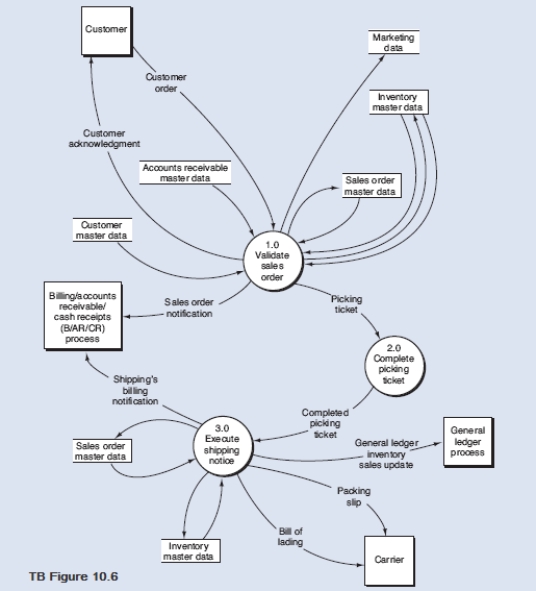
(Essay)
4.8/5 (84)
(84) ___________ applications in organizations are usually viewed as being focused on either operational or analytical applications.
(Multiple Choice)
4.7/5 (80)
(80) The flow of information from OE/S to marketing managers is an example of horizontal information flows.
(True/False)
4.8/5 (80)
(80) A bill of lading is the document representing the contract between the shipping company and the common carrier.
(True/False)
4.8/5 (72)
(72) A data flow or event that causes a process to begin is called a:
(Multiple Choice)
4.8/5 (77)
(77) In the OE/S process , the one input that creates the six outputs of general ledger inventory sales update, sales order notification, bill of lading, completed packing slip, shipping's billing notification, and customer acknowledgement is the ______________________________.
(Short Answer)
4.9/5 (81)
(81) If a customer refuses to accept a back order, then the sales order is terminated and is shown by a ____________________ data flow.
(Short Answer)
4.9/5 (82)
(82) When the sales-related data are captured in the sales order department and then the information flows to the managers housed in the marketing department, it is an example of a:
(Multiple Choice)
5.0/5 (86)
(86) In constructing a control matrix for a OE/S process, the principal data input(s) to the information system likely would be:
(Multiple Choice)
4.8/5 (81)
(81) A document that is used when filling a sales order to authorize the movement of goods from a warehouse to shipping is called a:
(Multiple Choice)
4.9/5 (76)
(76) The OE/S process helps support the decision needs of the ____________________ department.
(Short Answer)
4.9/5 (92)
(92) Vendor acknowledgements are sent to vendors to notify them that their orders have been accepted and to inform them of the expected delivery date.
(True/False)
4.8/5 (75)
(75) Below is a narrative of the "Validate sales order" portion of the order entry/sales process.Narrative Description
How does the OE/S process then validate a customer order? First, process 1.1 verifies the availability of the requested inventory by consulting the inventory master data.If a sufficient level of inventory is on hand to satisfy the request, the order is forwarded for further processing, as depicted by the data flow "Inventory available order." Conversely, if a customer orders goods that are not in stock, process
1.1 runs a special back order routine.This routine determines the inventory requirement necessary to satisfy the order and then sends the back order request to the purchasing department.This activity is depicted by the "Back order" data flow, which in reality is a specific type of exception routine (i.e., a specific type of reject stub).After the goods are received, the order is routinely processed.If the customer refuses to accept a back order, then the sales event is terminated, and the order is rejected, as shown by the "Reject" data flow.Information from the order that has potential value to
marketing is recorded in the marketing data store.After assuring inventory availability, process 1.2 establishes the customer's existence and then evaluates credit.With an enterprise system, one record should exist for each customer, wherever the customer is located and from whatever parts of the organization the customer makes purchases.This allows an organization to readily determine the amount of credit available to that customer worldwide.The credit check adds the amount of the order to accounts receivable balances, open sales orders (i.e., orders about to be receivables), and compare that total to the credit limit.If the customer has exceeded their credit limit, the order is rejected.Upon a successful credit approval, process 1.3 performs the following activities simultaneously:
-Updates the inventory master data to allocate the quantity ordered to the sales
order.The inventory balance could actually be reduced at this time to save a later
update of the inventory master data.-Updates the sales order master data to indicate that a completed sales order has
been created.-Disseminates the sales order.Required: From the DFD in TB Figure 10.2 and the narrative description above, explode bubble 1.0 into a lower-level diagram showing the details of that process. 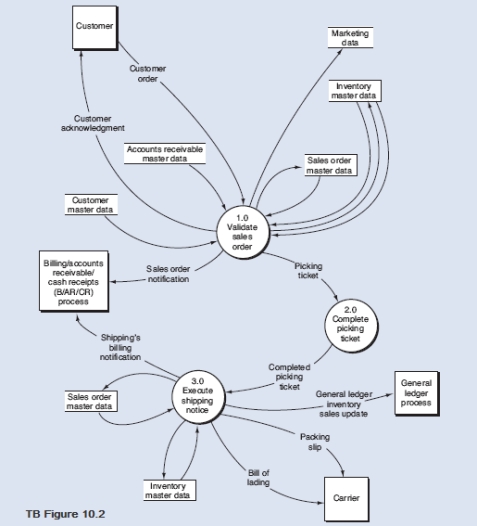
(Essay)
4.9/5 (78)
(78) ___________________________________ are sent to customers to notify them that their orders have been accepted and to inform them of the expected shipping date.
(Short Answer)
4.7/5 (82)
(82) 
Filters
- Essay(0)
- Multiple Choice(0)
- Short Answer(0)
- True False(0)
- Matching(0)