



 Chat with AI
Exam 21: Nuclear Chemistry

Exam 1: Introduction: Matter and Measurement163 Questions
Exam 2: Atoms, Molecules, and Ions250 Questions
Exam 3: Stoichiometry: Calculations With Chemical Formulas and Equations178 Questions
Exam 4: Aqueous Reactions and Solution Stoichiometry180 Questions
Exam 5: Thermochemistry154 Questions
Exam 6: Electronic Structure of Atoms186 Questions
Exam 7: Periodic Properties of the Elements176 Questions
Exam 8: Basic Concepts of Chemical Bonding147 Questions
Exam 9: Molecular Geometry and Bonding Theories183 Questions
Exam 10: Gases175 Questions
Exam 11: Liquids and Intermolecular Forces124 Questions
Exam 12: Solids and Modern Materials84 Questions
Exam 13: Properties of Solutions160 Questions
Exam 14: Chemical Kinetics134 Questions
Exam 15: Chemical Equilibrium97 Questions
Exam 16: Acid-Base Equilibria139 Questions
Exam 17: Additional Aspects of Aqueous Equilibria116 Questions
Exam 18: Chemistry of the Environment126 Questions
Exam 19: Chemical Thermodynamics125 Questions
Exam 20: Electrochemistry114 Questions
Exam 21: Nuclear Chemistry178 Questions
Exam 22: Chemistry of the Nonmetals194 Questions
Exam 23: Transition Metals and Coordination Chemistry165 Questions
Exam 24: The Chemistry of Life: Organic and Biological Chemistry131 Questions
Select questions type


 e represents ________.

Stable nuclei with low atomic numbers, up to 20, have a neutron to proton ratio of approximately ________.
(Short Answer)
4.8/5  (75)
(75) The half-life of 218Po is 3.1 minutes. How much of a 170 gram sample remains after 0.64 hours?
(Multiple Choice)
4.8/5 (82)
(82) The half-life for the beta decay of potassium-40 is 1.3 × 10⁹ years. What is the rate constant for this decay?
(Essay)
4.9/5 (70)
(70) In balancing the nuclear reaction  Br → E +
 e, the identity of element E is ________.
Br → E + e, the identity of element E is ________. (Multiple Choice)
4.8/5 (84)
(84) What happens to the atomic mass number and the atomic number of a radioisotope when it undergoes alpha emission?
(Essay)
4.9/5 (81)
(81) Consider the following data for a particular radionuclide: 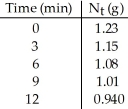 -What is the half-life (in min)of this radionuclide?
 (Multiple Choice)
4.9/5 (87)
(87) What is the missing product from this reaction?  P →
 S + _____
P → S + _____ (Multiple Choice)
4.9/5 (84)
(84) The beta decay of cesium-137 has a half-life of 30.0 years. How many years must pass to reduce a 30 mg sample of cesium 137 to 5.2 mg?
(Multiple Choice)
4.9/5 (80)
(80) Which one of the following is a correct representation of beta particle?
(Multiple Choice)
4.9/5 (77)
(77) 131I has a half-life of 8.04 days. Assuming you start with a 1.03 mg sample of 131I, how many mg will remain after 13.0 days?
(Multiple Choice)
4.9/5 (76)
(76) Which type of radioactive decay results in no change in mass number and atomic number for the starting nucleus?
(Multiple Choice)
4.9/5 (71)
(71) The mass of a proton is 1.00728 amu and that of a neutron is 1.00867 amu. What is the mass defect (in amu)of a  Ni nucleus? (The mass of a nickel-60 nucleus is 59.9308 amu.)
 (Multiple Choice)
4.8/5 (86)
(86) The half-life of 223Ra is 11.4 days. How much of a 200.0 mg sample remains after 600 hours?
(Multiple Choice)
4.8/5 (61)
(61) Which one of the following is a correct representation of an alpha particle?
(Multiple Choice)
4.7/5 (82)
(82) What is the largest number of protons that can exist in a nucleus and still be stable?
(Multiple Choice)
4.8/5 (62)
(62) The half-life for beta decay of strontium-90 is 28.8 years. A milk sample is found to contain 10.3 ppm strontium-90. How many years would pass before the strontium-90 concentration would drop to 1.0 ppm?
(Multiple Choice)
4.8/5 (75)
(75) The decay of a radionuclide with a half-life of 3.3 × 10⁵ years has a rate constant (in yr-1)equal to ________.
(Multiple Choice)
4.7/5 (84)
(84) Gamma radiation only changes the atomic number but not the mass number of a nucleus.
(True/False)
4.9/5 (85)
(85) The missing product from this reaction is ________.  I → _____ +
 e
I → _____ + e (Multiple Choice)
4.8/5 (75)
(75) 
Filters
- Essay(0)
- Multiple Choice(0)
- Short Answer(0)
- True False(0)
- Matching(0)