



 Chat with AI
Exam 9: Molecular Geometry and Bonding Theories

Exam 1: Introduction: Matter and Measurement163 Questions
Exam 2: Atoms, Molecules, and Ions250 Questions
Exam 3: Stoichiometry: Calculations With Chemical Formulas and Equations178 Questions
Exam 4: Aqueous Reactions and Solution Stoichiometry180 Questions
Exam 5: Thermochemistry154 Questions
Exam 6: Electronic Structure of Atoms186 Questions
Exam 7: Periodic Properties of the Elements176 Questions
Exam 8: Basic Concepts of Chemical Bonding147 Questions
Exam 9: Molecular Geometry and Bonding Theories183 Questions
Exam 10: Gases175 Questions
Exam 11: Liquids and Intermolecular Forces124 Questions
Exam 12: Solids and Modern Materials84 Questions
Exam 13: Properties of Solutions160 Questions
Exam 14: Chemical Kinetics134 Questions
Exam 15: Chemical Equilibrium97 Questions
Exam 16: Acid-Base Equilibria139 Questions
Exam 17: Additional Aspects of Aqueous Equilibria116 Questions
Exam 18: Chemistry of the Environment126 Questions
Exam 19: Chemical Thermodynamics125 Questions
Exam 20: Electrochemistry114 Questions
Exam 21: Nuclear Chemistry178 Questions
Exam 22: Chemistry of the Nonmetals194 Questions
Exam 23: Transition Metals and Coordination Chemistry165 Questions
Exam 24: The Chemistry of Life: Organic and Biological Chemistry131 Questions
Select questions type


The hybridization of the carbon atom labeled x in the molecule below is ________. 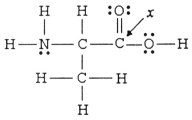
(Multiple Choice)
4.8/5  (74)
(74) The sp3d2 atomic hybrid orbital set accommodates ________ electron domains.
(Multiple Choice)
4.8/5 (68)
(68) The molecular geometry consists of ________.
(a) a nonbonding pair of electrons
(b) a single bond
(c) a multiple bond
(Multiple Choice)
4.9/5 (63)
(63) In molecular orbital theory, the σ1s orbital is ________ and the σ1s* orbital is ________ in the He2+ molecule.
(Multiple Choice)
4.8/5 (76)
(76) According to valence bond theory, which orbitals overlap in the formation of the bond in Br2?
(Multiple Choice)
4.9/5 (87)
(87) The hybridization of the oxygen atom labeled x in the structure below is ________. 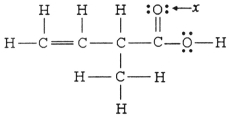
(Multiple Choice)
4.8/5 (101)
(101) An electron domain consists of ________.
(a) a nonbonding pair of electrons
(B) a single bond
(C) a multiple bond
(Multiple Choice)
4.9/5 (85)
(85) Using the VSEPR model, the electron-domain geometry of the central atom in XeF4 is ________.
(Multiple Choice)
4.9/5 (83)
(83) Possible shapes of AB3 molecules are linear, trigonal planar, and T-shaped.
(True/False)
4.9/5 (81)
(81) The 1s hydrogen orbital overlaps with the ________ iodine orbital in HI.
(Short Answer)
4.8/5 (72)
(72) The central atom in the O3 molecule has ________ nonbonded electron pair(s)and ________ bonded electron pair(s)in its valence shell.
(Multiple Choice)
4.9/5 (83)
(83) Nitrogen is colorless because the minimum energy to excite an electron is in the ultraviolet section of the spectrum.
(True/False)
5.0/5 (87)
(87) An antibonding π orbital contains a maximum of ________ electrons.
(Multiple Choice)
4.8/5 (72)
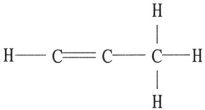
(72) The molecular geometry of the right-most carbon in the molecule below is ________. 
(Multiple Choice)
4.7/5 (86)
(86) In comparing the same two atoms bonded together, the ________ the bond order, the ________ the bond length, and the ________ the bond energy.
(Multiple Choice)
4.7/5 (88)
(88) 
Each molecular orbital can accommodate, at most, two electrons with their spins paired. This is called the ________.
(Short Answer)
4.9/5 (69)
(69) The molecular geometry of the BeCl2 molecule is ________, and this molecule is ________.
(Multiple Choice)
4.7/5 (70)
(70) The hybrid orbitals used for bonding by Xe in the unstable XeF2 molecule are ________ orbitals.
(Multiple Choice)
4.9/5 (96)
(96) 
Filters
- Essay(0)
- Multiple Choice(0)
- Short Answer(0)
- True False(0)
- Matching(0)