



 Chat with AI
Exam 9: Molecular Geometry and Bonding Theories

Exam 1: Introduction: Matter and Measurement163 Questions
Exam 2: Atoms, Molecules, and Ions250 Questions
Exam 3: Stoichiometry: Calculations With Chemical Formulas and Equations178 Questions
Exam 4: Aqueous Reactions and Solution Stoichiometry180 Questions
Exam 5: Thermochemistry154 Questions
Exam 6: Electronic Structure of Atoms186 Questions
Exam 7: Periodic Properties of the Elements176 Questions
Exam 8: Basic Concepts of Chemical Bonding147 Questions
Exam 9: Molecular Geometry and Bonding Theories183 Questions
Exam 10: Gases175 Questions
Exam 11: Liquids and Intermolecular Forces124 Questions
Exam 12: Solids and Modern Materials84 Questions
Exam 13: Properties of Solutions160 Questions
Exam 14: Chemical Kinetics134 Questions
Exam 15: Chemical Equilibrium97 Questions
Exam 16: Acid-Base Equilibria139 Questions
Exam 17: Additional Aspects of Aqueous Equilibria116 Questions
Exam 18: Chemistry of the Environment126 Questions
Exam 19: Chemical Thermodynamics125 Questions
Exam 20: Electrochemistry114 Questions
Exam 21: Nuclear Chemistry178 Questions
Exam 22: Chemistry of the Nonmetals194 Questions
Exam 23: Transition Metals and Coordination Chemistry165 Questions
Exam 24: The Chemistry of Life: Organic and Biological Chemistry131 Questions
Select questions type


The basis of the VSEPR model of molecular bonding is ________.
(Multiple Choice)
4.7/5  (94)
(94) For a molecule with the formula AB3, the molecular shape is ________.
(Multiple Choice)
4.9/5 (69)
(69) The bond angles marked a, b, and c in the molecule below are about ________, ________, and ________, respectively. 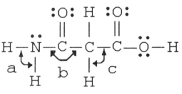
(Multiple Choice)
4.8/5 (76)
(76) The blending of one s atomic orbital and one p atomic orbital produces ________.
(Multiple Choice)
4.7/5 (80)
(80) The bond angles marked a, b, and c in the molecule below are about ________, ________, and ________, respectively. 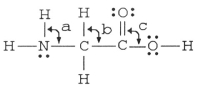
(Multiple Choice)
5.0/5 (80)
(80) The F-N-F bond angle in the NF3 molecule is slightly less than ________.
(Multiple Choice)
4.8/5 (82)
(82) According to MO theory, overlap of two p atomic orbitals produces ________.
(Multiple Choice)
4.9/5 (77)
(77) Boron trifluoride has three bonding domains, and its electron domain geometry is trigonal planar.
(True/False)
4.8/5 (75)
(75) In a typical multiple bond, the σ bond results from overlap of ________ orbitals and the π bond(s)result from overlap of ________ orbitals.
(Multiple Choice)
4.9/5 (74)
(74) The hybrid orbital set used by the central atom in PCl5 is ________.
(Multiple Choice)
4.8/5 (80)
(80) According to MO theory, overlap of two s atomic orbitals produces ________.
(Multiple Choice)
4.8/5 (82)
(82) The Lewis structure of carbon dioxide is given below. The hybridization of the carbon atom in carbon dioxide is ________. 
(Multiple Choice)
4.9/5 (71)
(71) A molecular orbital can accommodate a maximum of ________ electron(s).
(Multiple Choice)
4.8/5 (86)
(86) The order of MO energies in B2, C2, and N2 (σ2p > π2p), is different from the order in O2, F2, and Ne2 (σ2p > π2p). This is due to ________.
(Multiple Choice)
4.7/5 (81)
(81) For molecules of the general formula ABn, n can be greater than four ________.
(Multiple Choice)
5.0/5 (80)
(80) Of the following, only ________ appears to gain mass in a magnetic field.
(Multiple Choice)
4.8/5 (96)
(96) 
Filters
- Essay(0)
- Multiple Choice(0)
- Short Answer(0)
- True False(0)
- Matching(0)