



 Chat with AI
Exam 9: Molecular Geometry and Bonding Theories

Exam 1: Introduction: Matter and Measurement163 Questions
Exam 2: Atoms, Molecules, and Ions250 Questions
Exam 3: Stoichiometry: Calculations With Chemical Formulas and Equations178 Questions
Exam 4: Aqueous Reactions and Solution Stoichiometry180 Questions
Exam 5: Thermochemistry154 Questions
Exam 6: Electronic Structure of Atoms186 Questions
Exam 7: Periodic Properties of the Elements176 Questions
Exam 8: Basic Concepts of Chemical Bonding147 Questions
Exam 9: Molecular Geometry and Bonding Theories183 Questions
Exam 10: Gases175 Questions
Exam 11: Liquids and Intermolecular Forces124 Questions
Exam 12: Solids and Modern Materials84 Questions
Exam 13: Properties of Solutions160 Questions
Exam 14: Chemical Kinetics134 Questions
Exam 15: Chemical Equilibrium97 Questions
Exam 16: Acid-Base Equilibria139 Questions
Exam 17: Additional Aspects of Aqueous Equilibria116 Questions
Exam 18: Chemistry of the Environment126 Questions
Exam 19: Chemical Thermodynamics125 Questions
Exam 20: Electrochemistry114 Questions
Exam 21: Nuclear Chemistry178 Questions
Exam 22: Chemistry of the Nonmetals194 Questions
Exam 23: Transition Metals and Coordination Chemistry165 Questions
Exam 24: The Chemistry of Life: Organic and Biological Chemistry131 Questions
Select questions type


Using the VSEPR model, the electron-domain geometry of the central atom in ClF3 is ________.
(Multiple Choice)
4.8/5  (87)
(87) Of the following species, ________ will have bond angles of 120°.
(Multiple Choice)
4.9/5 (80)
(80) The hybridization of the oxygen atom labeled y in the structure below is ________. The C-O-H bond angle is ________. 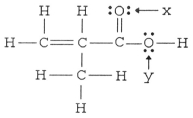
(Multiple Choice)
4.9/5 (71)
(71) The molecular geometry of the left-most carbon atom in the molecule below is ________. 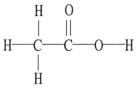
(Multiple Choice)
4.7/5 (79)
(79) The electron-domain geometry and the molecular geometry of a molecule of the general formula ABn are ________.
(Multiple Choice)
4.8/5 (82)
(82) The hybrid orbital set used by the central atom in SO3 is ________.
(Multiple Choice)
4.8/5 (89)
(89) The sensation of vision results from a nerve impulse that is triggered by the separation of retinal from ________.
(Short Answer)
4.8/5 (84)
(84) The Lewis structure of carbon monoxide is given below. The hybridizations of the carbon and oxygen atoms in carbon monoxide are ________ and ________, respectively. : C ≡ O :
(Multiple Choice)
4.8/5 (74)
(74) Using the VSEPR model, the molecular geometry of the central atom in IF5 is ________.
(Multiple Choice)
4.7/5 (88)
(88) The hybrid orbital set used by the central atom in ClO2- is ________.
(Multiple Choice)
4.8/5 (80)
(80) Molecular Orbital theory correctly predicts paramagnetism of oxygen gas, O2. This is because ________.
(Multiple Choice)
4.8/5 (62)
(62) The more unpaired electrons in a species, the stronger is the force of magnetic attraction. This is called ________.
(Short Answer)
4.9/5 (79)
(79) The highest energy occupied molecular orbital in the F-F bond of the F2 molecule is _____.
(Multiple Choice)
4.8/5 (80)
(80) The bond order of any molecule containing equal numbers of bonding and antibonding electrons is ________.
(Multiple Choice)
5.0/5 (77)
(77) Of the following, the central atom is sp3d2 hybridized only in ________.
(Multiple Choice)
4.8/5 (78)
(78) In the valence shell of an atom there are six electron domains. They will be arranged in a(n)________ geometry.
(Short Answer)
4.9/5 (74)
(74) The central atom in a certain molecule has 1 nonbonded electron pairs and 2 bonded electron pairs in its valence shell. The molecular geometry of this molecule is ________.
(Multiple Choice)
4.7/5 (66)
(66) Which of the following molecules or ions will exhibit delocalized bonding? NO2- NH4+ N3-
(Multiple Choice)
4.9/5 (76)
(76) The molecular geometry of the IF5 molecule is ________, and this molecule is ________.
(Multiple Choice)
4.9/5 (80)
(80) In counting the electron domains around the central atom in VSEPR theory, a ________ is not included.
(Multiple Choice)
4.7/5 (70)
(70) 
Filters
- Essay(0)
- Multiple Choice(0)
- Short Answer(0)
- True False(0)
- Matching(0)