



 Chat with AI
Exam 2: Atoms, Molecules, and Ions

Exam 1: Introduction: Matter and Measurement163 Questions
Exam 2: Atoms, Molecules, and Ions250 Questions
Exam 3: Stoichiometry: Calculations With Chemical Formulas and Equations178 Questions
Exam 4: Aqueous Reactions and Solution Stoichiometry180 Questions
Exam 5: Thermochemistry154 Questions
Exam 6: Electronic Structure of Atoms186 Questions
Exam 7: Periodic Properties of the Elements176 Questions
Exam 8: Basic Concepts of Chemical Bonding147 Questions
Exam 9: Molecular Geometry and Bonding Theories183 Questions
Exam 10: Gases175 Questions
Exam 11: Liquids and Intermolecular Forces124 Questions
Exam 12: Solids and Modern Materials84 Questions
Exam 13: Properties of Solutions160 Questions
Exam 14: Chemical Kinetics134 Questions
Exam 15: Chemical Equilibrium97 Questions
Exam 16: Acid-Base Equilibria139 Questions
Exam 17: Additional Aspects of Aqueous Equilibria116 Questions
Exam 18: Chemistry of the Environment126 Questions
Exam 19: Chemical Thermodynamics125 Questions
Exam 20: Electrochemistry114 Questions
Exam 21: Nuclear Chemistry178 Questions
Exam 22: Chemistry of the Nonmetals194 Questions
Exam 23: Transition Metals and Coordination Chemistry165 Questions
Exam 24: The Chemistry of Life: Organic and Biological Chemistry131 Questions
Select questions type


The atomic mass unit is presently based on assigning an exact integral mass (in amu)to an isotope of ________.
(Multiple Choice)
4.9/5  (74)
(74) The element X has three naturally occurring isotopes. The isotopic masses (amu)and % abundances of the isotopes are given in the table below. The average atomic mass of the element is ________ amu. 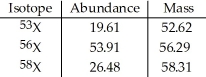
(Multiple Choice)
4.9/5 (80)
(80) Which one of the following will occur as diatomic molecules in elemental form?
(Multiple Choice)
4.7/5 (79)
(79) Which pair of elements is most apt to form a molecular compound with each other?
(Multiple Choice)
4.9/5 (80)
(80) Aluminum reacts with a certain nonmetallic element to form a compound with the general formula AlX. Element X is a diatomic gas at room temperature. Element X must be ________.
(Multiple Choice)
4.9/5 (81)
(81) Element M reacts with fluorine to form an ionic compound with the formula MF3. The M-ion has 21 electrons. Element M is ________.
(Multiple Choice)
4.7/5 (69)
(69) Which one of the following is not one of the postulates of Dalton's atomic theory?
(Multiple Choice)
4.8/5 (85)
(85) Copper and chlorine form an ionic compound whose formula is CuCl2. The name of this compound is ________.
(Multiple Choice)
4.8/5 (88)
(88) Of the three types of radioactivity characterized by Rutherford, which are particles?
(Multiple Choice)
4.7/5 (66)
(66) The formula for the compound formed between aluminum ions and phosphate ions is ________.
(Multiple Choice)
4.9/5 (76)
(76) 
Filters
- Essay(0)
- Multiple Choice(0)
- Short Answer(0)
- True False(0)
- Matching(0)