



 Chat with AI
Exam 2: Atoms, Molecules, and Ions

Exam 1: Introduction: Matter and Measurement163 Questions
Exam 2: Atoms, Molecules, and Ions250 Questions
Exam 3: Stoichiometry: Calculations With Chemical Formulas and Equations178 Questions
Exam 4: Aqueous Reactions and Solution Stoichiometry180 Questions
Exam 5: Thermochemistry154 Questions
Exam 6: Electronic Structure of Atoms186 Questions
Exam 7: Periodic Properties of the Elements176 Questions
Exam 8: Basic Concepts of Chemical Bonding147 Questions
Exam 9: Molecular Geometry and Bonding Theories183 Questions
Exam 10: Gases175 Questions
Exam 11: Liquids and Intermolecular Forces124 Questions
Exam 12: Solids and Modern Materials84 Questions
Exam 13: Properties of Solutions160 Questions
Exam 14: Chemical Kinetics134 Questions
Exam 15: Chemical Equilibrium97 Questions
Exam 16: Acid-Base Equilibria139 Questions
Exam 17: Additional Aspects of Aqueous Equilibria116 Questions
Exam 18: Chemistry of the Environment126 Questions
Exam 19: Chemical Thermodynamics125 Questions
Exam 20: Electrochemistry114 Questions
Exam 21: Nuclear Chemistry178 Questions
Exam 22: Chemistry of the Nonmetals194 Questions
Exam 23: Transition Metals and Coordination Chemistry165 Questions
Exam 24: The Chemistry of Life: Organic and Biological Chemistry131 Questions
Select questions type


The element X has three naturally occurring isotopes. The masses (amu)and % abundances of the isotopes are given in the table below. The average atomic mass of the element is ________ amu. 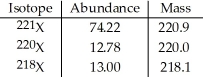
(Multiple Choice)
4.8/5  (74)
(74) Which pair of elements would you expect to exhibit the greatest similarity in their physical and chemical properties?
(Multiple Choice)
4.9/5 (82)
(82) Predict the empirical formula of the ionic compound that forms from sodium and fluorine.
(Multiple Choice)
4.9/5 (76)
(76) The formula for zinc phosphate is Zn3(PO4)2. What is the formula for cadmium arsenate?
(Multiple Choice)
4.9/5 (75)
(75) There are ________ protons, ________ neutrons, and ________ electrons in  I-.
I-. (Multiple Choice)
4.9/5 (82)
(82) The element X has three naturally occurring isotopes. The masses (amu)and % abundances of the isotopes are given in the table below. The average atomic mass of the element is ________ amu. 
(Multiple Choice)
4.8/5 (82)
(82) Different isotopes of a particular element contain different numbers of ________.
(Multiple Choice)
4.9/5 (79)
(79) The molecular formula of a compound is always ________ the empirical formula.
(Multiple Choice)
4.9/5 (72)
(72)  X
Element X has three naturally occurring isotopes. The masses (amu)and % abundances of the isotopes are given in the table below. The average atomic mass of the element is ________ amu. 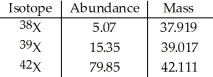
(Multiple Choice)
4.8/5 (74)
(74) 
Filters
- Essay(0)
- Multiple Choice(0)
- Short Answer(0)
- True False(0)
- Matching(0)