



 Chat with AI
Exam 2: Atoms, Molecules, and Ions

Exam 1: Introduction: Matter and Measurement163 Questions
Exam 2: Atoms, Molecules, and Ions250 Questions
Exam 3: Stoichiometry: Calculations With Chemical Formulas and Equations178 Questions
Exam 4: Aqueous Reactions and Solution Stoichiometry180 Questions
Exam 5: Thermochemistry154 Questions
Exam 6: Electronic Structure of Atoms186 Questions
Exam 7: Periodic Properties of the Elements176 Questions
Exam 8: Basic Concepts of Chemical Bonding147 Questions
Exam 9: Molecular Geometry and Bonding Theories183 Questions
Exam 10: Gases175 Questions
Exam 11: Liquids and Intermolecular Forces124 Questions
Exam 12: Solids and Modern Materials84 Questions
Exam 13: Properties of Solutions160 Questions
Exam 14: Chemical Kinetics134 Questions
Exam 15: Chemical Equilibrium97 Questions
Exam 16: Acid-Base Equilibria139 Questions
Exam 17: Additional Aspects of Aqueous Equilibria116 Questions
Exam 18: Chemistry of the Environment126 Questions
Exam 19: Chemical Thermodynamics125 Questions
Exam 20: Electrochemistry114 Questions
Exam 21: Nuclear Chemistry178 Questions
Exam 22: Chemistry of the Nonmetals194 Questions
Exam 23: Transition Metals and Coordination Chemistry165 Questions
Exam 24: The Chemistry of Life: Organic and Biological Chemistry131 Questions
Select questions type


The charge on the silver ion in the salt AgCl is ________.
(Multiple Choice)
4.9/5  (86)
(86) The element X has three naturally occurring isotopes. The isotopic masses (amu)and % abundances of the isotopes are given in the table below. The average atomic mass of the element is ________ amu. 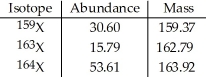
(Multiple Choice)
4.8/5 (79)
(79) Consider the following selected postulates of Dalton's atomic theory: (i)Each element is composed of extremely small particles called atoms.
(ii)Atoms are indivisible.
(iii)Atoms of a given element are identical.
(iv)Atoms of different elements are different and have different properties.
Which of the postulates is(are)no longer considered valid?
(Multiple Choice)
4.7/5 (88)
(88) Formulas that show how atoms are attached in a molecule are called ________.
(Multiple Choice)
4.8/5 (66)
(66) A molecule of water contains hydrogen and oxygen in a 1:8 ratio by mass. This is a statement of ________.
(Multiple Choice)
4.8/5 (84)
(84) Chromium and chlorine form an ionic compound whose formula is CrCl3. The name of this compound is ________.
(Multiple Choice)
4.9/5 (75)
(75) An atom of the most common isotope of gold,  Au, has ________ protons, ________ neutrons, and ________ electrons.
 (Multiple Choice)
5.0/5 (81)
(81) The gold foil experiment performed in Rutherford's lab ________.
(Multiple Choice)
4.9/5 (86)
(86) Which statement below correctly describes the responses of alpha, beta, and gamma radiation to an electric field?
(Multiple Choice)
5.0/5 (93)
(93) 
Filters
- Essay(0)
- Multiple Choice(0)
- Short Answer(0)
- True False(0)
- Matching(0)