



 Chat with AI
Exam 5: Gases

Exam 1: Chemistry: The Study of Change153 Questions
Exam 2: Atoms, Molecules, and Ions141 Questions
Exam 3: Mass Relationships in Chemical Reactions168 Questions
Exam 4: Reactions in Aqueous Solution161 Questions
Exam 5: Gases109 Questions
Exam 6: Thermo-Chemistry111 Questions
Exam 7: Quantum Theory and the Electronic Structure of Atoms115 Questions
Exam 8: Periodic Relationships Among the Elements119 Questions
Exam 9: Chemical Bonding I: Basic Concepts118 Questions
Exam 10: Chemical Bonding Ii: Molecular Geometry and Hybridization of Atomic Orbitals122 Questions
Exam 11: Intermolecular Forces and Liquids and Solids140 Questions
Exam 12: Physical Properties of Solutions109 Questions
Exam 13: Chemical Kinetics114 Questions
Exam 14: Chemical Equilibrium100 Questions
Exam 15: Acids and Bases163 Questions
Exam 16: Acid-Base Equilibria and Solubility Equilibria110 Questions
Exam 17: Chemistry in the Atmosphere41 Questions
Exam 18: Entropy, Free Energy, and Equilibrium112 Questions
Exam 19: Electrochemistry138 Questions
Exam 20: Metallurgy and the Chemistry of Metals58 Questions
Exam 21: Nonmetallic Elements and Their Compounds41 Questions
Exam 22: Transition Metal Chemistry and Coordination Compounds80 Questions
Exam 23: Nuclear Chemistry112 Questions
Exam 24: Organic Chemistry57 Questions
Exam 25: Synthetic and Natural Organic Polymers42 Questions
Select questions type


Calculate the volume occupied by 35.2 g of methane gas (CH4)at 25°C and 1.0 atm.R = 0.08206 L.atm/K.mol.
(Multiple Choice)
4.9/5  (86)
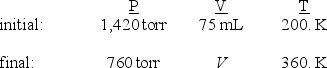
(86) 
Packaged cake mixes usually contain baking powder, a mixture of sodium hydrogen carbonate and calcium hydrogen phosphate that react to produce carbon dioxide gas when they are heated in water.The CO2(g)formed allows the cake to "rise." When such cake mixes are used at high altitudes, often the cake will rise too much and collapse, unless special instructions are followed.Why does this happen?
(Essay)
5.0/5 (88)
(88) A sample of N2 gas occupies 2.40 L at 20°C. If the gas is in a container that can contract or expand at constant pressure, at what temperature will the N2 occupy 4.80 L?
(Multiple Choice)
4.8/5 (88)
(88) A convenient way to produce very high purity oxygen in the laboratory is to decompose KMnO4(s)at high temperature according to the following chemical equation:
2KMnO4(s) K2MnO4(s)+ MnO2(s)+ O2(g)
If 2.50 L of O2(g)is needed at 1.00 atm and 20°C, what mass of KMnO4(s)should be decomposed? Assume the decomposition of KMnO4(s)goes to completion.
(Short Answer)
4.8/5 (73)
(73) At standard temperature and pressure, a given sample of water vapor occupies a volume of 2.80 L. How many moles of water vapor are present?
(Short Answer)
4.9/5 (91)
(91) Air contains 78% N2, 21% O2, and 1% Ar, by volume. What is the density of air at 1,000.torr and -10°C?
(Multiple Choice)
4.8/5 (84)
(84) What volume of CO2 gas at 645 torr and 800 K could be produced by the reaction of 45 g of CaCO3 according to the equation? CaCO3(s) CaO(s)+ CO2(g)
(Multiple Choice)
4.9/5 (74)
(74) Calculate the volume of H2(g)at 273 K and 2.00 atm that will be formed when 275 mL of 0.725 M HCl solution reacts with excess Mg to give hydrogen gas and aqueous magnesium chloride.
(Multiple Choice)
4.8/5 (89)
(89) Phosgene, a chemical warfare agent used in World War I, consists of 12.41% C, 16.17% O, and 71.69% Cl.1.00 L of this gas at STP has a mass of 4.42 g. What is the molecular formula of phosgene?
(Short Answer)
4.7/5 (73)
(73) A small bubble rises from the bottom of a lake, where the temperature and pressure are 4°C and 3.0 atm, to the water's surface, where the temperature is 25°C and the pressure is 0.95 atm.Calculate the final volume of the bubble if its initial volume was 2.1 mL.
(Multiple Choice)
4.9/5 (89)
(89) A pressure that will support a column of Hg to a height of 256 mm would support a column of water to what height? The density of mercury is 13.6 g/cm3; the density of water is 1.00 g/cm3.
(Multiple Choice)
5.0/5 (79)
(79) If the pressure of a gas sample is quadrupled and the absolute temperature is doubled, by what factor does the volume of the sample change?
(Multiple Choice)
4.8/5 (85)
(85) A sample of carbon monoxide gas was collected in a 2.0 L flask by displacing water at 28°C and 810 mmHg. Calculate the number of CO molecules in the flask. The vapor pressure of water at 28°C is 28.3 mmHg.
(Multiple Choice)
4.8/5 (89)
(89) Which of these gases will have the greatest density at the same specified temperature and pressure?
(Multiple Choice)
4.8/5 (99)
(99) A 2.50-L flask contains a mixture of methane (CH4)and propane (C3H8)at a pressure of 1.45 atm and 20°C. When this gas mixture is then burned in excess oxygen, 8.60 g of carbon dioxide is formed. (The other product is water.)What is the mole fraction of methane in the original gas mixture?
(Multiple Choice)
4.7/5 (76)
(76) Which of these gas molecules have the highest average kinetic energy at 25°C?
(Multiple Choice)
4.7/5 (69)
(69) What is the pressure of the gas trapped in the apparatus shown below when the atmospheric pressure is 720 mmHg? 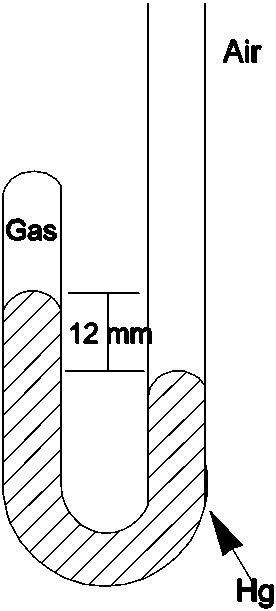
(Multiple Choice)
4.9/5 (91)
(91) A 1.17 g sample of an alkane hydrocarbon gas occupies a volume of 674 mL at 28°C and 741 mmHg.Alkanes are known to have the general formula CnH2n+2.What is the molecular formula of the gas in this sample? (R = 0.08206 L.atm/K.mol)
(Multiple Choice)
4.8/5 (71)
(71) A gaseous compound is 30.4% nitrogen and 69.6% oxygen by mass. A 5.25-g sample of the gas occupies a volume of 1.00 L and exerts a pressure of 1.26 atm at -4.0°C. Which of these choices is its molecular formula?
(Multiple Choice)
4.9/5 (74)
(74) 
Filters
- Essay(0)
- Multiple Choice(0)
- Short Answer(0)
- True False(0)
- Matching(0)