



 Chat with AI
Exam 21: Metals and Solid-State Materials

Exam 1: Chemistry: Matter and Measurement219 Questions
Exam 2: Atoms, molecules, and Ions257 Questions
Exam 3: Formulas, equations, and Moles208 Questions
Exam 4: Reactions in Aqueous Solutions174 Questions
Exam 5: Periodicity and the Atomic Structure of Atoms158 Questions
Exam 6: Ionic Bonds and Some Main-Group Chemistry173 Questions
Exam 7: Covalent Bonds and Molecular Structure232 Questions
Exam 8: Thermochemistry: Chemical Energy163 Questions
Exam 9: Gases: Their Properties and Behavior182 Questions
Exam 10: Liquids,solids,and Phase Changes186 Questions
Exam 11: Solutions and Their Properties192 Questions
Exam 12: Chemical Kinetics206 Questions
Exam 13: Chemical Equilibrium166 Questions
Exam 14: Aqueous Equilibria: Acids and Bases224 Questions
Exam 15: Applications of Aqueous Equilibria190 Questions
Exam 16: Thermodynamics: Entropy, free Energy, and Equilibrium144 Questions
Exam 17: Electrochemistry176 Questions
Exam 18: Hydrogen, oxygen, and Water175 Questions
Exam 19: The Main-Group Elements202 Questions
Exam 20: Transition Elements and Coordination Chemistry185 Questions
Exam 21: Metals and Solid-State Materials149 Questions
Exam 22: Nuclear Chemistry85 Questions
Exam 23: Organic and Biological Chemistry285 Questions
Select questions type


The following picture shows the electron populations of the bands of MO energy levels for elementary silicon. 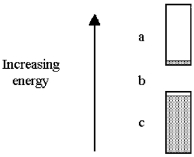 -In this picture the band gap is given by letter(s)
 (Multiple Choice)
4.8/5  (97)
(97) Silica (SiO2)can be prepared from silicon ethoxide by the sol-gel process.Write a balanced equation for the hydrolysis of silicon ethoxide.
(Multiple Choice)
4.8/5 (79)
(79) The following pictures show the electron population of the bands of MO energy levels for four different materials.  -Which of these materials has the lowest electrical conductivity?
 (Multiple Choice)
4.8/5 (83)
(83) What is the concentration process used to separate chalcopyrite (CuFeS2)from its gangue?
(Multiple Choice)
4.9/5 (76)
(76) Which of the following elements is most likely to occur as a metal sulfide ore?
(Multiple Choice)
4.9/5 (71)
(71) White tin has an electrical conductivity that decreases with increasing temperature,and gray tin has an electrical conductivity that increases with increasing temperature.Therefore,white tin is classified as a(n)________,and gray tin is classified as a(n)________.
(Multiple Choice)
4.8/5 (83)
(83) Copper can be obtained from its copper(I)sulfide ore by roasting.What is the balanced equation for the roasting of copper(I)sulfide?
(Essay)
4.9/5 (85)
(85) The following pictures show the electron populations of the composite s-d bands for four different transition metals.  -Which is the hardest metal?
 (Multiple Choice)
5.0/5 (78)
(78) The following picture shows the electron populations of the bands of MO energy levels for elementary silicon.
-In this picture the valence band is given by letter(s)
-In this picture the valence band is given by letter(s) (Multiple Choice)
4.8/5 (82)
(82) The chemical process of roasting is commonly used to facilitate the reduction of which metal ores?
(Multiple Choice)
4.8/5 (81)
(81) Nonoxide ceramics include silicon nitride,the formula of which is ________.
(Short Answer)
4.9/5 (88)
(88) Write a balanced chemical equation for obtaining iron metal by the reduction of hematite,Fe2O3,by hydrogen gas.
(Essay)
4.7/5 (73)
(73) What structural features appear necessary for superconductivity in the 1-2-3 YBa2Cu3O7 superconductor?
(Multiple Choice)
4.8/5 (79)
(79) According to band theory,the element having all of its bonding molecular orbitals filled and all of its antibonding orbitals empty in the 4s-3d composite band is ________.
(Short Answer)
4.8/5 (76)
(76) Below the superconducting transition temperature Tc,superconductors ________.
(Multiple Choice)
4.9/5 (82)
(82) Tin exists in two forms: gray tin and white tin.The electrical conductivity of gray tin increases with an increase in temperature,whereas the electrical conductivity of white tin decreases with an increase in temperature.The form of tin that is a semiconductor is ________ tin.
(Short Answer)
4.9/5 (71)
(71) The following pictures show the electron populations of the composite s-d bands for Sc,Ti,V,and Zn.  -Which picture corresponds to V?
 (Multiple Choice)
4.8/5 (70)
(70) 
Filters
- Essay(0)
- Multiple Choice(0)
- Short Answer(0)
- True False(0)
- Matching(0)