



 Chat with AI
Exam 21: Nuclear Chemistry

Exam 1: Introduction153 Questions
Exam 2: Atoms, Molecules, and Ions141 Questions
Exam 3: Stoichiometry168 Questions
Exam 4: Reactions in Aqueous Solution156 Questions
Exam 5: Gases109 Questions
Exam 6: Energy Relationships in Chemical Reactions105 Questions
Exam 7: The Electronic Structure of Atoms115 Questions
Exam 8: The Periodic Table119 Questions
Exam 9: Chemical Bonding I: the Covalent Bond118 Questions
Exam 10: Chemical Bonding Ii: Molecular Geometry and Hybridization of Atomic Orbitals120 Questions
Exam 11: Introduction to Organic Chemistry57 Questions
Exam 12: Intermolecular Forces and Liquids and Solids138 Questions
Exam 13: Physical Properties of Solutions109 Questions
Exam 14: Chemical Kinetics114 Questions
Exam 15: Chemical Equilibrium99 Questions
Exam 16: Acids and Bases163 Questions
Exam 17: Acid-Base Equilibria and Solubility Equilibria92 Questions
Exam 18: Thermodynamics112 Questions
Exam 19: Redox Reactions and Electrochemistry138 Questions
Exam 20: The Chemistry of Coordination Compounds76 Questions
Exam 21: Nuclear Chemistry112 Questions
Exam 22: Organic Polymerssynthetic and Natural42 Questions
Select questions type


Tritium is a radioisotope of hydrogen having a half-life of 12.3 years. If you initially had 1.0 * 10-7 mole of tritium, how many moles of tritium would be left after 78 years?
(Essay)
4.9/5  (82)
(82) What is the decay rate of a sample of a radioisotope that has an activity of 12 microcuries? [1 curie = 3.7 * 1010 disintegrations/s]
(Essay)
5.0/5 (98)
(98) In the uranium-238 decay series there are eight radioisotopes starting with  that decay by alpha emission, and six radioisotopes that decay by beta emission. The final product of this series is a stable isotope. The symbol for this product is
 (Multiple Choice)
4.9/5 (76)
(76)  .
Compare nuclear reactions with chemical reactions in terms of the quantity of energy released.
(Essay)
5.0/5 (97)
(97) Estimate the age of a bottled wine that has a tritium, 3H, content 60% that of freshly bottled wine. Tritium decays by beta decay and has a half-life of 12.3 yr. 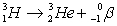
(Multiple Choice)
4.9/5 (85)
(85) A rock contains 0.37 mg of Pb-206 and 0.95 mg of U-238. The half-life of the decay series U-238 Pb-206 is 4.5 *109 yr. Assuming no Pb-206 was present in the rock initially, how old is the rock?
(Multiple Choice)
4.7/5 (72)
(72) Find the nuclear binding enrgy of uranium-234 (atomic mass = 234.040947 amu)in units of joules per nucleon. [Data: neutron mass = 1.674928 * 10-24 g; proton mass = 1.672623 * 10-24 g; electron mass = 9.109387 * 10-28 g; NA = 6.0221367 * 1023 /mol; c = 2.99792458 * 108 m/s]
(Multiple Choice)
4.9/5 (76)
(76) 
The isotope of iodine with mass number 128 undergoes beta decay with a half-life of 25.00 minutes. How long will it take for 93.75% of a sample of pure 128 I to decay?
(Short Answer)
4.8/5 (84)
(84) A radioisotope decays to give an alpha particle and Pb-208. What was the original element?
(Multiple Choice)
5.0/5 (72)
(72) Lead-209 undergoes beta decay. Write a balanced equation for this reaction.
(Essay)
4.8/5 (85)
(85) What would the atom ratio of 206Pb to 238U be in a uranium mineral from a rock that is 1.0 * 109 years old? t1/2(238U)= 4.5 * 109 yr.
(Multiple Choice)
4.8/5 (76)
(76) The Rb-87/Sr-87 method of dating rocks is often used by geologists: 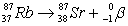 t1/2 = 6.0 * 1010 yr Estimate the age of a rock sample in which the present-day mole ratio of Rb-87 to Sr-87 is 36:1.
 (Multiple Choice)
4.8/5 (81)
(81)  .
The alpha particles emitted by radon-222 have an energy of 8.8 * 10-13 J. If a 200. g Pb brick absorbs 1.0 * 1010 alpha particles from radon decay, what dose in rads will the brick absorb?
(Short Answer)
4.9/5 (78)
(78) 
Filters
- Essay(0)
- Multiple Choice(0)
- Short Answer(0)
- True False(0)
- Matching(0)