



 Chat with AI
Exam 5: Gases

Exam 1: Introduction153 Questions
Exam 2: Atoms, Molecules, and Ions141 Questions
Exam 3: Stoichiometry168 Questions
Exam 4: Reactions in Aqueous Solution156 Questions
Exam 5: Gases109 Questions
Exam 6: Energy Relationships in Chemical Reactions105 Questions
Exam 7: The Electronic Structure of Atoms115 Questions
Exam 8: The Periodic Table119 Questions
Exam 9: Chemical Bonding I: the Covalent Bond118 Questions
Exam 10: Chemical Bonding Ii: Molecular Geometry and Hybridization of Atomic Orbitals120 Questions
Exam 11: Introduction to Organic Chemistry57 Questions
Exam 12: Intermolecular Forces and Liquids and Solids138 Questions
Exam 13: Physical Properties of Solutions109 Questions
Exam 14: Chemical Kinetics114 Questions
Exam 15: Chemical Equilibrium99 Questions
Exam 16: Acids and Bases163 Questions
Exam 17: Acid-Base Equilibria and Solubility Equilibria92 Questions
Exam 18: Thermodynamics112 Questions
Exam 19: Redox Reactions and Electrochemistry138 Questions
Exam 20: The Chemistry of Coordination Compounds76 Questions
Exam 21: Nuclear Chemistry112 Questions
Exam 22: Organic Polymerssynthetic and Natural42 Questions
Select questions type


On a spring morning (20°C)you fill your tires to a pressure of 2.25 atmospheres. As you ride along, the tire heats up to 45°C from the friction on the road. What is the pressure in your tires now?
(Short Answer)
4.8/5  (71)
(71) A sample of N2 gas occupies 2.40 L at 20°C. If the gas is in a container that can contract or expand at constant pressure, at what temperature will the N2 occupy 4.80 L?
(Multiple Choice)
4.8/5 (88)
(88) What is the pressure of the sample of gas trapped in the closed-tube mercury manometer shown below if atmospheric pressure is 751 mmHg and h = 17.3 cm? 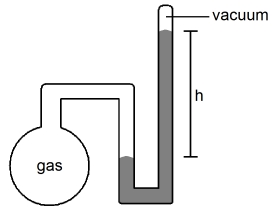
(Short Answer)
4.8/5 (84)
(84) Ammonium nitrite undergoes decomposition to produce only gases as shown below.
NH4NO2(s) N2(g)+ 2H2O(g)
How many liters of gas will be produced by the decomposition of 32.0 g of NH4NO2 at 525°C and 1.5 atm?
(Short Answer)
4.8/5 (84)
(84) A particular coal sample contains 2.32% S. When the coal is burned, the sulfur is converted to sulfur dioxide gas. What volume of SO2(g), measured at 25°C and 749 mmHg, is produced by burning 2.0 * 106 lb of this coal? (1 lb = 454 g)
(Essay)
4.8/5 (85)
(85) Calculate the volume of H2(g)at 273 K and 2.00 atm that will be formed when 275 mL of 0.725 M HCl solution reacts with excess Mg to give hydrogen gas and aqueous magnesium chloride.
(Multiple Choice)
4.8/5 (88)
(88) Many automobiles produce about 5 grams of NO for each mile they are driven. How many liters of NO gas at STP would be produced on a 100-mile trip?
(Short Answer)
4.9/5 (67)
(67) The mole fraction of oxygen molecules in dry air is 0.2095. What volume of dry air at 1.00 atm and 25°C is required for burning 1.00 L of hexane (C6H14, density = 0.660 g/mL)completely, yielding carbon dioxide and water?
(Multiple Choice)
4.9/5 (84)
(84) A spacecraft is filled with 0.500 atm of O2 and 0.500 atm of He. If there is a very small hole in the side of this craft such that gas is lost slowly into outer space,
(Multiple Choice)
4.9/5 (78)
(78) Give five examples of elements that occur as gases at room temperature and pressure?
(Essay)
4.9/5 (69)
(69) Calculate the density of N2O gas, in grams per liter, at 110°C and 12 atm.
(Short Answer)
4.9/5 (81)
(81) Gasoline (which can be considered to be octane, C8H18)burns in oxygen to produce carbon dioxide and water. What volume of carbon dioxide at STP is generated as a result of the combustion of 1.0 gal of gasoline?
(The density of gasoline is 0.81 g/mL. 1 gal = 3.78 L)
(Short Answer)
4.9/5 (83)
(83) Baking powder is made up of sodium hydrogen carbonate and calcium hydrogen phosphate. When baking powder is wet, these components react to produce carbon dioxide. The equation for this reaction is given below.
NaHCO3(aq)+ CaHPO4(aq) NaCaPO4(aq)+ CO2(g)+ H2O(l)
Assuming all of the carbon dioxide was released as a gas, how many liters of CO2(g)would be formed at room temperature from 4.00 g of NaHCO3 and excess CaHPO4?
(Short Answer)
4.9/5 (72)
(72) The mole fraction of oxygen molecules in dry air is 0.2095. What volume of dry air at 1.00 atm and 25°C is required for burning 1.00 L of octane (C8H18, density = 0.7025 g/mL)completely, yielding carbon dioxide and water?
(Multiple Choice)
4.9/5 (68)
(68) A 1.2 L flask contains 0.500 mole of ammonia (NH3)at 150°C. Calculate the pressure of the ammonia inside the flask.
(Multiple Choice)
4.9/5 (84)
(84) Samples of the following volatile liquids are opened simultaneously at one end of a room. If you are standing at the opposite end of this room, which species would you smell first? (Assume that your nose is equally sensitive to all these species.)
(Multiple Choice)
4.7/5 (86)
(86) Give five examples of compounds that exist as gases at room temperature and pressure.
(Essay)
4.9/5 (67)
(67) What will happen to the height (h)of the mercury column in the manometer shown below if the stopcock is opened, given that the atmospheric pressure is 755 mmHg? 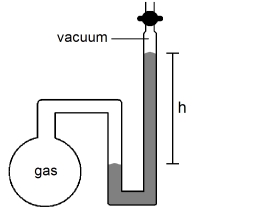
(Multiple Choice)
4.7/5 (75)
(75) 
Filters
- Essay(0)
- Multiple Choice(0)
- Short Answer(0)
- True False(0)
- Matching(0)