



 Chat with AI
Exam 5: Gases

Exam 1: Introduction153 Questions
Exam 2: Atoms, Molecules, and Ions141 Questions
Exam 3: Stoichiometry168 Questions
Exam 4: Reactions in Aqueous Solution156 Questions
Exam 5: Gases109 Questions
Exam 6: Energy Relationships in Chemical Reactions105 Questions
Exam 7: The Electronic Structure of Atoms115 Questions
Exam 8: The Periodic Table119 Questions
Exam 9: Chemical Bonding I: the Covalent Bond118 Questions
Exam 10: Chemical Bonding Ii: Molecular Geometry and Hybridization of Atomic Orbitals120 Questions
Exam 11: Introduction to Organic Chemistry57 Questions
Exam 12: Intermolecular Forces and Liquids and Solids138 Questions
Exam 13: Physical Properties of Solutions109 Questions
Exam 14: Chemical Kinetics114 Questions
Exam 15: Chemical Equilibrium99 Questions
Exam 16: Acids and Bases163 Questions
Exam 17: Acid-Base Equilibria and Solubility Equilibria92 Questions
Exam 18: Thermodynamics112 Questions
Exam 19: Redox Reactions and Electrochemistry138 Questions
Exam 20: The Chemistry of Coordination Compounds76 Questions
Exam 21: Nuclear Chemistry112 Questions
Exam 22: Organic Polymerssynthetic and Natural42 Questions
Select questions type


What is the pressure of the sample of gas trapped in the open-tube mercury manometer shown below if atmospheric pressure is 736 mmHg and h = 9.2 cm? 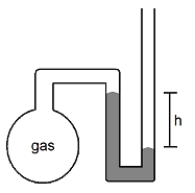
(Multiple Choice)
4.8/5  (73)
(73) What is the pressure (in atmospheres)of the sample of gas trapped in the open-tube mercury manometer shown below if atmospheric pressure is 735 mmHg and h = 8.3 cm? 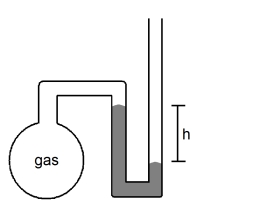
(Short Answer)
4.9/5 (74)
(74) A small bubble rises from the bottom of a lake, where the temperature and pressure are 4°C and 3.0 atm, to the water's surface, where the temperature is 25°C and the pressure is 0.95 atm. Calculate the final volume of the bubble if its initial volume was 2.1 mL.
(Multiple Choice)
4.7/5 (80)
(80) The van der Waals equation is a modification of the ideal gas equation. For what two facts does this equation account?
(Essay)
4.9/5 (83)
(83) A sample of carbon monoxide gas was collected in a 2.0 L flask by displacing water at 28°C and 810 mmHg. Calculate the number of CO molecules in the flask. The vapor pressure of water at 28°C is 28.3 mmHg.
(Multiple Choice)
5.0/5 (93)
(93) 
A 1.07 g sample of a Noble gas occupies a volume of 363 mL at 35°C and 678 mmHg. Identify the Noble gas in this sample? (R = 0.08206 L.atm/K.mol)
(Multiple Choice)
4.8/5 (68)
(68) A gaseous compound is 30.4% nitrogen and 69.6% oxygen by mass. A 5.25-g sample of the gas occupies a volume of 1.00 L and exerts a pressure of 1.26 atm at -4.0°C. Which of these choices is its molecular formula?
(Multiple Choice)
4.8/5 (84)
(84) How many molecules of N2 gas can be present in a 2.5 L flask at 50°C and 650 mmHg?
(Multiple Choice)
4.8/5 (83)
(83) A sample of mercury(II)oxide is placed in a 5.00 L evacuated container and heated until it decomposes entirely to mercury metal and oxygen gas. The container is then cooled to 25°C. One now finds that the gas pressure inside the container is 1.73 atm. What mass of mercury(II)oxide was originally placed into the container?
(Multiple Choice)
4.8/5 (81)
(81) At constant pressure, the density of a gas depends on temperature. Does the density increase or decrease as the temperature increases?
(Short Answer)
4.9/5 (88)
(88) An aerosol can with a volume of 0.50 L has a bursting point of 2.6 atm. If the can contains 1.0 g CO2 and is heated to 400°C, will it burst?
(Short Answer)
4.9/5 (66)
(66) A mixture of three gases has a total pressure of 1,380 mmHg at 298 K. The mixture is analyzed and is found to contain 1.27 mol CO2, 3.04 mol CO, and 1.50 mol Ar. What is the partial pressure of Ar?
(Multiple Choice)
4.7/5 (72)
(72) A 0.271 g sample of an unknown vapor occupies 294 mL at 140°C and 847 mmHg. The empirical formula of the compound is CH2. What is the molecular formula of the compound?
(Multiple Choice)
4.9/5 (73)
(73) The pressure of a gas sample was measured to be 489 mmHg. Which of the following is not an equivalent statement of that pressure? (1 atm = 1.01325 * 105 Pa)
(Multiple Choice)
4.9/5 (79)
(79) Calculate the volume occupied by 25.2 g of CO2 at 0.84 atm and 25°C. R = 0.08206 L.atm/K.mol.
(Multiple Choice)
4.8/5 (83)
(83) Calculate the number of moles of gas contained in a 10.0 L tank at 22°C and 105 atm. (R = 0.08206 L.atm/K.mol)
(Multiple Choice)
4.9/5 (73)
(73) A sample of a gas occupies 1.40 * 103 mL at 25°C and 760 mmHg. What volume will it occupy at the same temperature and 380 mmHg?
(Multiple Choice)
4.8/5 (73)
(73) Gases are sold in large cylinders for laboratory use. What pressure, in atmospheres, will be exerted by 2,500 g of oxygen gas (O2)when stored at 22°C in a 40.0 L cylinder?
(Multiple Choice)
4.9/5 (86)
(86) 
Filters
- Essay(0)
- Multiple Choice(0)
- Short Answer(0)
- True False(0)
- Matching(0)