



 Chat with AI
Exam 7: Alternative Pay Schemes and Labor Efficiency

Exam 1: Labor Economics: Introduction and Overview13 Questions
Exam 2: The Theory of Individual Labor Supply54 Questions
Exam 3: Population, Participation Rates, and Hours of Work44 Questions
Exam 4: Labor Quality: Investing in Human Capital49 Questions
Exam 5: The Demand for Labor64 Questions
Exam 6: Wage Determination and the Allocation of Labor38 Questions
Exam 7: Alternative Pay Schemes and Labor Efficiency49 Questions
Exam 8: The Wage Structure44 Questions
Exam 9: Mobility,Migration,and Efficiency50 Questions
Exam 10: Labor Unions and Collective Bargaining53 Questions
Exam 11: The Economic Impact of Unions50 Questions
Exam 12: Government and the Labor Market: Employment, Expenditures, and Taxation45 Questions
Exam 13: Government and the Labor Market: Legislation and Regulation49 Questions
Exam 14: Labor Market Discrimination60 Questions
Exam 15: Job Search: External and Internal34 Questions
Exam 16: The Distribution of Personal Earnings39 Questions
Exam 17: Labor Productivity: Wages,Prices,and Employment42 Questions
Exam 18: Employment and Unemployment52 Questions
Select questions type


In a work environment in which teamwork is highly valued,pay is more likely to be received as:
(Multiple Choice)
4.8/5  (81)
(81) Compared to their counterparts in other developed countries,CEOs in the U.S.are paid:
(Multiple Choice)
4.7/5 (69)
(69) refer to the diagram below. All points along the ray 0P reflect a constant proportion of wages to fringe benefits.
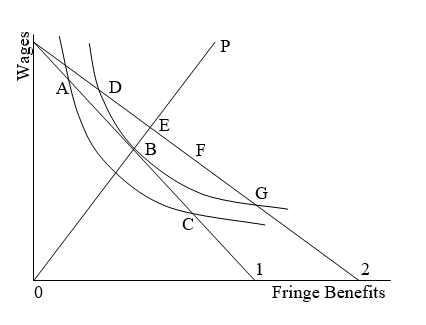 -Given isoprofit line 1,this worker's wage-fringe optimum is given by point:
 (Multiple Choice)
4.9/5 (70)
(70) Salaried workers can be considered "quasi-fixed resources" in that:
(Multiple Choice)
4.9/5 (81)
(81) refer to the following information. Suppose a “fully effective” worker can produce 20 units per hour in a particular firm. The firm’s wage-productivity relationship is given by the table below:
Wage Output per Worker \ 10 20 9 20 8 16 7 10
-If the actual wage is $7,the wage cost per effective unit of labor is:
(Multiple Choice)
4.8/5 (86)
(86) refer to the diagram below. All points along the ray 0P reflect a constant proportion of wages to fringe benefits.
-Which one of the following events could not have caused a shift from isoprofit line 1 to line 2?
-Which one of the following events could not have caused a shift from isoprofit line 1 to line 2? (Multiple Choice)
4.7/5 (87)
(87) Which one of the following best represents the principal-agent problem in the employer-employee relationship?
(Multiple Choice)
4.9/5 (63)
(63) 
Filters
- Essay(0)
- Multiple Choice(0)
- Short Answer(0)
- True False(0)
- Matching(0)