



 Chat with AI
Exam 5: The Demand for Labor

Exam 1: Labor Economics: Introduction and Overview13 Questions
Exam 2: The Theory of Individual Labor Supply54 Questions
Exam 3: Population, Participation Rates, and Hours of Work44 Questions
Exam 4: Labor Quality: Investing in Human Capital49 Questions
Exam 5: The Demand for Labor64 Questions
Exam 6: Wage Determination and the Allocation of Labor38 Questions
Exam 7: Alternative Pay Schemes and Labor Efficiency49 Questions
Exam 8: The Wage Structure44 Questions
Exam 9: Mobility,Migration,and Efficiency50 Questions
Exam 10: Labor Unions and Collective Bargaining53 Questions
Exam 11: The Economic Impact of Unions50 Questions
Exam 12: Government and the Labor Market: Employment, Expenditures, and Taxation45 Questions
Exam 13: Government and the Labor Market: Legislation and Regulation49 Questions
Exam 14: Labor Market Discrimination60 Questions
Exam 15: Job Search: External and Internal34 Questions
Exam 16: The Distribution of Personal Earnings39 Questions
Exam 17: Labor Productivity: Wages,Prices,and Employment42 Questions
Exam 18: Employment and Unemployment52 Questions
Select questions type


In comparing two otherwise identical industries X and Y,an economist finds that labor demand is more elastic in industry X.Which of the following would support this finding?

Free
(Multiple Choice)
5.0/5  (80)
(80) Correct Answer: Verified
C
A competitive firm will never choose to operate in stage(s):
Free
(Multiple Choice)
4.8/5 (76)
(76) Correct Answer:Verified
VerifiedB
are based on the short-run production function in the graph at right.
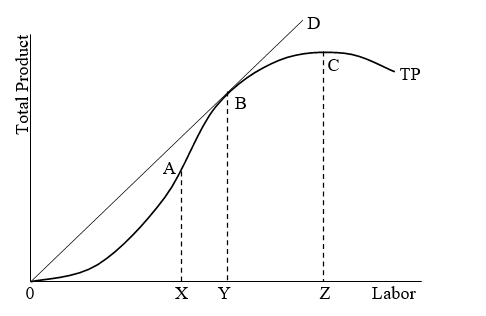 -The "law of diminishing marginal returns" begins to take effect at labor input level:
Free
(Multiple Choice)
4.9/5 (87)
(87) Correct Answer:Verified
VerifiedB
Skilled labor will benefit from an increase in the wage rate paid to unskilled labor if:
(Multiple Choice)
4.8/5 (86)
(86) (appendix)The slope of an isoquant at any point reflects the:
(Multiple Choice)
4.9/5 (84)
(84) Questions are based on the data in the following table. Assume that the labor market is perfectly competitive.
Labor Output 0 0 1 15 2 29 3 42 4 54 5 65 6 75 Price \ 10.00 10.00 10.00 10.00 10.00 10.00 10.00 Price \ 10.00 9.50 9.00 8.50 7.50 6.50 5.50
-Suppose the firm's product demand is given by the column labeled D1.If the wage rate is $120,the firm will achieve maximum profit by hiring _____ workers.
(Multiple Choice)
4.9/5 (71)
(71) When deriving the market demand curve for a particular type of labor,one must:
(Multiple Choice)
4.8/5 (77)
(77) are based on the short-run production function in the graph at right.
-The "zone of production" consists of labor inputs over the range of:
-The "zone of production" consists of labor inputs over the range of: (Multiple Choice)
4.8/5 (86)
(86) Which of the following best describes the output effect of a wage decrease?
(Multiple Choice)
4.9/5 (84)
(84) Value of marginal product (VMP)differs from marginal revenue product (MRP)in that:
(Multiple Choice)
4.7/5 (87)
(87) Compared to the long-run labor demand curve,the firm's short-run curve is typically:
(Multiple Choice)
4.9/5 (81)
(81) In the textile industry,industrial robots and assembly line workers are gross substitutes.Accordingly,the drop in the price of robots has:
(Multiple Choice)
4.8/5 (90)
(90) Questions are based on the data in the following table. Assume that the labor market is perfectly competitive.
0 0 1 15 2 29 3 42 4 54 5 65 \ 2.20 2.00 1.80 1.60 1.40 1.20
-If the wage is $11.00,how many workers will this profit-maximizing firm choose to employ?
(Multiple Choice)
4.8/5 (63)
(63) Questions are based on the data in the following table. Assume that the labor market is perfectly competitive.
Labor Output 0 0 1 15 2 29 3 42 4 54 5 65 6 75 Price \ 10.00 10.00 10.00 10.00 10.00 10.00 10.00 Price \ 10.00 9.50 9.00 8.50 7.50 6.50 5.50
-Suppose the firm's product demand is given by the column labeled D2.If the wage rate is $100,the firm will achieve maximum profit by hiring _____ workers
(Multiple Choice)
4.7/5 (77)
(77) Which of the following equalities holds when the profit-maximizing quantity of labor is employed in the short?run?
(Multiple Choice)
4.8/5 (79)
(79) The market wage increases from $9 to $11and the firm responds by reducing its labor force by 16%.The wage elasticity coefficient is:
(Multiple Choice)
4.9/5 (72)
(72) Questions are based on the data in the following table. Assume that the labor market is perfectly competitive.
Labor Output 0 0 1 15 2 29 3 42 4 54 5 65 6 75 Price \ 10.00 10.00 10.00 10.00 10.00 10.00 10.00 Price \ 10.00 9.50 9.00 8.50 7.50 6.50 5.50
-Suppose the firm's product demand is given by the column labeled D1.If the wage rate rises from $100 to $130,the firm will reduce the quantity of labor employed by _____ unit(s)
(Multiple Choice)
4.8/5 (70)
(70) 
Filters
- Essay(0)
- Multiple Choice(0)
- Short Answer(0)
- True False(0)
- Matching(0)