



 Chat with AI
Exam 4: Labor Quality: Investing in Human Capital

Exam 1: Labor Economics: Introduction and Overview13 Questions
Exam 2: The Theory of Individual Labor Supply54 Questions
Exam 3: Population, Participation Rates, and Hours of Work44 Questions
Exam 4: Labor Quality: Investing in Human Capital49 Questions
Exam 5: The Demand for Labor64 Questions
Exam 6: Wage Determination and the Allocation of Labor38 Questions
Exam 7: Alternative Pay Schemes and Labor Efficiency49 Questions
Exam 8: The Wage Structure44 Questions
Exam 9: Mobility,Migration,and Efficiency50 Questions
Exam 10: Labor Unions and Collective Bargaining53 Questions
Exam 11: The Economic Impact of Unions50 Questions
Exam 12: Government and the Labor Market: Employment, Expenditures, and Taxation45 Questions
Exam 13: Government and the Labor Market: Legislation and Regulation49 Questions
Exam 14: Labor Market Discrimination60 Questions
Exam 15: Job Search: External and Internal34 Questions
Exam 16: The Distribution of Personal Earnings39 Questions
Exam 17: Labor Productivity: Wages,Prices,and Employment42 Questions
Exam 18: Employment and Unemployment52 Questions
Select questions type


Which one of the following most closely approximates pure specific training?

Free
(Multiple Choice)
4.9/5  (77)
(77) Correct Answer: Verified
B
refer to the following diagram,in which MRPu refers to the marginal revenue product of an untrained worker,while MRPt refers to this worker's marginal revenue product as a result of a program of on-the-job training.
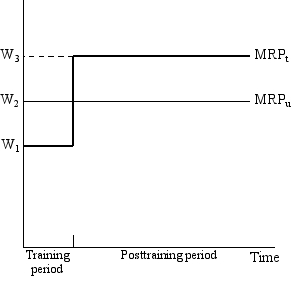 -In the case of general training,the wage rate during the training period will be _____,while the post-training wage will be _____.
Free
(Multiple Choice)
4.9/5 (81)
(81) Correct Answer:Verified
VerifiedA
based on the following diagram:
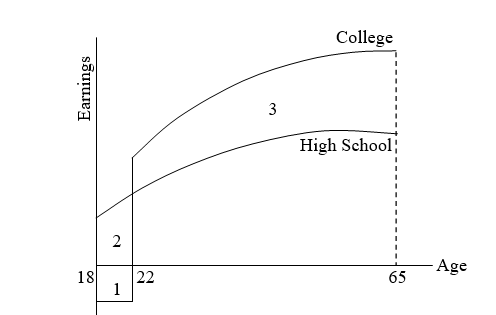 -Suppose there is now a 25% likelihood that a person's work career may be interrupted for ten years after schooling has been completed.In the diagram above,this development would:
Free
(Multiple Choice)
5.0/5 (75)
(75) Correct Answer:Verified
VerifiedD
Which one of the following would indicate a profitable human capital investment?
(Multiple Choice)
4.9/5 (73)
(73) based on the following diagram:
-According to human capital theory,areas 1,2,and 3 represent respectively:
-According to human capital theory,areas 1,2,and 3 represent respectively: (Multiple Choice)
4.8/5 (87)
(87) If education is undertaken as consumption as well as investment:
(Multiple Choice)
4.8/5 (90)
(90) The total economic cost of formal education typically does not include:
(Multiple Choice)
4.9/5 (78)
(78) The demand for human capital curves slope downward and to the right because:
(Multiple Choice)
4.9/5 (78)
(78) Human capital theory predicts that the proportion of people attending college will decrease if:
(Multiple Choice)
4.9/5 (74)
(74) All else equal,the social rate of return to education will be lower than the private return if:
(Multiple Choice)
4.8/5 (86)
(86) based on the following diagram:
-Which one of the following would increase the likelihood of investing in a college education?
-Which one of the following would increase the likelihood of investing in a college education? (Multiple Choice)
4.9/5 (85)
(85) 
Filters
- Essay(0)
- Multiple Choice(0)
- Short Answer(0)
- True False(0)
- Matching(0)