



 Chat with AI
Exam 9: Mobility,Migration,and Efficiency

Exam 1: Labor Economics: Introduction and Overview13 Questions
Exam 2: The Theory of Individual Labor Supply54 Questions
Exam 3: Population, Participation Rates, and Hours of Work44 Questions
Exam 4: Labor Quality: Investing in Human Capital49 Questions
Exam 5: The Demand for Labor64 Questions
Exam 6: Wage Determination and the Allocation of Labor38 Questions
Exam 7: Alternative Pay Schemes and Labor Efficiency49 Questions
Exam 8: The Wage Structure44 Questions
Exam 9: Mobility,Migration,and Efficiency50 Questions
Exam 10: Labor Unions and Collective Bargaining53 Questions
Exam 11: The Economic Impact of Unions50 Questions
Exam 12: Government and the Labor Market: Employment, Expenditures, and Taxation45 Questions
Exam 13: Government and the Labor Market: Legislation and Regulation49 Questions
Exam 14: Labor Market Discrimination60 Questions
Exam 15: Job Search: External and Internal34 Questions
Exam 16: The Distribution of Personal Earnings39 Questions
Exam 17: Labor Productivity: Wages,Prices,and Employment42 Questions
Exam 18: Employment and Unemployment52 Questions
Select questions type


Which of the following would be considered a real (as opposed to pecuniary)externality associated with migration?

Free
(Multiple Choice)
4.8/5  (73)
(73) Correct Answer: Verified
B
If an economics professor moves from the University of California at Berkeley to the University of Texas at Austin,that is an example of:
Free
(Multiple Choice)
4.9/5 (77)
(77) Correct Answer:Verified
VerifiedC
refer to the following diagram. Initially, wage rates are WM in Country M and WU in Country U. Subsequent migration results in an equalization of wage rates.  -For native Country U workers,migration causes a collective loss equal to area:
Free
(Multiple Choice)
4.9/5 (83)
(83) Correct Answer:Verified
VerifiedC
Research by Borjas on relatively recent immigrants to the U.S.suggests that they:
(Multiple Choice)
5.0/5 (71)
(71) Concerning the relationship between unemployment and migration,empirical studies generally find that:
(Multiple Choice)
4.8/5 (88)
(88) The expected private rate of return to migration to a particular individual:
(Multiple Choice)
4.7/5 (79)
(79) Early empirical evidence reported by Barry Chiswick indicated that foreign-born persons migrating to the U.S.,all else constant:
(Multiple Choice)
4.8/5 (70)
(70) Assuming competitive markets,migration in response to wage differentials will likely result in:
(Multiple Choice)
4.8/5 (73)
(73) "Any worker for whom the present value of lifetime earnings will increase by migration will choose to move." This statement is:
(Multiple Choice)
4.7/5 (74)
(74) Which one of the following will tend to decrease the perceived costs of a move relative to the perceived benefits?
(Multiple Choice)
4.9/5 (83)
(83) Suppose a proposed law will ban migration into the U.S..Considering who gains and who loses from migration,economic theory suggests that,in general:
(Multiple Choice)
4.9/5 (85)
(85) Suppose a proposed law will expand migration into the U.S..Economic theory suggests that there will be a net gain accruing to U.S.workers who are:
(Multiple Choice)
4.9/5 (88)
(88) refer to the following diagram. Initially, wage rates are WM in Country M and WU in Country U. Subsequent migration results in an equalization of wage rates.
-The combined gain in efficiency of the two countries is equal to:
-The combined gain in efficiency of the two countries is equal to: (Multiple Choice)
4.7/5 (83)
(83) An increase of 500 illegal alien workers would most likely:
(Multiple Choice)
4.8/5 (80)
(80) Answer questions on the basis of the following diagram. Assume all migration is costless.
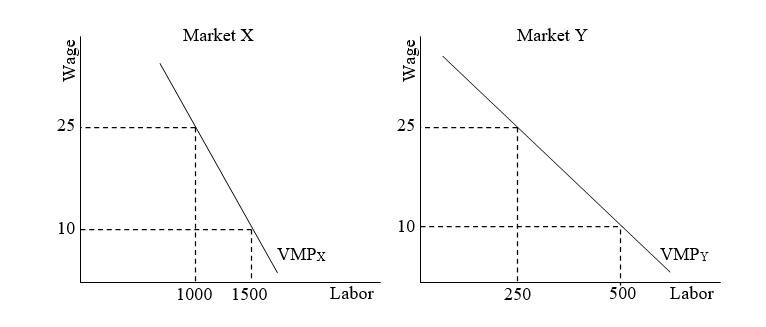 -If there are initially 1000 workers in country X and 500 workers in country Y,then we should expect:
 (Multiple Choice)
4.9/5 (85)
(85) refer to the following diagram, in which Sd is the supply curve of domestic labor, St is the total labor supply curve including the supplies of illegal immigrant workers. L is measured in thousands of workers. -Consider the market depicted in the diagram.Supporters of illegal immigrants claim that no domestic workers are willing to do this type of work.Their claims are:
 (Multiple Choice)
4.9/5 (70)
(70) 
Filters
- Essay(0)
- Multiple Choice(0)
- Short Answer(0)
- True False(0)
- Matching(0)