



 Chat with AI
Exam 9: Mobility,Migration,and Efficiency

Exam 1: Labor Economics: Introduction and Overview13 Questions
Exam 2: The Theory of Individual Labor Supply54 Questions
Exam 3: Population, Participation Rates, and Hours of Work44 Questions
Exam 4: Labor Quality: Investing in Human Capital49 Questions
Exam 5: The Demand for Labor64 Questions
Exam 6: Wage Determination and the Allocation of Labor38 Questions
Exam 7: Alternative Pay Schemes and Labor Efficiency49 Questions
Exam 8: The Wage Structure44 Questions
Exam 9: Mobility,Migration,and Efficiency50 Questions
Exam 10: Labor Unions and Collective Bargaining53 Questions
Exam 11: The Economic Impact of Unions50 Questions
Exam 12: Government and the Labor Market: Employment, Expenditures, and Taxation45 Questions
Exam 13: Government and the Labor Market: Legislation and Regulation49 Questions
Exam 14: Labor Market Discrimination60 Questions
Exam 15: Job Search: External and Internal34 Questions
Exam 16: The Distribution of Personal Earnings39 Questions
Exam 17: Labor Productivity: Wages,Prices,and Employment42 Questions
Exam 18: Employment and Unemployment52 Questions
Select questions type


Following the downturn in air travel following the September 11,2001 terrorist attacks,several thousand highly paid Seattle-based union workers were laid off from airplane manufacturer Boeing.Many of these workers left the Seattle area to accept jobs paying less than their Boeing jobs.What can we conclude from their actions?
(Multiple Choice)
4.9/5  (70)
(70) refer to the following diagram, in which Sd is the supply curve of domestic labor, St is the total labor supply curve including the supplies of illegal immigrant workers. L is measured in thousands of workers. -Consider the market depicted in the diagram.If all illegal aliens were deported:
 (Multiple Choice)
5.0/5 (72)
(72) Answer questions on the basis of the following diagram. Assume all migration is costless.
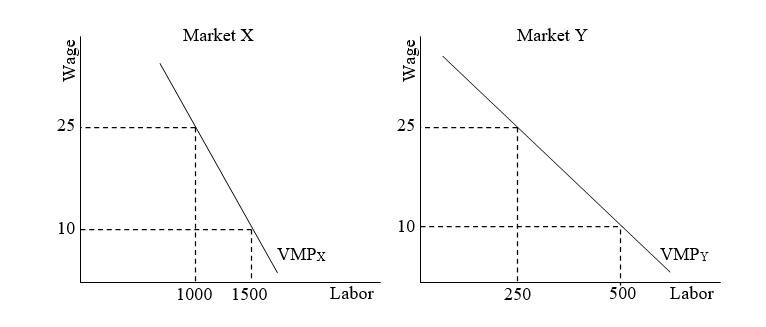 -Assume there are initially 1000 workers in country X and 500 workers in country Y.As workers begin to migrate,the total value of output will:
 (Multiple Choice)
4.9/5 (75)
(75) refer to the following information given in the table below. There are initially 28 workers in market A and 63 workers in market B as indicated by the shaded cells. All markets are assumed competitive and there is perfect information and costless migration; jobs in markets A and B are identical in all nonwage aspects.
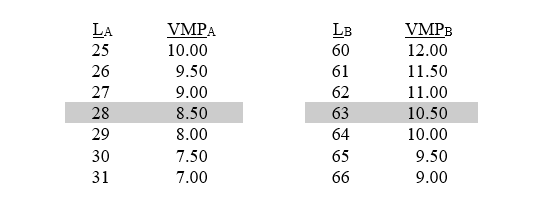 -Given the initial situation,which one of the following may be expected to occur?
 (Multiple Choice)
4.9/5 (92)
(92) refer to the following diagram. Initially, wage rates are WM in Country M and WU in Country U. Subsequent migration results in an equalization of wage rates.  -For Country M capital owners,migration causes a collective loss equal to area:
 (Multiple Choice)
4.7/5 (74)
(74) The average economic rate of return to migration is estimated to be:
(Multiple Choice)
4.7/5 (75)
(75) Sam left his job as an auto mechanic to accept a position in his local Sears store as an auto parts salesman.This is an example of:
(Multiple Choice)
5.0/5 (91)
(91) Suppose there is an increase in immigration rates of unskilled,illegal aliens.Which of the following is not likely to result?
(Multiple Choice)
4.8/5 (83)
(83) Answer questions on the basis of the following diagram. Assume all migration is costless.
-If wages are initially $10 in country X and $25 in country Y,then we should expect a relative price advantage in country:
-If wages are initially $10 in country X and $25 in country Y,then we should expect a relative price advantage in country: (Multiple Choice)
4.9/5 (76)
(76) In the equation for the net present value of migration,,the term "C" refers to:
(Multiple Choice)
4.9/5 (79)
(79) Which one of the following helps to explain the observed relationship between age and mobility?
(Multiple Choice)
4.9/5 (80)
(80) Because migration typically involves present sacrifice in order to obtain a greater stream of future earnings,many economists consider migration to be:
(Multiple Choice)
4.8/5 (79)
(79) In the equation for the net present value of migration,,the term "E2" refers to:
(Multiple Choice)
4.7/5 (79)
(79) Older workers are less likely to migrate because older workers:
(Multiple Choice)
4.8/5 (85)
(85) refer to the following information given in the table below. There are initially 28 workers in market A and 63 workers in market B as indicated by the shaded cells. All markets are assumed competitive and there is perfect information and costless migration; jobs in markets A and B are identical in all nonwage aspects.
-After all adjustments to equilibrium take place in this market,the equilibrium wage rate in markets A and B,respectively,are:
-After all adjustments to equilibrium take place in this market,the equilibrium wage rate in markets A and B,respectively,are: (Multiple Choice)
4.9/5 (81)
(81) 
Filters
- Essay(0)
- Multiple Choice(0)
- Short Answer(0)
- True False(0)
- Matching(0)