



 Chat with AI
Exam 6: Wage Determination and the Allocation of Labor

Exam 1: Labor Economics: Introduction and Overview13 Questions
Exam 2: The Theory of Individual Labor Supply54 Questions
Exam 3: Population, Participation Rates, and Hours of Work44 Questions
Exam 4: Labor Quality: Investing in Human Capital49 Questions
Exam 5: The Demand for Labor64 Questions
Exam 6: Wage Determination and the Allocation of Labor38 Questions
Exam 7: Alternative Pay Schemes and Labor Efficiency49 Questions
Exam 8: The Wage Structure44 Questions
Exam 9: Mobility,Migration,and Efficiency50 Questions
Exam 10: Labor Unions and Collective Bargaining53 Questions
Exam 11: The Economic Impact of Unions50 Questions
Exam 12: Government and the Labor Market: Employment, Expenditures, and Taxation45 Questions
Exam 13: Government and the Labor Market: Legislation and Regulation49 Questions
Exam 14: Labor Market Discrimination60 Questions
Exam 15: Job Search: External and Internal34 Questions
Exam 16: The Distribution of Personal Earnings39 Questions
Exam 17: Labor Productivity: Wages,Prices,and Employment42 Questions
Exam 18: Employment and Unemployment52 Questions
Select questions type


For a firm hiring labor and selling its output in perfectly competitive markets:

Free
(Multiple Choice)
4.7/5  (66)
(66) Correct Answer: Verified
A
refer to the following table that shows the short-run production relationship and the product demand schedule for a firm.
Labor Output Output Price 1 10 \ 20.00 2 15 19.00 3 19 18.00 4 22 17.00 5 24 16.00 6 25 15.00
-What is the value of the third worker's marginal product?
Free
(Multiple Choice)
4.8/5 (87)
(87) Correct Answer:Verified
VerifiedC
Which of the following best explains why the market labor supply curve is upward sloping,even though individual supply curves are normally backward bending?
Free
(Multiple Choice)
4.8/5 (77)
(77) Correct Answer:Verified
VerifiedD
A firm can hire 20 workers for $10 per hour,but finds it must raise the wage to $11 to attract another worker.If it must pay all its workers the same wage,the marginal wage cost of the 21st worker is:
(Multiple Choice)
4.9/5 (77)
(77) A monopsonist's marginal wage cost curve is positively sloped because:
(Multiple Choice)
4.8/5 (74)
(74) A perfectly competitive labor market may be characterized by all of the following except:
(Multiple Choice)
4.9/5 (85)
(85) refer to the following diagram of a perfectly competitive labor market: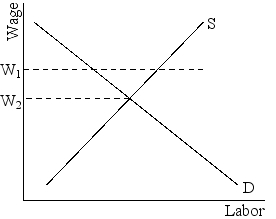 -For the supply and demand curves in the diagram,the level of employment will be highest at:
 (Multiple Choice)
4.8/5 (93)
(93) refer to the following diagram that shows the labor demand for a monopolistic firm hiring labor from a competitive labor market.
 -At the profit maximizing level of employment,the wage rate is _____ and the level of employment is _____:
 (Multiple Choice)
4.9/5 (78)
(78) At the profit maximizing level of employment for a monopsonist:
(Multiple Choice)
4.9/5 (75)
(75) Compared to the allocatively efficient amount,a monopsonist tends to hire:
(Multiple Choice)
4.9/5 (98)
(98) There will be a shortage of labor in a particular market if:
(Multiple Choice)
4.8/5 (77)
(77) refer to the following diagram of a competitive labor market.
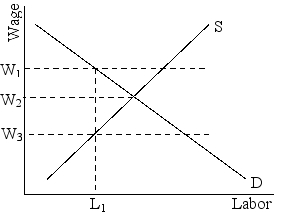 -Suppose the wage is currently W3 and L1 is the level of employment.Then we should expect the wage to:
 (Multiple Choice)
4.8/5 (87)
(87) Since passage of NAFTA ,trade between the U.S.,Canada,and Mexico has:
(Multiple Choice)
4.9/5 (68)
(68) In a perfectly competitive environment,the height of the market labor supply curve at any given number of labor hours indicates:
(Multiple Choice)
4.8/5 (80)
(80) Which one of the following is generally considered a characteristic of a perfectly competitive labor market?
(Multiple Choice)
4.8/5 (79)
(79) Which one of the following conditions is required for allocative efficiency?
(Multiple Choice)
4.8/5 (83)
(83) refer to the following diagram of a competitive labor market.
-Suppose the wage is currently W1 and L1 is the level of employment.If the firm sells its output competitively,the value of the last worker's additional output is _____ and the opportunity cost of the last worker's time is _____:
-Suppose the wage is currently W1 and L1 is the level of employment.If the firm sells its output competitively,the value of the last worker's additional output is _____ and the opportunity cost of the last worker's time is _____: (Multiple Choice)
5.0/5 (72)
(72) Compared to a monopsonist that sells its output in a competitive product market,an otherwise identical monopsonist with monopoly power in the product market will pay:
(Multiple Choice)
4.8/5 (71)
(71) 
Filters
- Essay(0)
- Multiple Choice(0)
- Short Answer(0)
- True False(0)
- Matching(0)