



 Chat with AI
Exam 11: The Economic Impact of Unions

Exam 1: Labor Economics: Introduction and Overview13 Questions
Exam 2: The Theory of Individual Labor Supply54 Questions
Exam 3: Population, Participation Rates, and Hours of Work44 Questions
Exam 4: Labor Quality: Investing in Human Capital49 Questions
Exam 5: The Demand for Labor64 Questions
Exam 6: Wage Determination and the Allocation of Labor38 Questions
Exam 7: Alternative Pay Schemes and Labor Efficiency49 Questions
Exam 8: The Wage Structure44 Questions
Exam 9: Mobility,Migration,and Efficiency50 Questions
Exam 10: Labor Unions and Collective Bargaining53 Questions
Exam 11: The Economic Impact of Unions50 Questions
Exam 12: Government and the Labor Market: Employment, Expenditures, and Taxation45 Questions
Exam 13: Government and the Labor Market: Legislation and Regulation49 Questions
Exam 14: Labor Market Discrimination60 Questions
Exam 15: Job Search: External and Internal34 Questions
Exam 16: The Distribution of Personal Earnings39 Questions
Exam 17: Labor Productivity: Wages,Prices,and Employment42 Questions
Exam 18: Employment and Unemployment52 Questions
Select questions type


Regarding unions and productivity,empirical results show that:

Free
(Multiple Choice)
4.8/5  (81)
(81) Correct Answer: Verified
A
Unions may reduce economic efficiency by:
Free
(Multiple Choice)
4.9/5 (101)
(101) Correct Answer:Verified
VerifiedC
Fallick and Hassett suggest that the tendency of union firms to merge with union firms can be explained by their finding that:
Free
(Multiple Choice)
4.8/5 (86)
(86) Correct Answer:Verified
VerifiedD
refer to the following diagram. Wages in both the union and nonunion sectors are initially $10. The union then negotiates a wage rate of $12. The post-negotiation nonunion wage is not yet known. -The measured union wage advantage in this market is:
 (Multiple Choice)
4.9/5 (81)
(81) refer to the following diagram. Wages in both the union and nonunion sectors are initially $10. The union then negotiates a wage rate of $12. The post-negotiation nonunion wage is not yet known.
-The spillover effect would be modeled by:
-The spillover effect would be modeled by: (Multiple Choice)
4.8/5 (93)
(93) If Wu is the union wage and Wn is the nonunion wage,the pure union wage advantage is:
(Multiple Choice)
4.7/5 (70)
(70) If nonunion workers in a given occupation are paid $16 per hour while union workers receive $20 per hour,the pure union wage advantage is:
(Multiple Choice)
4.9/5 (80)
(80) Hirsch and Macpherson estimate the overall union wage advantage to be approximately:
(Multiple Choice)
4.9/5 (89)
(89) As a percentage of total work-time,the average amount of work-time lost because of strikes annually is typically:
(Multiple Choice)
4.9/5 (78)
(78) Suppose the union wage rate rises.The "spillover effect" suggests that the nonunion wage rate should _____; the "threat effect" suggests that the nonunion wage rate should _____.
(Multiple Choice)
4.8/5 (76)
(76) The allocative efficiency loss associated with unions arises because:
(Multiple Choice)
4.8/5 (83)
(83) refer to the following graph, in which all product markets are assumed to be competitive.'
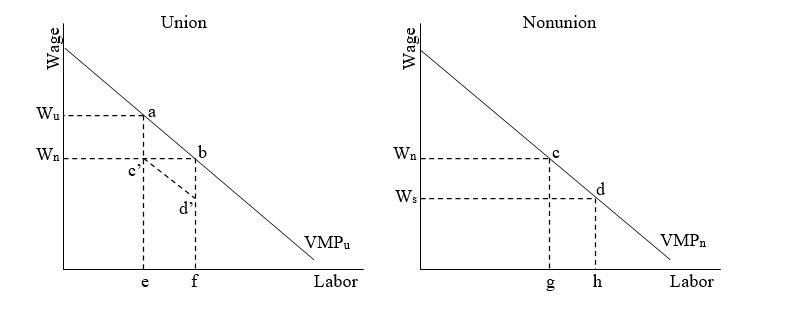 -Assume the two labor demand curves are identical,and that all union workers who lose their job as a result of the union wage increase from Wn to Wu find jobs in the nonunion sector.The area corresponding to the efficiency loss is:
 (Multiple Choice)
4.8/5 (78)
(78) In their study of the Bridgestone/Firestone tire recalls,Krueger and Mas find that:
(Multiple Choice)
4.8/5 (76)
(76) If union workers in a given occupation are paid $20 per hour while nonunion workers receive $16 per hour,the measured union wage advantage is:
(Multiple Choice)
4.9/5 (81)
(81) "The union wage advantage is understated because nonunion wages rise as consumer demand shifts away from relatively higher priced union produced goods." This describes the:
(Multiple Choice)
4.8/5 (71)
(71) The nonunion wage rate may rise as the result of a union wage increase because of the:
(Multiple Choice)
4.9/5 (73)
(73) Evidence suggests that unions reduce firm profitability and discourage investment,so that:
(Multiple Choice)
4.9/5 (75)
(75) refer to the following diagram. Wages in both the union and nonunion sectors are initially $10. The union then negotiates a wage rate of $12. The post-negotiation nonunion wage is not yet known.
-The product market effect would be modeled by shifting the:
-The product market effect would be modeled by shifting the: (Multiple Choice)
4.9/5 (77)
(77) It is difficult to measure the pure union wage advantage because:
(Multiple Choice)
4.7/5 (72)
(72) 
Filters
- Essay(0)
- Multiple Choice(0)
- Short Answer(0)
- True False(0)
- Matching(0)