



 Chat with AI
Exam 11: The Economic Impact of Unions

Exam 1: Labor Economics: Introduction and Overview13 Questions
Exam 2: The Theory of Individual Labor Supply54 Questions
Exam 3: Population, Participation Rates, and Hours of Work44 Questions
Exam 4: Labor Quality: Investing in Human Capital49 Questions
Exam 5: The Demand for Labor64 Questions
Exam 6: Wage Determination and the Allocation of Labor38 Questions
Exam 7: Alternative Pay Schemes and Labor Efficiency49 Questions
Exam 8: The Wage Structure44 Questions
Exam 9: Mobility,Migration,and Efficiency50 Questions
Exam 10: Labor Unions and Collective Bargaining53 Questions
Exam 11: The Economic Impact of Unions50 Questions
Exam 12: Government and the Labor Market: Employment, Expenditures, and Taxation45 Questions
Exam 13: Government and the Labor Market: Legislation and Regulation49 Questions
Exam 14: Labor Market Discrimination60 Questions
Exam 15: Job Search: External and Internal34 Questions
Exam 16: The Distribution of Personal Earnings39 Questions
Exam 17: Labor Productivity: Wages,Prices,and Employment42 Questions
Exam 18: Employment and Unemployment52 Questions
Select questions type


refer to the following diagram. Wages in both the union and nonunion sectors are initially $10. The union then negotiates a wage rate of $12. The post-negotiation nonunion wage is not yet known. -The pure union wage advantage in this market is:
 (Multiple Choice)
4.7/5  (76)
(76) The nonunion wage rate may fall as the result of a union wage increase because of the:
(Multiple Choice)
4.8/5 (73)
(73) Which of the following best describes the events following the deregulation of the trucking and airline industries by 1980?
(Multiple Choice)
4.9/5 (77)
(77) Which one of the following does not help to explain why union workers receive more fringe benefits than nonunion workers?
(Multiple Choice)
4.8/5 (63)
(63) Compared to the private sector,empirical research suggests that the union wage advantage in the public sector is approximately:
(Multiple Choice)
5.0/5 (81)
(81) Union workers receive more compensation than otherwise similar nonunion workers.This fact:
(Multiple Choice)
4.8/5 (75)
(75) All of the following suggest that unions may improve productivity and efficiency except:
(Multiple Choice)
4.9/5 (78)
(78) The measured union wage advantage may overstate the pure union wage advantage because:
(Multiple Choice)
4.7/5 (82)
(82) Compared to other industrial countries such as Canada,France,Italy,and the United Kingdom,the incidence of strikes in the United States is:
(Multiple Choice)
4.8/5 (87)
(87) refer to the following graph, in which all product markets are assumed to be competitive.'
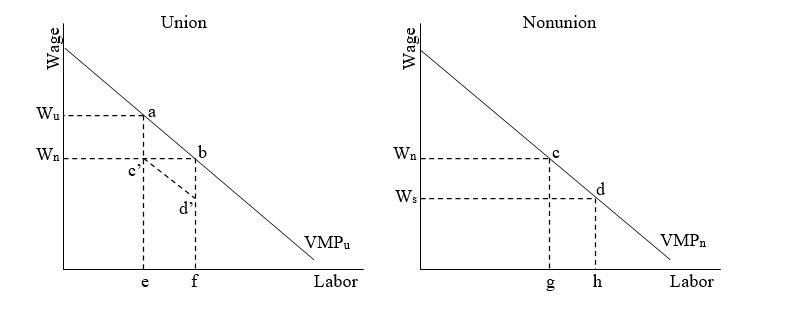 -If all displaced union workers opt to remain in the union sector hoping to be recalled,the area corresponding to the efficiency loss of the union wage increase is:
 (Multiple Choice)
4.8/5 (91)
(91) Which of the following statements is supported by empirical evidence?
(Multiple Choice)
4.8/5 (73)
(73) In industry A,all displaced workers remain in the union sector waiting to be recalled.In industry B,all displaced workers seek work in the nonunion sector.All else constant,the:
(Multiple Choice)
4.9/5 (78)
(78) 
Filters
- Essay(0)
- Multiple Choice(0)
- Short Answer(0)
- True False(0)
- Matching(0)