



 Chat with AI
Exam 4: Labor Quality: Investing in Human Capital

Exam 1: Labor Economics: Introduction and Overview13 Questions
Exam 2: The Theory of Individual Labor Supply54 Questions
Exam 3: Population, Participation Rates, and Hours of Work44 Questions
Exam 4: Labor Quality: Investing in Human Capital49 Questions
Exam 5: The Demand for Labor64 Questions
Exam 6: Wage Determination and the Allocation of Labor38 Questions
Exam 7: Alternative Pay Schemes and Labor Efficiency49 Questions
Exam 8: The Wage Structure44 Questions
Exam 9: Mobility,Migration,and Efficiency50 Questions
Exam 10: Labor Unions and Collective Bargaining53 Questions
Exam 11: The Economic Impact of Unions50 Questions
Exam 12: Government and the Labor Market: Employment, Expenditures, and Taxation45 Questions
Exam 13: Government and the Labor Market: Legislation and Regulation49 Questions
Exam 14: Labor Market Discrimination60 Questions
Exam 15: Job Search: External and Internal34 Questions
Exam 16: The Distribution of Personal Earnings39 Questions
Exam 17: Labor Productivity: Wages,Prices,and Employment42 Questions
Exam 18: Employment and Unemployment52 Questions
Select questions type


The declining college wage premium in the 1970s is generally attributed to the:
(Multiple Choice)
4.9/5  (86)
(86) Evidence suggests that,during recessions,the college enrollment rate:
(Multiple Choice)
4.7/5 (80)
(80) Which of the following statements about on-the-job training is most supported by empirical evidence?
(Multiple Choice)
4.8/5 (89)
(89) The private rate of return on human capital may _____ the social rate because _____.
(Multiple Choice)
4.9/5 (73)
(73) Based on standardized test scores for students in the following countries,which has the highest measured schooling quality?
(Multiple Choice)
4.8/5 (91)
(91) Mary's employer is considering her for a firm-specific training program that will cost $3 per hour.Her current marginal revenue product is $15 per hour and will rise to $20 upon completion of the program.Of the following,Mary's training and post-training wage,respectively,will most likely be:
(Multiple Choice)
4.9/5 (80)
(80) based on the following diagram:
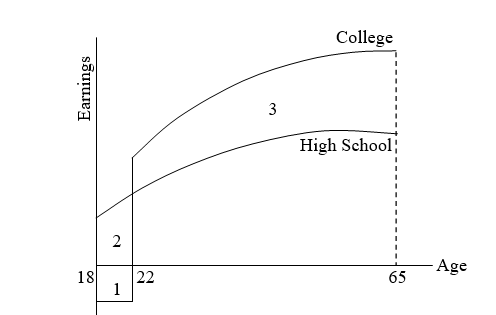 -In deciding whether or not to go to college,one would compare the discounted value of:
 (Multiple Choice)
4.7/5 (86)
(86) At the optimal amount of education,the internal rate of return on education is:
(Multiple Choice)
4.8/5 (66)
(66) If part of the typical college graduates additional earnings is attributable to ability and not to education:
(Multiple Choice)
4.9/5 (90)
(90) Personal differences in demand for human capital curves can be explained by differences in all of the following,except:
(Multiple Choice)
4.9/5 (88)
(88) The increase in the college wage premium during the 1980s was most likely caused by:
(Multiple Choice)
4.9/5 (80)
(80) refer to the following diagram,in which MRPu refers to the marginal revenue product of an untrained worker,while MRPt refers to this worker's marginal revenue product as a result of a program of on-the-job training.
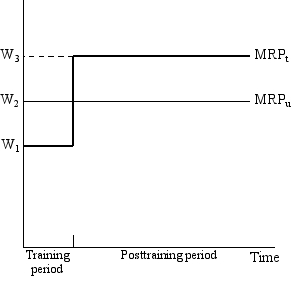 -In the case of specific training,the wage rate during the training period will be _____,while the post-training wage will be _____.
 (Multiple Choice)
4.9/5 (89)
(89) Which one of the following circumstances would most likely lead to increased investment in education by women?
(Multiple Choice)
4.8/5 (76)
(76) Consider an individual who will invest a total of $10,000 in direct and indirect costs for training in order to increase earnings by $12,500 for the next year.Suppose the interest rate is 8%.If this person plans to retire the following year,the net present value of this investment is closest to:
(Multiple Choice)
4.9/5 (84)
(84) 
Filters
- Essay(0)
- Multiple Choice(0)
- Short Answer(0)
- True False(0)
- Matching(0)