



 Chat with AI
Exam 7: Alternative Pay Schemes and Labor Efficiency

Exam 1: Labor Economics: Introduction and Overview13 Questions
Exam 2: The Theory of Individual Labor Supply54 Questions
Exam 3: Population, Participation Rates, and Hours of Work44 Questions
Exam 4: Labor Quality: Investing in Human Capital49 Questions
Exam 5: The Demand for Labor64 Questions
Exam 6: Wage Determination and the Allocation of Labor38 Questions
Exam 7: Alternative Pay Schemes and Labor Efficiency49 Questions
Exam 8: The Wage Structure44 Questions
Exam 9: Mobility,Migration,and Efficiency50 Questions
Exam 10: Labor Unions and Collective Bargaining53 Questions
Exam 11: The Economic Impact of Unions50 Questions
Exam 12: Government and the Labor Market: Employment, Expenditures, and Taxation45 Questions
Exam 13: Government and the Labor Market: Legislation and Regulation49 Questions
Exam 14: Labor Market Discrimination60 Questions
Exam 15: Job Search: External and Internal34 Questions
Exam 16: The Distribution of Personal Earnings39 Questions
Exam 17: Labor Productivity: Wages,Prices,and Employment42 Questions
Exam 18: Employment and Unemployment52 Questions
Select questions type


refer to the diagram below. All points along the ray 0P reflect a constant proportion of wages to fringe benefits.
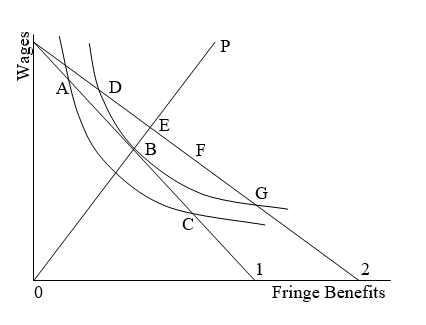 -Suppose some development rotates the isoprofit line outward,to line 2.If history is a guide,we would expect this worker's new wage-fringe optimum to be at point:
 (Multiple Choice)
4.8/5  (75)
(75) A simple income-leisure model might predict that salaried workers would work fewer hours than hourly workers.In fact the opposite seems to be true,in part because:
(Multiple Choice)
4.8/5 (93)
(93) Which one of the following is not typically offered as an explanation for efficiency wages?
(Multiple Choice)
4.8/5 (77)
(77) The effectiveness of profit-sharing plans may be diminished because:
(Multiple Choice)
4.8/5 (74)
(74) The proportion of total compensation paid out as fringe benefits tends to be larger in:
(Multiple Choice)
4.8/5 (74)
(74) Fringe benefits currently account for approximately what percentage of total compensation?
(Multiple Choice)
4.9/5 (78)
(78) refer to the diagram below. All points along the ray 0P reflect a constant proportion of wages to fringe benefits.
-If the isoprofit line shifts from line 1 to line 2,then:
-If the isoprofit line shifts from line 1 to line 2,then: (Multiple Choice)
4.8/5 (79)
(79) Fringe benefits will tend to be a greater proportion of total compensation,the:
(Multiple Choice)
4.9/5 (81)
(81) Which of the following best exemplifies a piece-rate compensation scheme?
(Multiple Choice)
4.8/5 (76)
(76) Labor market efficiency requires that each worker be allocated to:
(Multiple Choice)
4.8/5 (70)
(70) In 1914 Ford Motor Company doubled the wage it paid its employees,resulting in:
(Multiple Choice)
4.9/5 (87)
(87) If a firm can offer fringe benefits worth more than one dollar for a one dollar reduction in wages:
(Multiple Choice)
4.7/5 (89)
(89) In their study of "job lock," Buchmueller and Valetta conclude:
(Multiple Choice)
4.7/5 (83)
(83) A firm might choose to pay its employees a wage higher than that which would clear the market because:
(Multiple Choice)
4.8/5 (85)
(85) The employer's share of the Social Security and Medicare components of the payroll tax has increased,from 6.13% in 1980 to its current rate of 7.65%.Because employers pay no payroll tax on many fringe benefits,this change in tax rates has effectively:
(Multiple Choice)
4.8/5 (74)
(74) 
Filters
- Essay(0)
- Multiple Choice(0)
- Short Answer(0)
- True False(0)
- Matching(0)