



 Chat with AI
Exam 12: MRP and ERP

Exam 1: Introduction to Operations Management74 Questions
Exam 2: Competitiveness, Strategy, and Productivity72 Questions
Exam 3: Forecasting164 Questions
Exam 4: Product and Service Design76 Questions
Exam 4: Extension: Reliability12 Questions
Exam 5: Strategic Capacity Planning for Products and Services106 Questions
Exam 5: Extension: Decision Theory123 Questions
Exam 6: Process Selection and Facility Layout150 Questions
Exam 7: Work Design and Measurement151 Questions
Exam 7: Extension: Learning Curves68 Questions
Exam 8: Location Planning and Analysis80 Questions
Exam 8: Extension: The Transportation Model20 Questions
Exam 9: Management of Quality102 Questions
Exam 10: Quality Control141 Questions
Exam 10: Extension: Acceptance Sampling65 Questions
Exam 11: Aggregate Planning and Master Scheduling88 Questions
Exam 12: MRP and ERP89 Questions
Exam 13: Inventory Management161 Questions
Exam 14: Jit and Lean Operations87 Questions
Exam 14: Extension: Maintenance38 Questions
Exam 15: Supply Chain Management89 Questions
Exam 16: Scheduling134 Questions
Exam 17: Project Management137 Questions
Exam 18: Management of Waiting Lines81 Questions
Exam 19: Linear Programming111 Questions
Select questions type


In MRP, the gross requirements of a given component part are calculated from:
(Multiple Choice)
4.7/5  (85)
(85) The bill of materials indicates how much material will be needed to produce the quantities on a given master production schedule.
(True/False)
4.9/5 (88)
(88) Which one of the following most closely describes the MRP approach that is used for components or subassemblies to compensate for variations in lead time?
(Multiple Choice)
4.9/5 (67)
(67) Scheduled receipts differ from planned receipts in that scheduled receipts:
(Multiple Choice)
4.9/5 (69)
(69) The development and application of MRP depended upon two developments: (1) the recognition of the difference between independent and dependent demand, and (2):
(Multiple Choice)
4.9/5 (72)
(72) Which of the following most closely describes dependent demand?
(Multiple Choice)
4.7/5 (71)
(71) The bill of materials contains information on lead times and current inventory position on every component required to produce the end item.
(True/False)
4.8/5 (74)
(74) Net requirements for component J are as follows: 60 units in week 2, 40 units in week 3, and 60 units in week 5. If a fixed-period, two-period lot-sizing method is used, what will be the quantity of the first planned receipt?
(Multiple Choice)
4.9/5 (81)
(81) Which of these items would be most likely to have dependent demand?
(Multiple Choice)
4.9/5 (80)
(80) Develop a material requirements plan for end item P and its components, given the following tree. Assume that all lead times are one week, and that lot-for-lot ordering is used except for item F, which is ordered in multiples of 400 units.
One hundred units of P should be available at the start of week 4 and at the start of week 8. Beginning inventories are: 20 Ps, 100 As, and 200 Fs.
Scheduled receipts are: 800 Fs at the start of week 1. 
(Essay)
4.7/5 (73)
(73) Bunny Helpers, Inc., has just received an order for 100 Deluxe Easter Baskets, which must be ready for delivery at the start of week 6. An MRP planner has prepared the following table showing product structure, lead times (orders are lot-for-lot), and quantities on hand: Deluxe Easter Basket BOM Lead Time On-Hand Deluxe Easter Basket 1 week 10 Dark Chocolate Truffles (2 per) 2 weeks 30 Carved Chocolate Eggs (4 per) 1 week 50 Each Deluxe Basket contains two dark chocolate truffles and four carved chocolate eggs; additionally one bottle of Alka-Seltzer is included for those who overindulge. When should an order for carved chocolate eggs be released?
(Multiple Choice)
4.9/5 (80)
(80) Using the product tree shown, determine the following:
(A) The quantity of component K that will be needed to assemble 80 units of P, assuming no on-hand inventory of any components exists.
(B) The quantity of component K needed to assemble 80 units of P, given on-hand inventory of 30 As, 50 Bs, and 20 Cs.
[Add closing parens in figure where needed.]
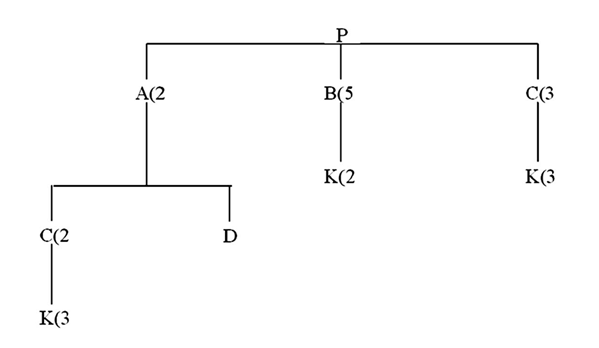
(Essay)
4.8/5 (82)
(82) The inventory records contain information on the status of each item by time period.
(True/False)
4.8/5 (85)
(85) The term pegging refers to identifying the parent items that have generated a given set of material requirements for a part or subassembly.
(True/False)
4.8/5 (86)
(86) Load reports show capacity requirements for departments or work centers which may be more or less than the capacity available in that work center.
(True/False)
4.7/5 (66)
(66) Which one of the following most closely describes net material requirements?
(Multiple Choice)
4.9/5 (82)
(82) A regenerative MRP system is one that is updated continuously, every time there is a schedule change.
(True/False)
4.8/5 (80)
(80) 
Filters
- Essay(0)
- Multiple Choice(0)
- Short Answer(0)
- True False(0)
- Matching(0)