



 Chat with AI
Exam 20: Income Inequality and Poverty

Exam 1: Ten Principles of Economics439 Questions
Exam 2: Thinking Like an Economist617 Questions
Exam 3: Interdependence and the Gains From Trade527 Questions
Exam 4: The Market Forces of Supply and Demand698 Questions
Exam 5: Elasticity and Its Application595 Questions
Exam 6: Supply, Demand, and Government Policies644 Questions
Exam 7: Consumers, Producers, and the Efficiency of Markets549 Questions
Exam 8: Application: The Costs of Taxation511 Questions
Exam 9: Application: International Trade493 Questions
Exam 10: Externalities524 Questions
Exam 11: Public Goods and Common Resources433 Questions
Exam 12: The Design of the Tax System551 Questions
Exam 13: The Costs of Production420 Questions
Exam 14: Firms in Competitive Markets543 Questions
Exam 15: Monopoly637 Questions
Exam 16: Monopolistic Competition587 Questions
Exam 17: Oligopoly496 Questions
Exam 18: The Markets for the Factors of Production564 Questions
Exam 19: Earnings and Discrimination490 Questions
Exam 20: Income Inequality and Poverty457 Questions
Exam 21: The Theory of Consumer Choice440 Questions
Exam 22: Frontiers of Microeconomics441 Questions
Select questions type


Compare and contrast the "life cycle" hypothesis and the "permanent income" hypothesis. What are their respective implications for inequality in the income distribution?
(Essay)
4.9/5  (80)
(80) In the United States from 1935 to 2011 the share of total income earned by the bottom fifth of income earners rose and then fell.
(True/False)
4.7/5 (85)
(85) Based on U.S. income data from 2011, the bottom fifth of all families received approximately what percent of all income?
(Multiple Choice)
4.8/5 (89)
(89) Table 20-1
The following table shows the distribution of income in Marysville.
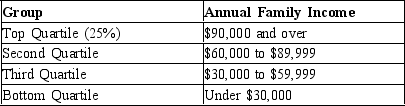 -Refer to Table 20-1. Seventy-five percent of all families have incomes below what level?
 (Multiple Choice)
4.8/5 (71)
(71) Suppose that Jamal is moving to a state where personal incomes are distributed randomly. If Jamal believes in liberalism, he would prefer
(Multiple Choice)
4.8/5 (87)
(87) Which of the following is an example of a welfare program?
(Multiple Choice)
4.9/5 (87)
(87) Economists who support minimum-wage legislation are likely to believe that the
(Multiple Choice)
4.8/5 (88)
(88) Robert Nozick criticizes Rawls's concept of justice by using an example of
(Multiple Choice)
4.9/5 (83)
(83) If greater equality is the benefit of government intervention into the allocation of society's resources, what is the cost?
(Short Answer)
4.9/5 (74)
(74) When we compare the income distribution of the United States to those of other countries, we find that the U.S. has
(Multiple Choice)
4.9/5 (79)
(79) According to a study by Michael Cox and Richard Alm, consumption per person in the richest 20% of households was only 2.1 times consumption per person in the poorest 20% of households.
(True/False)
4.8/5 (80)
(80) A utilitarian government will pursue policies that redistribute income from the rich to the poor. One problem with these policies is that
(Multiple Choice)
4.7/5 (72)
(72) Economists who study economic mobility have found that, if a father earns 20 percent above his generation's average income, his son will most likely earn
(Multiple Choice)
4.9/5 (79)
(79) The top 5 percent of U.S. annual family income in 2011 was $205,200 or more.
(True/False)
5.0/5 (66)
(66) The income distribution in the United States shows that the income share of the top fifth of all families is
(Multiple Choice)
4.7/5 (79)
(79) Scenario 20-5
Suppose the government implemented a negative income tax and used the following formula to compute a family's
tax liability:
Taxes owed = (1/4 of income) - $10,000
-Refer to Scenario 20-5. A family earning $110,000 before taxes would have how much after-tax income?
(Multiple Choice)
4.9/5 (71)
(71) Scenario 20-2
The government is proposing switching from a progressive tax system, in which families pay 15% of the first $40,000 earned, 30% of the next $40,000 earned, and 45% of any income over $80,000 to a tax system in which every family pays 1/4 of its income regardless of how much they earn and all income redistribution is eliminated. That is, the tax revenue generated is used only for infrastructure, public administration, and national defense.
-Refer to Scenario 20-2. Which group would be most in favor of the proposed change in tax policy?
(Multiple Choice)
4.8/5 (83)
(83) 
Filters
- Essay(0)
- Multiple Choice(0)
- Short Answer(0)
- True False(0)
- Matching(0)