



 Chat with AI
Exam 20: Income Inequality and Poverty

Exam 1: Ten Principles of Economics439 Questions
Exam 2: Thinking Like an Economist617 Questions
Exam 3: Interdependence and the Gains From Trade527 Questions
Exam 4: The Market Forces of Supply and Demand698 Questions
Exam 5: Elasticity and Its Application595 Questions
Exam 6: Supply, Demand, and Government Policies644 Questions
Exam 7: Consumers, Producers, and the Efficiency of Markets549 Questions
Exam 8: Application: The Costs of Taxation511 Questions
Exam 9: Application: International Trade493 Questions
Exam 10: Externalities524 Questions
Exam 11: Public Goods and Common Resources433 Questions
Exam 12: The Design of the Tax System551 Questions
Exam 13: The Costs of Production420 Questions
Exam 14: Firms in Competitive Markets543 Questions
Exam 15: Monopoly637 Questions
Exam 16: Monopolistic Competition587 Questions
Exam 17: Oligopoly496 Questions
Exam 18: The Markets for the Factors of Production564 Questions
Exam 19: Earnings and Discrimination490 Questions
Exam 20: Income Inequality and Poverty457 Questions
Exam 21: The Theory of Consumer Choice440 Questions
Exam 22: Frontiers of Microeconomics441 Questions
Select questions type


Table 20-4
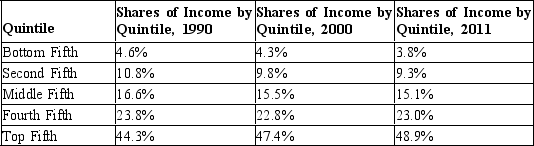 Source: U.S. Bureau of Census
-Refer to Table 20-4. In 2011, the top fifth of families have
Source: U.S. Bureau of Census
-Refer to Table 20-4. In 2011, the top fifth of families have (Multiple Choice)
4.9/5  (84)
(84) Based on U.S. income data from 2011, the top fifth of all families received
(Multiple Choice)
4.9/5 (76)
(76) Table 20-3
The Distribution of Income in Edgerton
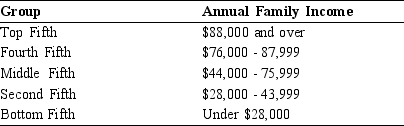 -Refer to Table 20-3. According to the table, what percent of families in Edgerton have income levels at or above $76,000?
 (Multiple Choice)
4.8/5 (65)
(65) The Supplemental Security Income (SSI) program focuses on the poor who are sick or disabled.
(True/False)
4.8/5 (70)
(70) Scenario 20-7
Zooey is a single mother of two young children whose husband died in a tragic car accident. She earns $20,000 per year working as a cashier at a grocery store. The government uses a negative income tax system in which Taxes owed = (1/4 of income) - $15,000.
-Refer to Scenario 20-7. Zooey's brother Zander owes $10,000 in taxes. How much does he earn?
(Short Answer)
4.8/5 (82)
(82) Assume that the government proposes a negative income tax that calculates the taxes owed as follows: taxes owed equal 30% of income less $12,000. A family that earns an income of $40,000 will
(Multiple Choice)
4.7/5 (73)
(73) The poverty line in the country of Dismal is $20,000. The distribution of income for Dismal is as follows: Number of Families Income

 1,000 less than $10,000
2,000 between $10,000 and $20,000
2,000 between $20,000 and $30,000
800 between $30,000 and $40,000
200 over $40,000
 The poverty rate in Dismal is
1,000 less than $10,000
2,000 between $10,000 and $20,000
2,000 between $20,000 and $30,000
800 between $30,000 and $40,000
200 over $40,000
The poverty rate in Dismal is (Multiple Choice)
5.0/5 (91)
(91) Which of the following is not a characteristic of the Earned Income Tax Credit (EITC)?
(Multiple Choice)
5.0/5 (87)
(87) In the parable of the leaky bucket, a fundamental problem with government redistribution programs is identified. As long as the government only has "leaky buckets" at its disposal,
(Multiple Choice)
4.9/5 (81)
(81) The Hicks family owns a blueberry farm in Maine. The Ward family owns a blueberry farm in Massachusetts. A drought in Massachusetts destroys half of the Ward family's harvest for one year. For the Ward family, their
(Multiple Choice)
4.8/5 (66)
(66) What is one argument made by proponents of in-kind transfers over cash payments to the needy?
(Essay)
4.8/5 (76)
(76) The distribution of income for Inequalia is as follows: Number of Families Income

 200 less than $5,000
300 between $5,000 and $10,000
500 between $10,000 and $15,000
700 between $15,000 and $20,000
300 over $20,000
 If the poverty rate in Inequalia is 25 percent, what is the poverty line in Inequalia?
200 less than $5,000
300 between $5,000 and $10,000
500 between $10,000 and $15,000
700 between $15,000 and $20,000
300 over $20,000
If the poverty rate in Inequalia is 25 percent, what is the poverty line in Inequalia? (Multiple Choice)
5.0/5 (82)
(82) Liberalism aims to raise the welfare of the worst-off person in society. This rule is called the
(Multiple Choice)
4.7/5 (88)
(88) Table 20-7
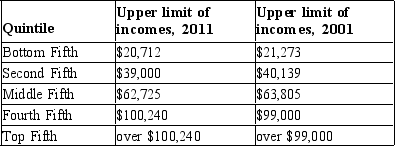 -Refer to Table 20-7. Which of the following is the best overall conclusion to draw from the data?
 (Multiple Choice)
4.9/5 (80)
(80) Which of the following is not an example of in-kind transfers?
(Multiple Choice)
4.9/5 (83)
(83) Suppose the government used the following formula to compute a family's tax liability: Taxes owed = 28% of income - $8,000. How much would a family have to earn to owe $0 in taxes?
(Multiple Choice)
4.7/5 (90)
(90) 
Filters
- Essay(0)
- Multiple Choice(0)
- Short Answer(0)
- True False(0)
- Matching(0)