



 Chat with AI
Exam 20: Income Inequality and Poverty

Exam 1: Ten Principles of Economics439 Questions
Exam 2: Thinking Like an Economist617 Questions
Exam 3: Interdependence and the Gains From Trade527 Questions
Exam 4: The Market Forces of Supply and Demand698 Questions
Exam 5: Elasticity and Its Application595 Questions
Exam 6: Supply, Demand, and Government Policies644 Questions
Exam 7: Consumers, Producers, and the Efficiency of Markets549 Questions
Exam 8: Application: The Costs of Taxation511 Questions
Exam 9: Application: International Trade493 Questions
Exam 10: Externalities524 Questions
Exam 11: Public Goods and Common Resources433 Questions
Exam 12: The Design of the Tax System551 Questions
Exam 13: The Costs of Production420 Questions
Exam 14: Firms in Competitive Markets543 Questions
Exam 15: Monopoly637 Questions
Exam 16: Monopolistic Competition587 Questions
Exam 17: Oligopoly496 Questions
Exam 18: The Markets for the Factors of Production564 Questions
Exam 19: Earnings and Discrimination490 Questions
Exam 20: Income Inequality and Poverty457 Questions
Exam 21: The Theory of Consumer Choice440 Questions
Exam 22: Frontiers of Microeconomics441 Questions
Select questions type


A common criticism of government programs that are designed to assist the poor is that
(Multiple Choice)
4.7/5  (76)
(76) If a government could successfully achieve the maximin criterion, each member of society would have an equal income.
(True/False)
4.8/5 (80)
(80) A government policy aimed at protecting people against the risk of adverse events is called .
(Short Answer)
4.9/5 (87)
(87) Which of the three political philosophies discussed in the textbook, if any, think the government should not take from some individuals and give to others to achieve any particular distribution of income?
(Short Answer)
4.8/5 (87)
(87) With a minimum wage law, the workers who remain employed benefit from a .
(Short Answer)
4.8/5 (74)
(74) Table 20-14
Income Inequality in the United States
The values in the table reflect the percentages of pre-tax-and transfer income.
 Source: US Census Bureau
-Refer to Table 20-14. In percentage terms, how much less income did the bottom 40% of families have in 2010 than in 1980?
Source: US Census Bureau
-Refer to Table 20-14. In percentage terms, how much less income did the bottom 40% of families have in 2010 than in 1980? (Short Answer)
4.8/5 (87)
(87) Because people can borrow when they are young, the life cycle theory would suggest that one's standard of living depends on
(Multiple Choice)
4.8/5 (87)
(87) When comparing the percentage of income (or expenditure) of the lowest and highest 10 percent of the population,
(Multiple Choice)
4.9/5 (64)
(64) The life-cycle pattern of income variation causes inequality in the distribution of annual income, but it does not necessarily represent .
(Short Answer)
4.7/5 (91)
(91) The poverty rate for female households with no spouse present is approximately
(Multiple Choice)
4.8/5 (76)
(76) Which of the following does not explain the rise in income inequality in the United States from 1970 to 2011?
(Multiple Choice)
4.8/5 (85)
(85) Table 20-15
Income Inequality in 2010 in the United States by Race
The values in the table reflect the percentages of pre-tax-and-transfer income.
 Source: US Census Bureau
-Refer to Table 20-15. In percentage point terms, how much more did the top 5% of the Asian population earn than it would have if income were distributed equally?
Source: US Census Bureau
-Refer to Table 20-15. In percentage point terms, how much more did the top 5% of the Asian population earn than it would have if income were distributed equally? (Short Answer)
4.8/5 (84)
(84) Which of the following will not occur when government policies are enacted to make the distribution of income more equitable?
(Multiple Choice)
4.7/5 (85)
(85) John Rawls, who developed the way of thinking called liberalism, argued that government policies should be aimed at maximizing the sum of utility of everyone in society.
(True/False)
4.8/5 (83)
(83) Table 20-3
The Distribution of Income in Edgerton
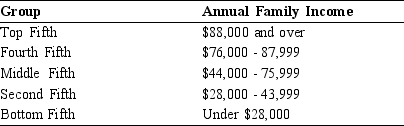 -Refer to Table 20-3. According to the table, what percent of families in Edgerton have income levels below $44,000?
 (Multiple Choice)
4.8/5 (81)
(81) The poverty line is set by the government so that 10 percent of all families fall below that line and are thereby classified as "poor."
(True/False)
4.8/5 (76)
(76) 
Filters
- Essay(0)
- Multiple Choice(0)
- Short Answer(0)
- True False(0)
- Matching(0)