



 Chat with AI
Exam 20: Income Inequality and Poverty

Exam 1: Ten Principles of Economics439 Questions
Exam 2: Thinking Like an Economist617 Questions
Exam 3: Interdependence and the Gains From Trade527 Questions
Exam 4: The Market Forces of Supply and Demand698 Questions
Exam 5: Elasticity and Its Application595 Questions
Exam 6: Supply, Demand, and Government Policies644 Questions
Exam 7: Consumers, Producers, and the Efficiency of Markets549 Questions
Exam 8: Application: The Costs of Taxation511 Questions
Exam 9: Application: International Trade493 Questions
Exam 10: Externalities524 Questions
Exam 11: Public Goods and Common Resources433 Questions
Exam 12: The Design of the Tax System551 Questions
Exam 13: The Costs of Production420 Questions
Exam 14: Firms in Competitive Markets543 Questions
Exam 15: Monopoly637 Questions
Exam 16: Monopolistic Competition587 Questions
Exam 17: Oligopoly496 Questions
Exam 18: The Markets for the Factors of Production564 Questions
Exam 19: Earnings and Discrimination490 Questions
Exam 20: Income Inequality and Poverty457 Questions
Exam 21: The Theory of Consumer Choice440 Questions
Exam 22: Frontiers of Microeconomics441 Questions
Select questions type


The calculation of the poverty line includes adjustments for
(Multiple Choice)
4.8/5  (82)
(82) The poverty line is an absolute standard and is based on the cost of providing an adequate diet.
(True/False)
4.8/5 (71)
(71) A family's ability to buy goods and services depends largely on the family's
(Multiple Choice)
4.9/5 (85)
(85) Marco earns more than Antonio. A legislator proposes taxing Marco to supplement Antonio's income. A libertarian would view this proposal as
(Multiple Choice)
4.7/5 (74)
(74) Table 20-6
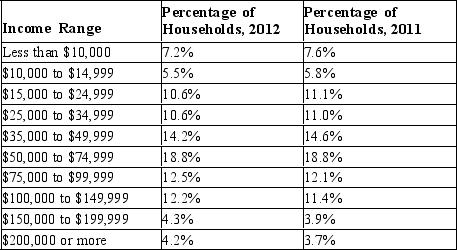 -Refer to Table 20-6. In both 2011 and 2012, approximately 25% of the population earned less than
 (Multiple Choice)
5.0/5 (76)
(76) Which political philosophy argues that the government should choose policies to maximize the total utility of everyone in society?
(Short Answer)
4.8/5 (85)
(85) Poor families are eligible for financial assistance, without having to demonstrate any additional "need,"
(Multiple Choice)
4.9/5 (65)
(65) Scenario 20-3
Suppose that a society is made up of five families whose incomes are as follows:
$120,000; $90,000; $30,000; $30,000; and $18,000.
The federal government is considering two potential income tax plans:
Plan A is a negative income tax plan where the taxes owed equal 1/3 of income minus $20,000.
Plan B is a two-tiered plan where families earning less than $35,000 pay no income tax and families earning more than $35,000 pay 10% of their income in taxes. The income tax revenue collected from those families earning over
$35,000 is then redistributed equally to those families earning less than $35,000.
-Refer to Scenario 20-3. Assuming that utility is directly proportional to the cash value of after-tax income, which government policy would an advocate of libertarianism prefer?
(Multiple Choice)
4.9/5 (85)
(85) The poverty line is based on the percentage of people who cannot afford an adequate diet.
(True/False)
4.8/5 (73)
(73) A utilitarian government has to balance the gains from greater income equality against the losses from distorted work incentives. To maximize total utility, therefore, the government
(Multiple Choice)
4.9/5 (81)
(81) Government vouchers to purchase food, also known as food stamps, are an example of
(Multiple Choice)
4.9/5 (74)
(74) "An extra dollar of income gives more additional satisfaction to a poor person than to a rich person." This is an important assumption of which political philosophy?
(Multiple Choice)
4.7/5 (77)
(77) Which of the following represents a problem in measuring inequality?
(Multiple Choice)
4.9/5 (69)
(69) Suppose society consists of four individuals: Andy, Bill, Carl, and David. Andy has $20,000 of income, Bill has $40,000 of income, Carl has $60,000 of income, and David has $80,000 of income. A utilitarian would argue that
(Multiple Choice)
4.9/5 (72)
(72) What measure does the federal government use when setting the official poverty line in the US?
(Essay)
4.9/5 (66)
(66) Table 20-10
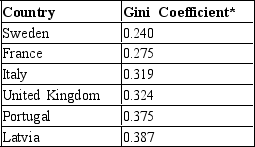 *A Gini coefficient is a commonly used measure of income inequality, with values between 0 and 1 (0 corresponds to perfect equality whereby everyone has exactly the same income, and 1 corresponds to perfect inequality where one person has all the income, while everyone else has zero income).
Source: The World Bank
-Refer to Table 20-10. Which of the following statements is correct?
*A Gini coefficient is a commonly used measure of income inequality, with values between 0 and 1 (0 corresponds to perfect equality whereby everyone has exactly the same income, and 1 corresponds to perfect inequality where one person has all the income, while everyone else has zero income).
Source: The World Bank
-Refer to Table 20-10. Which of the following statements is correct? (Multiple Choice)
4.8/5 (87)
(87) When the government provides poor families with antipoverty programs such as welfare, Medicaid, food stamps, and the Earned Income Tax Credit which are all tied to income,
(Multiple Choice)
4.9/5 (90)
(90) If the U.S. government determines that the cost of feeding an urban family of four is $5,200 per year, then the official poverty line for a family of that type is
(Multiple Choice)
4.8/5 (78)
(78) 
Filters
- Essay(0)
- Multiple Choice(0)
- Short Answer(0)
- True False(0)
- Matching(0)