



 Chat with AI
Exam 20: Income Inequality and Poverty

Exam 1: Ten Principles of Economics439 Questions
Exam 2: Thinking Like an Economist617 Questions
Exam 3: Interdependence and the Gains From Trade527 Questions
Exam 4: The Market Forces of Supply and Demand698 Questions
Exam 5: Elasticity and Its Application595 Questions
Exam 6: Supply, Demand, and Government Policies644 Questions
Exam 7: Consumers, Producers, and the Efficiency of Markets549 Questions
Exam 8: Application: The Costs of Taxation511 Questions
Exam 9: Application: International Trade493 Questions
Exam 10: Externalities524 Questions
Exam 11: Public Goods and Common Resources433 Questions
Exam 12: The Design of the Tax System551 Questions
Exam 13: The Costs of Production420 Questions
Exam 14: Firms in Competitive Markets543 Questions
Exam 15: Monopoly637 Questions
Exam 16: Monopolistic Competition587 Questions
Exam 17: Oligopoly496 Questions
Exam 18: The Markets for the Factors of Production564 Questions
Exam 19: Earnings and Discrimination490 Questions
Exam 20: Income Inequality and Poverty457 Questions
Exam 21: The Theory of Consumer Choice440 Questions
Exam 22: Frontiers of Microeconomics441 Questions
Select questions type


Table 20-1
The following table shows the distribution of income in Marysville.
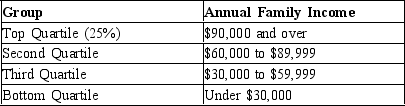 -Refer to Table 20-1. Fifty percent of all families have incomes below what level?
 (Multiple Choice)
5.0/5  (88)
(88) Which of the following pholitical philosophies would support redistribution of income that makes society fully egalitarian?
(Multiple Choice)
4.9/5 (83)
(83) The lack of progress in reducing the poverty rate since the early 1970s is most closely related with which of the following factors?
(Multiple Choice)
4.9/5 (89)
(89) Assume that the government proposes a negative income tax that calculates taxes owed by the following formula, Taxes Owed = (1/3  Income) - $10,000.
a. $120,003
b. $90,003
c. $60,003
d. $30,003
e. $0
<sub
Income) - $10,000.
a. $120,003
b. $90,003
c. $60,003
d. $30,003
e. $0
<sub (Essay)
4.9/5 (83)
(83) Table 20-4
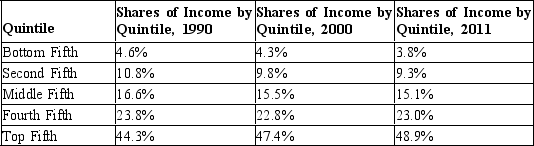 Source: U.S. Bureau of Census
-Refer to Table 20-4. Comparing data from 2000 and 2011, which of the following statements is correct?
Source: U.S. Bureau of Census
-Refer to Table 20-4. Comparing data from 2000 and 2011, which of the following statements is correct? (Multiple Choice)
4.7/5 (78)
(78) Scenario 20-7
Zooey is a single mother of two young children whose husband died in a tragic car accident. She earns $20,000 per year working as a cashier at a grocery store. The government uses a negative income tax system in which Taxes owed = (1/4 of income) - $15,000.
-Refer to Scenario 20-7. Does Zooey owe or receive money from the government? How much?
(Short Answer)
4.8/5 (76)
(76) In the United States, labor earnings are about what percent of total income?
(Multiple Choice)
4.8/5 (65)
(65) What percentage of millionaires in the United States are self-made?
(Multiple Choice)
4.8/5 (93)
(93) What is the primary problem in comparing income inequality in the US with income inequality in other countries?
(Short Answer)
4.8/5 (76)
(76) A disadvantage associated with a minimum wage law to reduce poverty is that it
(Multiple Choice)
4.8/5 (80)
(80) Table 20-3
The Distribution of Income in Edgerton
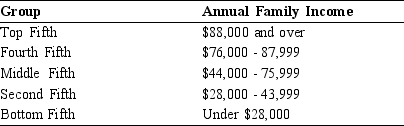 -Refer to Table 20-3. Where would the government in Edgerton set the poverty line to have a poverty rate of 40 percent?
 (Multiple Choice)
4.9/5 (78)
(78) Table 20-14
Income Inequality in the United States
The values in the table reflect the percentages of pre-tax-and transfer income.
 Source: US Census Bureau
-Refer to Table 20-14. In 2010, how many more percentage points of total income did the top fifth of the population earn compared to if the income distribution were completely equal?
Source: US Census Bureau
-Refer to Table 20-14. In 2010, how many more percentage points of total income did the top fifth of the population earn compared to if the income distribution were completely equal? (Short Answer)
4.9/5 (95)
(95) Scenario 20-4
Suppose the government implemented a negative income tax and used the following formula to compute a family's tax liability:
Taxes owed = (1/5 of income) - $15,000
-Refer to Scenario 20-4. A family earning $100,000 before taxes would have how much after-tax income?
(Multiple Choice)
4.8/5 (88)
(88) Table 20-2
Percentage of Before-Tax Income Received by Families in Hapland
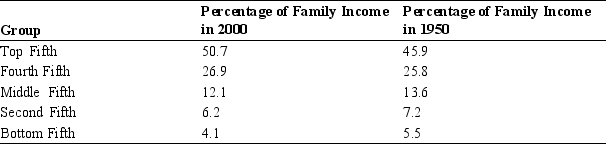 -Refer to Table 20-2. According to the table, from 1950 to 2000, the Hapland income distribution became
 (Multiple Choice)
4.9/5 (77)
(77) The maximin criterion is the idea that the government should aim to maximize the well-being of the worst-off person in society.
(True/False)
4.7/5 (86)
(86) Scenario 20-2
The government is proposing switching from a progressive tax system, in which families pay 15% of the first $40,000 earned, 30% of the next $40,000 earned, and 45% of any income over $80,000 to a tax system in which every family pays 1/4 of its income regardless of how much they earn and all income redistribution is eliminated. That is, the tax revenue generated is used only for infrastructure, public administration, and national defense.
-Refer to Scenario 20-2. Which philosopher would be most in favor of the proposed change in tax policy?
(Multiple Choice)
4.9/5 (97)
(97) There is very little economic mobility in the United States, which means that once a family is poor, it is very likely to remain poor for at least a decade.
(True/False)
4.7/5 (75)
(75) 
Filters
- Essay(0)
- Multiple Choice(0)
- Short Answer(0)
- True False(0)
- Matching(0)